Microsoft ends support for Internet Explorer on June 16, 2022.
We recommend using one of the browsers listed below.
- Microsoft Edge(Latest version)
- Mozilla Firefox(Latest version)
- Google Chrome(Latest version)
- Apple Safari(Latest version)
Please contact your browser provider for download and installation instructions.



When you select a year, you can see the list of articles for the selected year.
November 4, 2025
CEO Press Conference
Financial Results for the Second Quarter of FY2025
Representative Member of the Board, President and CEO Akira Shimada
(Attendees)
Senior Vice President, Head of Finance and Accounting Toshihiko Nakamura
Senior Vice President, Head of Corporate Strategy Planning Akitoshi Hattori
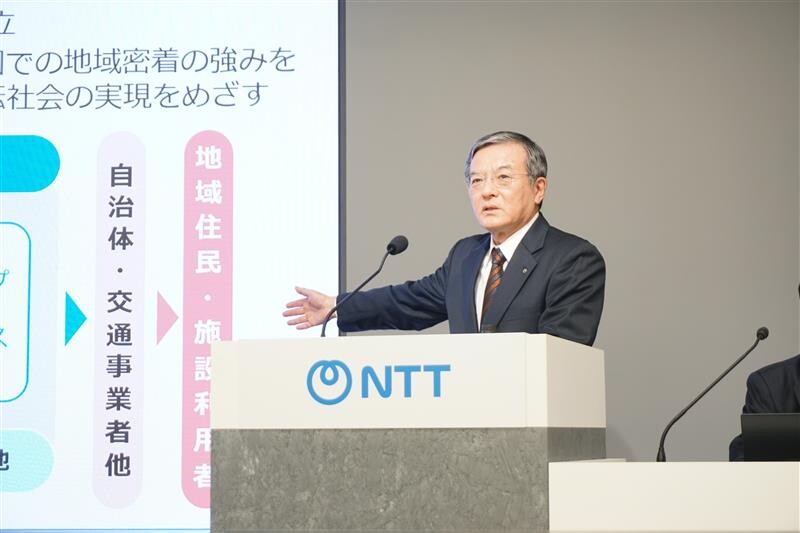


(President Shimada)
I would like to explain the financial results for the second quarter of fiscal year 2025.
Consolidated results for the second quarter recorded year-on-year increases in both revenue and profit. Operating revenue reached a record high for a second quarter. Although there was approximately 60 billion yen in revenue reduction due to foreign exchange effects, revenue increased year-on-year by 182.1 billion yen to 6.7727 trillion yen, driven by the expansion of corporate business across NTT Group companies and higher revenue associated with the REIT conversion of our data centers.
Regarding profit, although there were cost investments at NTT DOCOMO for strengthening the customer base and improving mobile network quality, EBITDA increased by 54.9 billion yen year-on-year to 1.7405 trillion yen, and operating profit increased by 24.8 billion yen to 945 billion yen, due in part to the REIT conversion of data centers. In the second half, by accelerating measures to reinforce competitiveness at NTT DOCOMO, including strengthening the customer base and improving mobile network quality, we intend to further expand our foundation for future growth.
Although the competitive environment remains challenging, we will continue to make every effort to expand corporate business and reduce costs in order to achieve the full-year profit plan for the NTT Group. Net profit increased by 40.9 billion yen year-on-year to 595.7 billion yen, mainly due to the increase in operating profit.
Next, I will explain revenue and profit by segment.
In the Integrated ICT Business Segment, although consumer telecommunications revenue decreased due to a decline in mobile service revenue, overall revenue increased year-on-year as a result of organic growth in corporate business and Smart Life business, mainly in financial services. Although corporate business profit increased, overall segment profit declined year-on-year due to cost investments associated with initiatives to strengthen the customer base and improve network quality. In the second half, we intend to accelerate efforts to reinforce competitiveness and work steadily to maintain and expand the customer base. Although the competitive environment remains tough, we will continue to expand growth businesses such as corporate and Smart Life, while maximizing cost reduction to achieve the full-year profit plan.
In the Global Solutions Business Segment, although foreign exchange had a negative impact of approximately 60 billion yen, revenue and profit increased year-on-year due to capturing digitalization demand in Japan and higher revenue associated with the REIT conversion of data centers. We will continue to aim for the annual profit target through expansion of orders and revenue both domestically and overseas, as well as continued cost control.
In the Regional Communications Business Segment, although revenue from legacy businesses decreased, increases in corporate business and optical-business revenue resulted in year-on-year revenue growth, while profit remained roughly in line with the previous year. Net additions of optical services increased year-on-year due to strengthened sales of the 10-gigabit plan and the bulk-contract plan for the condominium market.
In Others (Real Estate, Energy and Others), revenue increased year-on-year due to expansion of office and commercial operations at NTT Urban Solutions and growth in data center engineering. However, profit decreased due to lower gains from property sales.
Next, I would like to explain the topics.
First, I will explain the establishment of a new company in the autonomous driving field. The NTT Group has long been engaged in numerous proof-of-concept trials nationwide. To accelerate the social implementation of autonomous driving, we will consolidate the expertise accumulated by each NTT Group company and establish a dedicated autonomous driving company, NTT Mobility Corporation, in December. The new company will further advance collaboration with stakeholders and work to solve various challenges related to the social implementation of autonomous driving. By leveraging communication network services, an area in which the NTT Group has strong capabilities, we aim to roll out related services and solutions and contribute to realizing a safer, more secure, and more sustainable autonomous driving society.
Next, I will explain the results of the Osaka-Kansai Expo, which closed on October 13. During the 184-day exhibition period, approximately 390,000 visitors came to the NTT Pavilion. In particular, the world's first performance using IOWN technology, presented by Perfume, was extremely well received. We would like to express our sincere gratitude. In addition, with a total of 2,300 NTT Group employees participating in the operation of the pavilion, we believe this became a valuable opportunity to foster a sense of unity across the NTT Group and enhance EX (Employee Experience). We will make use of the insights gained through the various use cases enabled by technologies such as IOWN and connect them to future value creation and the realization of a sustainable society.
Next, I will explain the business development of IOWN following the Osaka-Kansai Expo. For the IOWN APN, use cases are expanding, including utilization at major sporting events, and since November we have begun providing services to the financial industry in Hong Kong, further broadening our global reach. As we announced at the recent NTT PR/IR DAY, in IOWN optical computing, we aim to commercialize an optoelectronic convergence device called PEC-2 (CPO) next fiscal year through collaboration with global partners, and commercialize an optical chiplet utilizing NTT's proprietary technology by 2028.
Furthermore, Cho-Kabuki: SEKAI NO HANA MUSUBU KOTONOHA, which incorporates IOWN technologies such as digital twins, is scheduled to be staged at Kabukiza in December, marking steady progress toward the social implementation of IOWN.
Next, regarding the interim dividend.
As announced at the beginning of the fiscal year, an interim dividend of 2.65 yen per share will be paid in November. For the full-year dividend, including the year-end dividend, we plan to achieve the 15th consecutive year of dividend increases. Share repurchases are currently underway, and as of the end of October, progress toward the 200-billion-yen repurchase authorization through the end of next March stands at 82.6 billion yen, or approximately 40 percent, proceeding steadily.
Progress on initiatives under the medium-term management strategy since August is as shown.
This concludes my explanation.
Q&A Session
-
Please tell us about the specific business activities, target customers, and business objectives of NTT Mobility.
Ultimately, the end users are local residents and customers who use taxis, and transportation operators are the ones who provide those services, while public transportation is generally managed by local governments. We are therefore envisioning a company that delivers an autonomous-driving package to these entities. This package includes the provision of autonomous vehicles, the introduction of driving areas, operational support, monitoring and remote-monitoring systems, as well as various related services, all of which will be provided to municipalities and transportation operators as an integrated offering.
To achieve this, we will form alliances not only with automobile manufacturers and autonomous-driving system vendors that support these services, but also work closely with NTT Group companies that will handle sales. Up to now, various NTT Group companies, including NTT WEST, NTT DOCOMO BUSINESS, and NTT DOCOMO, have conducted around 35 proof-of-concept trials nationwide. Our intention is to consolidate all of this expertise into a single entity, NTT Mobility, and use it as the foundation for future business development.
The government aims to introduce autonomous mobility services at around 100 locations by 2027 and has stated that it seeks to have autonomous vehicles in operation by around 2030. We intend to participate fully in this area of business and aim to generate several tens of billions of yen in revenue by around 2030. The market is growing rapidly, and many taxi operators face the social issue of having vehicles but a shortage of drivers, resulting in very low utilization rates. We hope to address such social issues as quickly as possible. With the continued aging of the population and growing demand, we want to capture these needs effectively. -
Regarding the domestic business synergy initiatives between the NTT DATA Group and other NTT Group companies, you originally planned to provide an explanation around autumn, but at PR/IR Day you also mentioned that there has been a delay. Could you please explain again the progress and the challenges?
A project to create synergies between NTT DATA and other Group companies is already in place. However, this year marks the final year of NTT DATA's current medium-term strategy, and discussions have shifted toward not only pursuing synergies but also considering growth strategies for the period beyond next year as a combined package.
For example, there is the idea of consolidating corporate accounts between NTT DATA and NTT DOCOMO BUSINESS. But when we examine the details, the scale of the customer base differs significantly. NTT DATA has customers in the hundreds, while NTT DOCOMO BUSINESS has customers in the upper thousands. The sectors each company covers and the degree to which they are deeply involved also differ. The most important question is whether consolidating accounts will truly allow us to deliver appropriate services to each customer. Therefore, we must engage in deeper discussions on an individual customer basis to fully understand the implications.
We are also discussing whether companies within the NTT Group that are not major core entities but have more specialized roles should be positioned more closely under NTT DATA. NTT DATA itself has begun considering what direction it should take from next year onward, and what business model and business plan it should pursue over a three- or five-year horizon to drive growth.
Because we must examine both synergy initiatives and future growth strategies together, announcing only the synergies would leave us unable to address questions about the pathway for growth beyond next year. For this reason, we have decided to postpone the announcement originally planned for autumn or winter, and instead plan to provide it sometime after spring. -
As the NTT holding company, from a macro perspective, what do you expect from NTT DOCOMO going forward? With market share declining, what are you asking of the company?
With regard to the competitive environment, NTT DOCOMO has a history of continually losing market share. We are currently thinking about providing customers with higher value-added services in the Smart Life business, so rather than maintaining the current share instead of 35 percent, we are asking NTT DOCOMO to increase it further. In that sense, I believe this year is the critical moment.
I think NTT DOCOMO will speak to this later, but in the second quarter, because they ended new subscriptions for the 0.5 GB irumo plan, MNP also turned negative. However, the trend reversed in October, and MNP returned to positive in October, so we really want NTT DOCOMO to win the competition in the second half as well. This is the critical moment. To that end, of course we will invest costs, and we would like them to use this timing to reinforce initiatives that will lead to a new sales structure for next year and beyond. This is why we want them to strengthen sales even if it means spending more.
We expect NTT DOCOMO to use its own capabilities to cover the costs by cutting expenses, selling off assets that are no longer needed, and applying various creative measures. -
You announced a business partnership with WOWOW in the content domain. How do you expect this to contribute to DOCOMO's current situation, and are you also considering expanding into video streaming services beyond WOWOW?
I would like you to confirm the details regarding WOWOW with NTT DOCOMO later, but fundamentally, the idea is to enhance the content of docomo MAX. To strengthen Lemino, we will add WOWOW's content to the offering. We will also provide content to WOWOW, and on top of that, we will add d Anime Store. Customers will be able to choose two options from four—NBA, DAZN, WOWOW, and d Anime Store. By offering a docomo MAX with a broader range of choices, we aim to further improve customer satisfaction and respond properly to the diverse needs of our customers. For details, please check with President Maeda.
In addition, we intend to further strengthen video streaming and anime. Since customer interests are extremely wide-ranging, we will listen closely to customer feedback, and if necessary, consider further enhancements to the content lineup. First, by working together with WOWOW, we expect to strengthen our offerings through new, original initiatives, and we have high expectations for this collaboration. -
By consolidating the autonomous driving-related businesses that have until now been pursued separately within the NTT Group, what effects or advantages do you expect to gain? What unique strengths does NTT bring to this area? In the United States and China, Level 4 autonomous driving services have already been implemented, and Japan is falling behind. I would also like to hear your aspirations on this.
The key point in consolidating the NTT Group's autonomous driving-related businesses is the provision of systems such as remote monitoring. Up until now, we have conducted various PoCs individually, but we want to integrate the platform that supports them into a single unified system.
For example, we are operating May Mobility's autonomous vehicles in Nagoya. In practice, we install May Mobility's system on Toyota vehicles. Going forward, however, we must operate these vehicles in an integrated manner, combining map data and the communication environment. May Mobility's system is one example, but there are other systems as well. With the new company, our goal is to operate all of these systems reliably on a single platform. Operating separately would not be efficient, either in terms of cost or operations.
We believe that enabling multiple autonomous driving operators to run their vehicles on a single autonomous driving platform represents the capability of a telecommunications operator like us, one with high information processing capacity. This is one of the major elements of bringing everything together.
Naturally, we have strong relationships with various automobile manufacturers, including Toyota. Currently, we are using Toyota vehicles, but other automakers will also likely provide vehicles. We hope to pursue the ability to operate all of these vehicles on the same platform. -
You are collaborating with Toyota on traffic accident prevention. How does that relate to this new initiative?
Toyota's safety platform is being developed with nationwide coverage in mind, while the NTT Mobility platform we are implementing this time is intended to provide services specifically to local-area transportation operators. For that reason, we are working with Toyota to jointly build the foundational platform on which our system will run.
The platform we are developing with Toyota serves as a broader infrastructure layer. It supports functions such as traffic signal information, vehicle-to-vehicle distance and positioning, communication with surrounding vehicles, computational processing, and various other types of infrastructure. It is not limited to autonomous driving; it also incorporates information for controlling traffic signals to create a safer overall system. You can think of this as the underlying infrastructure.
The platform we are announcing this time will operate on top of that foundational infrastructure. There are multiple layers of platforms, but the one we are developing with Toyota is closer to the infrastructure layer, and I hope that helps clarify the relationship between the two. -
Could you share your expectations for the Takaichi administration?
We have very high expectations for the new Takaichi administration. Prime Minister Takaichi previously served as Minister for Internal Affairs and Communications, and even at that time, I felt she had a deep understanding of advanced technologies. In areas such as AI and semiconductors, Japan needs industry, academia, and government to work together to drive research and development in new fields and move toward social implementation. Given Prime Minister Takaichi's strong interest in these areas, I believe her leadership will be extremely positive for Japan's economic and social development.
In addition, issues related to economic security and the growing number of cyberattacks are becoming increasingly important. Because she also has a strong interest in these safety and security areas, our expectations for her administration are very high. -
Do you have any comments regarding Perfume's announcement that they will suspend their activities?
President Maeda of NTT DOCOMO may have even stronger personal feelings about this, but ever since the group delivered a flawless performance across three locations, London, Tokyo, and New York, at the launch of 5G, I have followed their activities with great interest. They have also been extremely supportive of our business, for which we are very grateful. I believe the success of the NTT Pavilion was in no small part thanks to the contributions of the three members of Perfume.
With that in mind, I also believe they deserve time to rest. I hope they will take this period to recharge and eventually return to the stage with renewed energy. This is my personal hope, and it is something the entire NTT Group looks forward to as well. -
Could you tell us about the number of employees and the organizational structure of NTT Mobility?
We expect the company to start with a staff of several dozen. Naturally, the organization will expand as the number of projects increases. The first step is to establish the company under the holding company and bring together personnel from within the NTT Group who are currently involved in autonomous driving.
Because vehicle operation involves various specialized rules and legal frameworks, we will also need experts from automotive manufacturers and other relevant fields to participate. Forming alliances and bringing in external expertise will be essential. It would be difficult to succeed relying solely on NTT Group employees. We plan to strengthen the company by drawing on a variety of resources, including hiring professionals with relevant experience from outside the NTT Group. -
Could you share your views on the current status of d NEOBANK and on NTT DOCOMO's network quality?
Since SBI Sumishin Net Bank, which provides d NEOBANK, has recently become a subsidiary of NTT DOCOMO, we expect DOCOMO to properly prepare and announce, at the appropriate timing, what new services will be introduced and how they will integrate with the DOCOMO economic sphere. DOCOMO and SBI Sumishin Net Bank are currently examining these possibilities as a joint team. At this stage, only points-related collaboration has been discussed publicly, but creating new services going forward will be essential. We ask for a little more time.
As for network quality, DOCOMO is working to strengthen it in parallel with enhancing its marketing efforts. In major cities nationwide, downlink throughput of 100 Mbps or higher is now available in roughly 80 percent of areas. The number of base stations is steadily increasing, but traffic volume continues to grow, so it is unlikely that everything can be completed within this fiscal year alone. DOCOMO intends to continue adding base stations and installing new equipment this year, but the work will likely continue into the next fiscal year as well. Over these two years this year and next, we plan to put full effort into ensuring high network quality. For further details, please check with NTT DOCOMO. -
Regarding the NTT Pavilion at the Osaka-Kansai Expo, there have been mentions of allowing visitors to view or re-experience the exhibits at NTT WEST. Are you considering nationwide deployment or reconfiguration of the pavilion content?
While it would be difficult to establish a permanent installation, we are considering opportunities to showcase parts of it, for example at NTT R&D FORUM 2025. We are now moving into a phase where the content presented at the Osaka-Kansai Expo can be further put into practical use and real-world implementation in other locations. We would like to explore ways to make it accessible in various places and continue working so that people can experience and utilize it more widely.
-
There were reports that DAZN would jointly stream the World Cup with NTT DOCOMO. Could you comment on this?
Unfortunately, I have not heard anything about that, so I cannot comment.
END
Corporate


NTT Group Medium-Term Management Strategy
NTT STORY
WEB media that thinks about the future with NTT