Microsoft ends support for Internet Explorer on June 16, 2022.
We recommend using one of the browsers listed below.
- Microsoft Edge(Latest version)
- Mozilla Firefox(Latest version)
- Google Chrome(Latest version)
- Apple Safari(Latest version)
Please contact your browser provider for download and installation instructions.



Approach to Integrating TCFD and TNFD
Approach to Integrating TCFD and TNFD
As climate and nature are closely related, increases in temperature have increased the risk of consequential effects such as water shortages and ecological change. As business operators, we also predict that intensified disasters and increased burdens on nature as a result of climate change will lead to greater physical risks. In the case that there is a greater global trend toward demanding the preservation of nature, operating companies must actively respond to such a situation and avoid transition risks such as regulations. The NTT Group has conceived various responses to tackle these challenges. Information about the current state of these responses are disclosed according to the TCFD/TNFD frameworks.
Governance
The NTT Group regards the promotion of sustainability as an important management issue, and items of particular importance, such as creating environmental targets for the entire Group, are decided based on discussions held with directors.
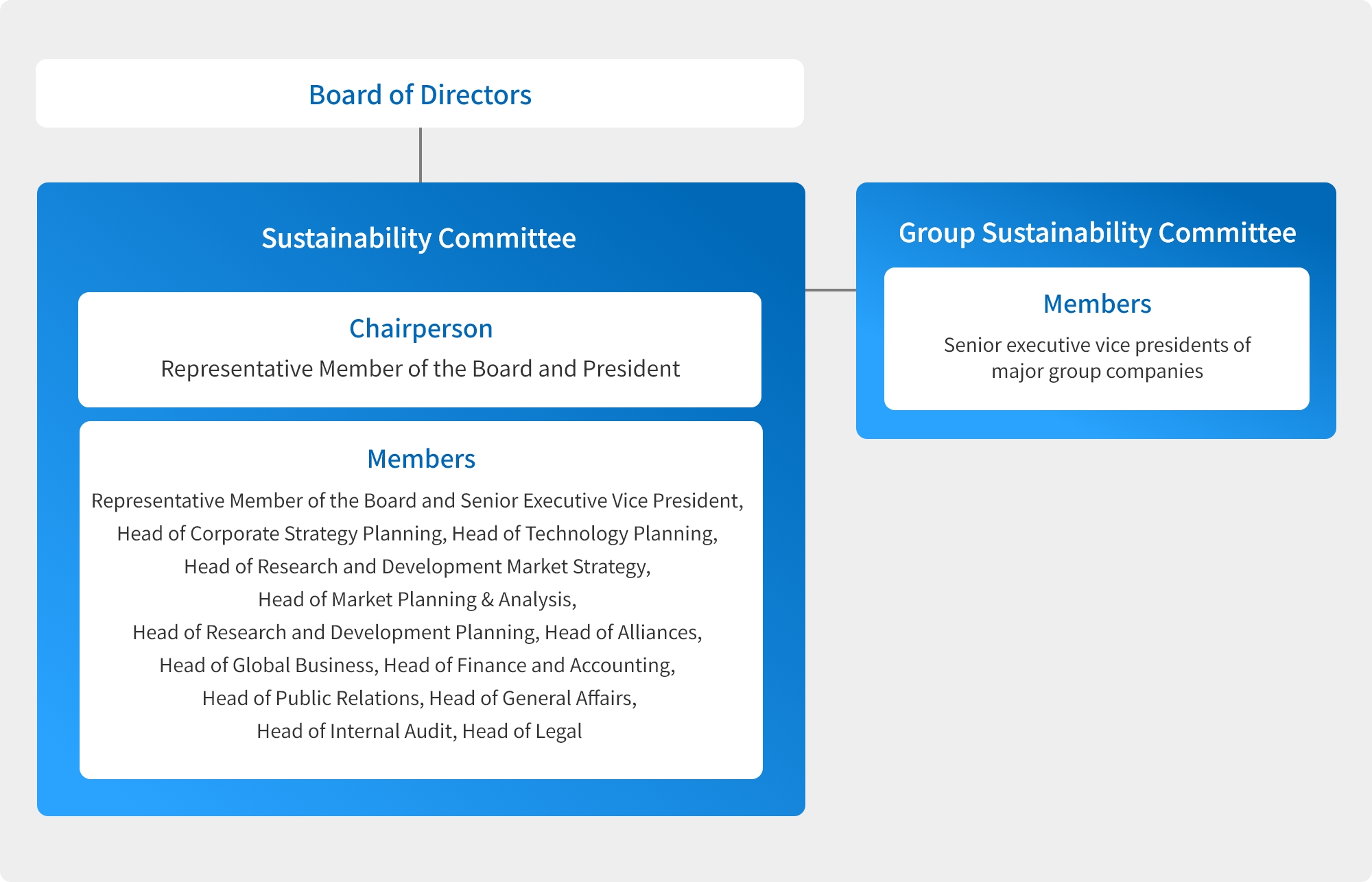
Under the governance structure overseen by the Directors, we have established a Sustainability Committee (chaired by the President and Chief Executive Officer) directly reporting to the Board. This committee is responsible for managing the policy direction and progress of sustainability initiatives across the entire Group. Policies related to sustainability (the Charter and creating and abolishing accompanying policies, particularly deciding critical indicators) will be decided by the Board of Directors via the Sustainability Committee.
In fiscal 2021, we took a comprehensive look at new issues surrounding sustainability and identified key issues to address and activities to undertake.
The validity of the specific issues we have identified and their level of priority is subject to an annual review by the Board of Directors, following discussions within the Sustainability Committee. During the Board of Directors meeting held on April 20, 2023, we determined four key categories for sustainability in fiscal 2023 based on the reviewed priorities: 1) Climate Change, 2) Human Capital, 3) New Value Creation, and 4) Resilience.
Strategy
The NTT Group formulated its Environment and Energy Vision "NTT Green Innovation toward 2040" and is advancing initiatives to reduce its environmental impact to achieve carbon neutrality by 2040. Besides promoting renewable energy usage as part of its own efforts to promote green power, the company is also working to enhance its environmental energy initiatives and information disclosure by promoting IOWN research and development aimed at achieving extremely low power consumption, introducing an internal carbon pricing system, and utilizing green bonds.
With regard to opportunities, we are focusing on expanding renewable energy options at data centers, aiding in the development of processes for visualizing greenhouse gas emissions, and broadening the sale of green energy to both corporate and individual clients.
Also, in alignment with our new medium-term management strategy announced in May 2023, the NTT Group is committed to achieving a Circular Economy Society. This includes promoting green solutions through the combination of Green Energy and ICT, expanding our renewable energy generation business, optimizing and efficiently securing a stable supply of locally produced, locally consumed electricity, recycling resources among various industries, and further accelerating regional development, all with the aim of creating a sustainable society. At the same time, we aim to extend the scope of "NTT Green Innovation toward 2040" to include Scope 3, as part of our efforts to achieve net-zero emissions.
*You can scroll horizontally
| Scenario | Overview | Reference Methodology for Scenario |
|---|---|---|
| 1.5°C Scenario | Scenario in which the decarbonization of society is achieved rapidly ... A future in which the target increase of 1.5°C has been attained |
IEA World Energy Outlook:NZE*1 IPCC AR6 WG1:SSP1-1.9 |
| 4°C Scenario | Scenario in which physical risks materialize ... A future in which the average temperature has risen by 4°C |
IEA World Energy Outlook:STEPS IPCC AR6 WG1:RCP8.5*2 |
*1In this scenario, carbon pricing set for developed nations for 2030 is expected to be 130 USD/t-CO₂.
*2The "Synthesis Report on Observations, Projections, and Impact Assessments of Climate Change, 2018," which incorporates this scenario, assumes significantly increased heavy rain across Japan, increased rates of landslides, and major damage to hilly areas adjacent to suburbs.
【Scenario Assumptions】
1.5°C Scenario: About 90% of the NTT Group's greenhouse gas emissions stem from electricity use, so the introduction of carbon pricing mechanisms will pose a significant risk.
4°C Scenario: The NTT Group provides many services essential to daily life, and recognizes the loss of service stability due to natural disasters as a major risk.
Risks and Opportunities Identified
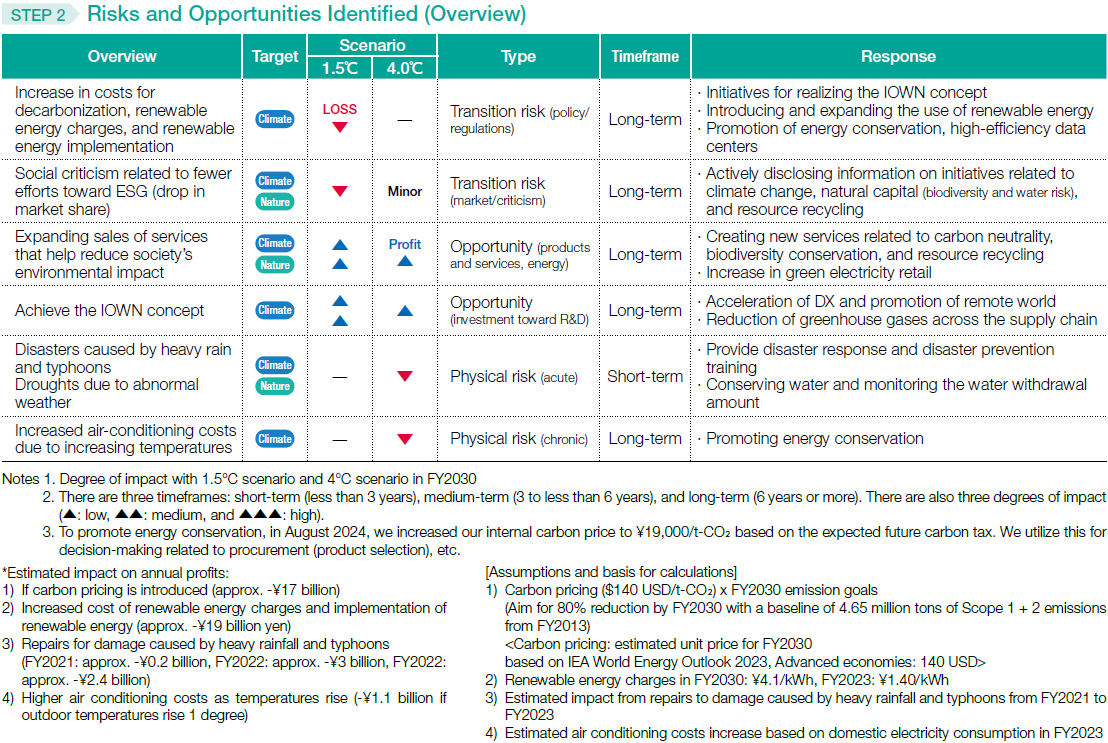
The NTT Group analyzes the risks and opportunities associated with the 1.5°C scenario and the 4°C scenario for fiscal 2030 as follows:
Notes
1.The impacts of the 1.5°C scenario and the 4°C scenario for fiscal 2030 are categorized into three levels.
2.Timeframe: short-term (less than 3 years), medium-term (3 to less than 6 years), and long-term (6 years or more).
[Assumptions and Calculation Basis]
1)Carbon pricing (USD 140 per t-CO₂) × Fiscal 2030 target emissions
2)Renewable energy surcharge: 4.2 yen/kWh in fiscal 2030 and 3.98 yen/kWh in fiscal 2025, sharp rise in the price of non-fossil certificates.
3)Estimated impact of disaster recovery from heavy rainfall and typhoons in fiscal 2023-2025.
[Estimated Annual Impact on Profit]
1)If carbon pricing is introduced: approximately -20 billion yen.
2)Higher costs of procuring renewable energy: approximately -20 billion yen.
3)Disaster recovery from heavy rainfall and typhoons: approximately -2.4 billion yen in fiscal 2023, -1.5 billion yen in fiscal 2024, and -0.5 billion yen in fiscal 2025.
1.5°C Scenario
Transition Risks (Policy and Regulations) and Opportunities
The NTT Group uses over 8 billion kWh annually, and demand for power is expected to rise due to the use of AI. The introduction of renewable energy surcharges and a carbon tax, as decarbonization efforts make progress, is a risk that would increase business costs. In response, we are promoting initiatives aimed at realizing carbon neutrality by 2040 based on "NTT Green Innovation toward 2040."
However, the increasing demand for renewable energy in response to decarbonization efforts is also a business opportunity. Through NTT G×Inno, the NTT Group provides solutions that combine green energy and ICT, expands its own renewable energy generation business, and promotes the optimal supply of energy. We also see the increasing demand for cloud-based data centers that are highly energy-efficient as a business opportunity.
Transition Risks (Market / Reputation)
If our efforts to address climate change are seen as insufficient, there are risks such as our corporate value decreasing, customers drifting away, and our stock price dropping.
In response, we have been promoting NTT Green Innovation toward 2040 and have achieved a rank of "A," the highest available, in the area of climate change in the CDP.
We have also been certified by SBTi as having 1.5°C-aligned targets for Scope 1 and 2 and "Net Zero" for Scope 1, 2, and 3.


As part of our initiatives in Japan, various telecommunications facilities, buildings, and towers are equipped with the following flood and storm damage protection measures.
| Buildings / Towers | Outside Plants | |
|---|---|---|
| Flood and Water Damage Prevention |
|
|
For more details, please visit the NTT EAST website (Japanese only)
4°C Scenario
Physical Risks (Acute) and Opportunities
The NTT Group provides services to support social infrastructure, including communications networks and information systems. However, earthquakes, tsunamis, typhoons, flooding, and other natural disasters present the risk of disrupting business operations and interrupting the provisioning of these services, and can even result in having to pay compensation for damage or losing the public trust.
In order to reduce risk, we continue to implement measures such as deploying power supply vehicles and portable satellite equipment, conducting disaster drills, and implementing disaster-resistant designs and flood mitigation measures for telecommunications equipment and buildings.
Because customers must also implement measures to guard against the risk of natural disasters and system failures, we also anticipate increased demand for BCP-related services, such as backup power supplies, as disaster risks increase.
Physical Risks (Chronic)
Increases in temperature carry the risk of increasing demand for cooling in our telecommunications buildings and data centers located both inside and outside Japan, and of increasing power consumption.
In response, we continue to promote means of conserving energy and reducing operational costs by using temperature sensors to optimally control air conditioning and by enhancing waste heat and airflow management.
Risk Management
The NTT Group discusses risks and opportunities related to key sustainability issues at Sustainability Committee meetings and reports these to the Board of Directors.
Additionally, as part of the NTT Group's risk management process, the Business Risk Management Promotion Committee--headed by the senior executive vice president--along with the Group Business Risk Management Promotion Committee are central to establishing and operating a PDCA cycle for risk management, with the aim of anticipating and preventing the occurrence of the potential risks close at hand and minimizing losses in the event that risks do materialize. The processes concerning the identification, evaluation, and management of sustainability-related risks are integrated into the NTT Group's overall risk management framework.
Climate change, resource recycling, and biodiversity are treated as business environment and strategy-related risks within the Business Risk Management Promotion Committee.
Environment
NTT STORY
WEB media that thinks about the future with NTT