Microsoft ends support for Internet Explorer on June 16, 2022.
We recommend using one of the browsers listed below.
- Microsoft Edge(Latest version)
- Mozilla Firefox(Latest version)
- Google Chrome(Latest version)
- Apple Safari(Latest version)
Please contact your browser provider for download and installation instructions.



Risk Management
Our Policy and Approach
Comprehensive assessments are carried out for risks resulting from the environment surrounding the NTT Group's business along with business strategy and operations responding to that environment, as well as from perspectives including risks resulting from involvement with government, such as those involving regulations.
Business Risk Management
We have put in place risk management regulations that define fundamental policies concerning risk management in order to anticipate and prevent the occurrence of potential risks close at hand and minimizing losses in the event that risks do materialize.
The Business Risk Management Promotion Committee--headed by the senior executive vice president--along with the Group Business Risk Management Promotion Committee are central to establishing and operating a PDCA cycle for risk management.
In fiscal 2025, the Business Risk Management Promotion Committee met twice, as did the Group Business Risk Management Promotion Committee, identifying risks that could have companywide effects and discussing policies for their management.
In order to bring the NTT Group together as one to address risk management, an NTT Group Business Risk Management Manual is created and distributed to all NTT Group companies.
This manual establishes advance courses of action, NTT Group coordination methods and response policies in the case that risks materialize, communication flows, and more, maintaining and operating a system that makes swift responses possible.
Heads of each organization follow established management policies for identified risks involving businesses under their jurisdiction and respond as needed in order to manage said risks across all companies while also creating measures to avoid or minimize such risks.
Type of Risk
Risks affecting corporate strategy
- Risks relating to business growth
- Risks relating to the environment
- Risks relating to advances in customer experience (CX)
- Risks relating to advances in employee experience (EX)
Risks affecting the business environment
- Risks relating to financial markets
- Risks relating to contingent damages
- Risks relating to geopolitics
- Risks relating to intellectual property
Risks affecting business activities
- Risks relating to errors in provided services
- Risks relating to security incidents
- Risks relating to public relations activities
- Risks relating to compliance
- Risks relating to contracts
- Risks relating to improper use of AI, etc.
- Risks that affect business due to regulatory compliance, government stock holdings, etc.
Organization for Implementation
At NTT, Risk Management Regulations are in place, which define fundamental policies concerning inhouse risk management for effective and efficient business operations. Risk management is carried out based on a continuous PDCA cycle under the leadership of the Business Risk Management Committee, chaired by the representative director and senior executive vice president, and comprised of heads of departments and offices as committee members.
Each department in charge reports on their risk management situation to the Business Risk Management Promotion Committee, while an internal auditing department audits the status of efforts as a third line of defense.

Main Initiatives
From time to time, NTT reviews assumed risks and management policies based on changes in the social environment.
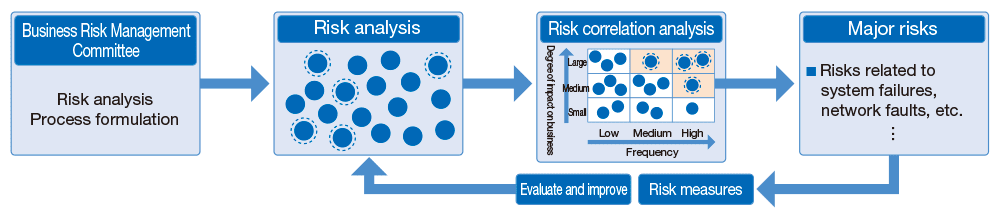
In the identification of Companywide risks, the Business Risk Management Committee leads analysis processes for the risks faced by the NTT Group are formulated and periodically implements risk analyses in accordance with these processes.
In addition, after a correlation analyses on these risks, it specifies those risks with the potential to have the greatest impact as material risks, and we decide on countermeasures.
Matters pertaining to risk management are discussed at meetings of the Business Risk Management Committee.
As part of risk monitoring, each department in charge reports on the status of monitoring and risk mitigation effects to the Business Risk Management Committee, while the Internal Audit Department conducts individual audits on the status of initiatives to address material risks and reports results to the Board of Directors in the subsequent fiscal year.
Among other things, risks are also identified by focusing on the perspective of conduct risk--where customers and other stakeholders suffer negative consequences as a result of actions taken by the NTT Group--by ensuring better planning and implementation of appropriate measures.
In order to increase the effectiveness of risk management and develop an awareness of risk as a foundation to support these initiatives, we conduct training for all officers of major NTT Group companies and also provide all NTT Group employees with education and training. We cover a wide range of topics, such as global economic and social issues, cybersecurity, compliance, the use of AI, and risk management, and provide educational opportunities based on the roles and responsibilities at each level.
Assessing Risk
We have identified the following long-term (3-5+ years) emerging risks that we see as having the largest effect on future management out of all identified risks.
Risks relating to advances in employee experience (EX)
In the information and telecommunications market and other related markets, our business environment is changing at an unprecedented pace due to the rapid advancement of AI and growing uncertainty, including the current international situation. Companies must now, more than ever, play a role in supporting the sustainability of society and industry, rather than focusing only on their own growth. As stated in our medium-term management strategy announced in May 2023 (partially revised in May 2026), in addition to leveraging AI to accelerate profit growth in our smart life business, centered on domestic and overseas enterprise businesses and financial services, we will continue initiatives aimed at shifting to the AIOWN next-generation infrastructure for the age of AI, which optimizes resources, such as GPUs, networks, and power, and handles operations, including those at the edge. By doing so, we aim to contribute to the sustainable growth of society and industry and enhance our medium- to long-term corporate value.
In this environment, strengthening EX is critical for improving productivity and creativity, and for the retention of exceptional personnel. Decreased EX could adversely affect NTT Group's ability to develop new technologies, design new services, enhance its existing services, and execute its growth strategy, which could affect its results of operations and financial condition.
We have formulated a human resources strategy and policy and are strengthening our efforts in order to handle such risks. In order to create new value, improve customer experience (CX), and achieve a sustainable society, we focus on employee experience (EX) and aim to create a virtuous cycle that gives rise to new value. Specifically, we will a) Further encourage independent career development, b) Maintain an open and innovative corporate culture, and c) Create environments conducive to work. The NTT Group also conducts employee engagement surveys and strengthens initiatives to improve any issues that are identified. The NTT Group analyzes the results of these assessments, and policies for various measures for improvement are submitted to the Sustainability Committee and others, while feedback is also given to employees.
Geopolitical Risks
As the NTT Group operates both in Japan and overseas, international issues such as terrorism, armed acts, and regional conflicts can threaten the safety of employees, or damage buildings and equipment. Recent increased fears regarding economic stability may affect local business development, supply chains, financing and more. Such disruptions can hinder business operations, prevent the stable provision of services, and create other operational challenges.
Depending on the situation, these problems may not be limited to the country or region in question and may affect global business continuity.
Consequently, there is a possibility that employees may suffer direct damage, that it may take a long time to restore networks and systems, or that we may not be able to stably provide services due to difficulty in procuring fuel and equipment. This could result in a decrease in income and a large amount of repair costs.
Depending on the circumstances, the NTT Group may be liable for such damages.
In addition, these factors could reduce the credibility and corporate image of the NTT Group.
Given these risks, the NTT Group is strengthening information management methods both in Japan and overseas, conducting regular training to confirm the safety of employees, ensuring security of important equipment such as communication buildings, designing redundant transmission routes, and strengthening emergency power sources for communication buildings and base stations in the event of long-term power outages.
In addition, the NTT Group has released the NTT Group Supply Chain Sustainability Promotion Guidelines. The NTT Group requests suppliers to develop business continuity plans to minimize the impact on the supply chain in case of situations that have a significant impact on business continuity, such as rising prices of raw materials, logistics disruptions, and difficulty in obtaining raw materials and parts, due to international problems, etc., and will cooperate with relevant suppliers to implement measures to minimize the impact on the business if such situations occur.
As described above, the NTT Group has taken various measures to ensure the safe and stable operation of systems and networks necessary for business continuity.
Risks relating to improper use of AI, etc.
In order to promote the use of AI, the NTT Group continues to engage in new value creation through fundamental business process transformation and generative AI-related businesses, based on the idea of leaving all work to AI. However, if this business does not expand as expected due to delays in establishing systems to implement AI internally amid rapid advances in AI, increased costs related to implementation, delays in model development in response to rapid changes in the market and demand, delays in collaborating with partners and others to build ecosystems, and delays in addressing legal regulations and social acceptance, it could result in reduced competitiveness, increased costs in maintaining service quality, and the loss of growth opportunities. This could affect NTT Group management results and the financial condition of the Group. If the use of AI does become widespread in various industries, but AI is used improperly, it could result in financial burdens and tarnish the image of the NTT Group and our client companies, which could prevent the NTT Group from fulfilling its social responsibilities. With these risks in mind, the NTT Group provides training on the basics of AI to roughly 340,000 Group employees and continues to promote training for personnel in the practical use of AI. We have also established rules relating to AI governance, with the goal of preventing serious incidents and achieving robust AI governance throughout the Group. We have also adopted a risk-based approach based on the scale of the risk, to not hinder the active use of AI. Specifically, we have established AI management systems in which checklists based on information such as past cases of AI incidents and government guidelines are created, risks are categorized, and then AI risk management officers at each Group operating company work with project managers to evaluate the risks of each AI project and then consider and implement countermeasures. The holding company monitors the proper operation of these AI management systems in each Group operating company and provides guidance when necessary. Through these AI governance measures, we are committed to providing AI services that our customers can use with peace of mind.
Governance
NTT STORY
WEB media that thinks about the future with NTT