Microsoft ends support for Internet Explorer on June 16, 2022.
We recommend using one of the browsers listed below.
- Microsoft Edge(Latest version)
- Mozilla Firefox(Latest version)
- Google Chrome(Latest version)
- Apple Safari(Latest version)
Please contact your browser provider for download and installation instructions.


Society
Human Resources Strategy
Our Policy and Approach
The NTT Group aims to realize a sustainable society through creating new value and enhancing the customer experience (CX). The driving force behind this is enhancing the employee experience (EX). By establishing environments where employees can experience a feeling of fulfillment and growth, and challenge themselves independently, we strive to realize a positive cycle of creating new value and innovation and then returning the benefits of these efforts to our customers and society.
Our human resources strategy is positioned as an important foundation supporting the realization of our management strategy and business strategy. To promote the transformation of our business portfolio as described in our medium-term management strategy, the transformation of work utilizing AI and digital technologies, and the strengthening of our global competitiveness, we continue to clarify the human resources portfolio we will need for the future and engage in unified efforts to enhance hiring, training, placement, reskilling, and engagement.
Additionally, in order to increase the effectiveness of our human resources strategy, we set indicators for each of the three pillars of our human resources strategy and continuously monitor the progress and results of the measures we implement. At the same time, we continue to strengthen the connection between our human resources strategy and management strategy by taking a comprehensive approach in confirming our human capital indicators (such as engagement and human resource development) and indicators relating to productivity and business results.
Finally, we place a special emphasis on both the direction forward of the entire Group and the business needs of each company. Although human resource themes are defined for the entire NTT Group, each company and organization formulates specific measures based on the business challenges they are facing, and the status and results of these measures are shared periodically. This promotes the sharing of learning and best practices across the Group and helps to advance our human resources strategy.
Going forward, we will utilize our human resources strategy to ensure that employees can apply their skills and to enhance organizational capabilities, and aim to realize sustainable business growth and increase our corporate value by increasing CX, increasing productivity, and creating innovation.

Investing in human capital and increasing corporate value
The NTT Group views investment in human resources not as a cost, but as an important management investment for realizing sustainable growth and increasing corporate value.
As our business environment continues to change dramatically, our employees' individual skills and willingness to take on challenges will serve as our source of competitiveness. Toward that end, we continue to engage in efforts such as conducting training and career development, training AI and digital personnel, hiring and training specialized personnel, increasing human resources mobility, supporting autonomous career formation, and increasing engagement to help strengthen the competitiveness of our business, create innovation, and increase productivity.
To determine the results of investing in human capital, we continue to monitor output indicators such as skill acquisition, personnel placement, and engagement enhancement, in addition to input indicators such as investment amounts, training hours, and participation in training. Additionally, we confirm whether these initiatives lead to results, such as increased productivity or business growth, and aim to strengthen the connection between our human resources strategy and management strategy.
The results of investing in human capital are not always evident in the short term. For example, training AI and digital personnel and hiring and training specialized personnel lead to skill acquisition, business transformation, and new value creation, and are therefore linked to future profitability and increased productivity. It is for this reason that we continuously confirm investment, measures, behavioral changes, and results as a series of connected processes, while also engaging in efforts to improve measures and maximize our return on investment.
Going forward, we will visualize the relationship between our human capital indicators, employee engagement, and business results, and will continuously share information with our investors and stakeholders with regard to how our investment in people is helping to increase corporate value.
Governance
In order to increase the effectiveness of our human resources strategy, the NTT Group promotes policies and key themes across the Group, together with initiatives tailored to meet the needs of the business of each company. We set human resource themes and KPIs that focus on the entire Group and formulate measures based on the individual business challenges of each company and organization, in an attempt to connect our management strategy and human resources strategy.
In monitoring the progress of our human resources strategy, we periodically confirm the implementation status of each measure, changes to our skill and human resources portfolios, and indicators relating to business results and productivity, in addition to Group-wide KPIs such as the employee engagement rate. These indicators are shared with management and relevant departments to quickly detect issues and revise measures, thereby maintaining a cycle of continuous improvement.
The results of analyzing employee engagement surveys and human resource data are also shared as feedback with Group company management and Human Resources, for use in conducting improvement activities tailored to the business challenges and organizational challenges of each company. Issues and best practices across the entire Group are shared through means such as related meetings, and this helps us to implement improvements and advance measures across the Group.
| Level or Meeting Organization | Major Roles |
|---|---|
| Board of Directors, management meetings | Confirmation of direction of human resources strategy, important KPIs, and major risks/challenges |
| CHRO, officer in charge of human resources | Overseeing of human resources strategy of entire Group, promotion of key themes/measures |
| Holding company Human Resources | Group policy/KPI design, data analysis, feedback to companies, sharing of best practices |
| Group company management and Human Resources | Formulation/implementation of measures tailored to business strategy and organizational challenges of each company, promotion of improvement activities |
| Organizations and workplaces | Dialogue, implementation of measures, improvement activities to increase employee engagement |
In promoting our human resources strategy, the CHRO and the officer in charge of human resources oversee the human resources strategy of the entire Group, under the supervision of entities such as the Board of Directors and management meetings, while Human Resources in the holding company is responsible for designing policies and KPIs for the entire Group, analyzing data, and providing feedback to each company. Each Group company formulates measures tailored to its own business strategy and organizational challenges, and these measures are then implemented by engaging in dialogue and conducting improvement activities within each organization or workplace.
Managing risk
In promoting our human resources strategy, we recognize risks such as shortages of human resources required to implement our management strategy and business strategy, delays in acquiring specialized skills such as the use of AI and digital technologies, reduced employee engagement and well-being, and reduced productivity and willingness to take on challenges due to insufficient strategic understanding or career prospects as major risks relating to human capital.
We continuously monitor these risks through the use of employee engagement surveys and human resource data, the progress of measures, and indicators relating to business results and productivity. Once identified, issues are shared as feedback with management, relevant departments, and Group companies; dialogues and measures are reviewed; and best practices are shared across the Group, in order to reduce risk and improve the effectiveness of our human resources strategy.
Targets and Performance
Sustainability Indicator
The employee engagement rate is continuously monitored as a KPI across the entire Group, and we confirm the status of improvements against results for the previous fiscal year and the reference fiscal year. Going forward, in addition to transitions in engagement, we will confirm the status of improvements in key areas such as strategy penetration, dialogues with management, and career formation to gain a more detailed understanding of trends in employee well-being.
*You can scroll horizontally
| Item | Fiscal 2025 target | Fiscal 2025 results | Fiscal 2026 target |
|---|---|---|---|
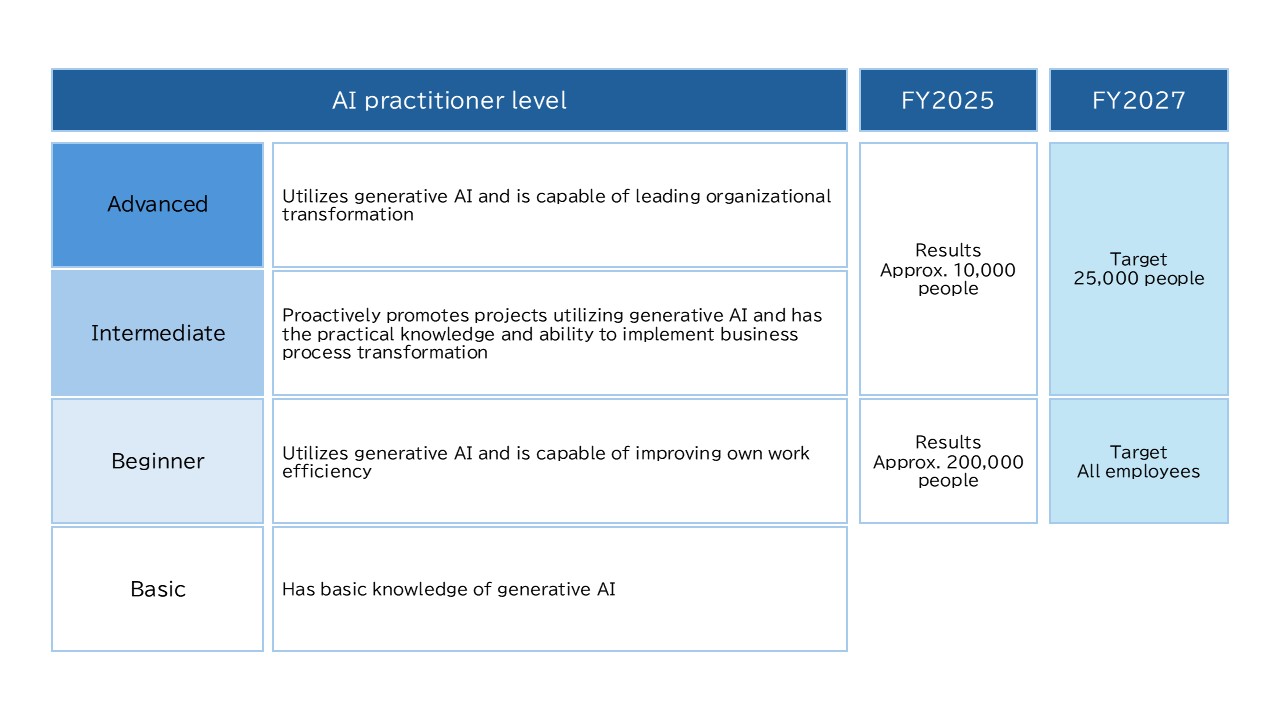
| (11-3) Number of Employees with Practical AI Skills(Fiscal 2027 target) | Introductory or above: 100,000 employees | Introductory: 196,000 employees Intermediate or above: 10,000 employees |
Introductory: All employees Intermediate or above: 25,000 employees (as of end of fiscal 2027) |
| (Common to 16-19) Employee engagement rate | Improvement vs FY2022 (57%) | 64% | Improvement vs FY2022 (57%) |
(11-3)Boundary:International group companies
(Common to 16-19)Boundary:NTT, NTT DOCOMO(including NTT DOCOMO BUSINESS), NTT East, NTT West, NTT DATA Group, NTT Urban Solutions, NTT Anode Energy, and their designated subsidiaries.
Main Initiatives
Employee Engagement Survey
The NTT Group began conducting employee engagement surveys in fiscal 2021, and we have set four items measuring engagement as Group-wide KPIs. The results of these surveys are also reflected in executive compensation and bonus performance indicators for all managers, so that management, managers, and workplaces will work together to increase employee engagement. We also analyze the results of these surveys to identify factors affecting employee well-being and fulfillment, in order to lead to improvement activities and dialogue within each company and organization.
Additionally, viewing increasing engagement as an important theme for management, we are promoting the continual involvement of management together with improvement activities conducted by individual managers and workplaces. In addition to using survey results as performance indicators, we analyze the factors underlying these results and take specific measures in key areas such as strategy penetration, dialogues with management, and career formation support, in order to lead to effective improvements.
NTT Group's Four KPIs
--The willingness to make voluntary contributions--
①I am motivated to contribute more than is required to get the job done at the company
--Attachment to and pride in the company--
②I am proud to work at this company
③I would recommend our company as a great place towork to those I know
--Job satisfaction--
④I gain a sense of personal accomplishment through my work
Specific Initiatives
We conduct a correlation analysis with engagement (four KPI items) to identify items affecting engagement, and then implement measures in order of priority. The results of the analysis are shared as feedback with each company and organization in order to lead to specific actions, such as engaging in dialogue with management, supporting career formation, and improving workplace communication. Therefore, rather than treating employee surveys simply as a means of assessing the current situation, we use them as part of a cycle of engaging in improvement activities and verifying results.

Maintenance Area Initiatives
We have confirmed that comfortable work environments and psychological safety, two items relating to internal communication, have reached a comparatively good level within the NTT Group. Providing opportunities for growth is another strength of ours, and the ratio of employees who feel they are able to make use of their skills and abilities is improving. We plan on continuing dialogue with employees and engaging in initiatives to create an exciting workplace where all can experience true growth.
Areas Needing Improvement Initiatives
The survey conducted for fiscal 2023 indicated "strategy penetration," "dialogue with management," and "careers" as areas in need of improvement. We see these not as separate issues, but as a series of related issues. That we have been unable to sufficiently communicate the direction of the company going forward affects employees' career prospects and their job satisfaction, which affects engagement.
Strategy Penetration and Dialog with the Management
It is important to clearly communicate what strategies the company will adopt to promote business, what approach management will take in implementing these strategies, and what expectations and support each employee will have. Toward that end, we are working to improve understanding of and satisfaction with our strategies by expanding opportunities for dialogue between management and employees and exchanging opinions based on the results of surveys conducted within each organization.
Careers
We continue to expand opportunities for employees to actively consider how they can leverage their own strengths and expertise, and how to form their own careers, based on the direction of the company going forward. More specifically, we are supporting the autonomous efforts of employees to form their own careers through such means as the Career Design Boot Camp, a career-focused event, and networking events with Specialist Grade (SG) employees possessing advanced expertise.
As a result of these initiatives, we were able to improve the engagement score significantly over the previous year (+7 points over the previous year and +4 points over the reference year). Going forward, we will identify challenges based on survey results, engage in dialogue within each company and organization, implement improvement measures, and continue to verify results, with the aim of improving employee engagement and well-being. We will also clarify the relationship between human capital investment and engagement, business results, and productivity, and will increase the effectiveness of how we manage human capital.
【Column】Why do organizations that can take on challenges produce results?
With business environments changing rapidly, it is important to provide employees with environments where they can take on challenges and demonstrate their abilities while growing, to continue to create new value. The NTT Group conducted an analysis of an employee engagement survey and organizational performance to verify the relationship between engagement and performance. In this document, we provide insights into organizational development obtained from the results of this analysis.
▶ Access the full PDF here
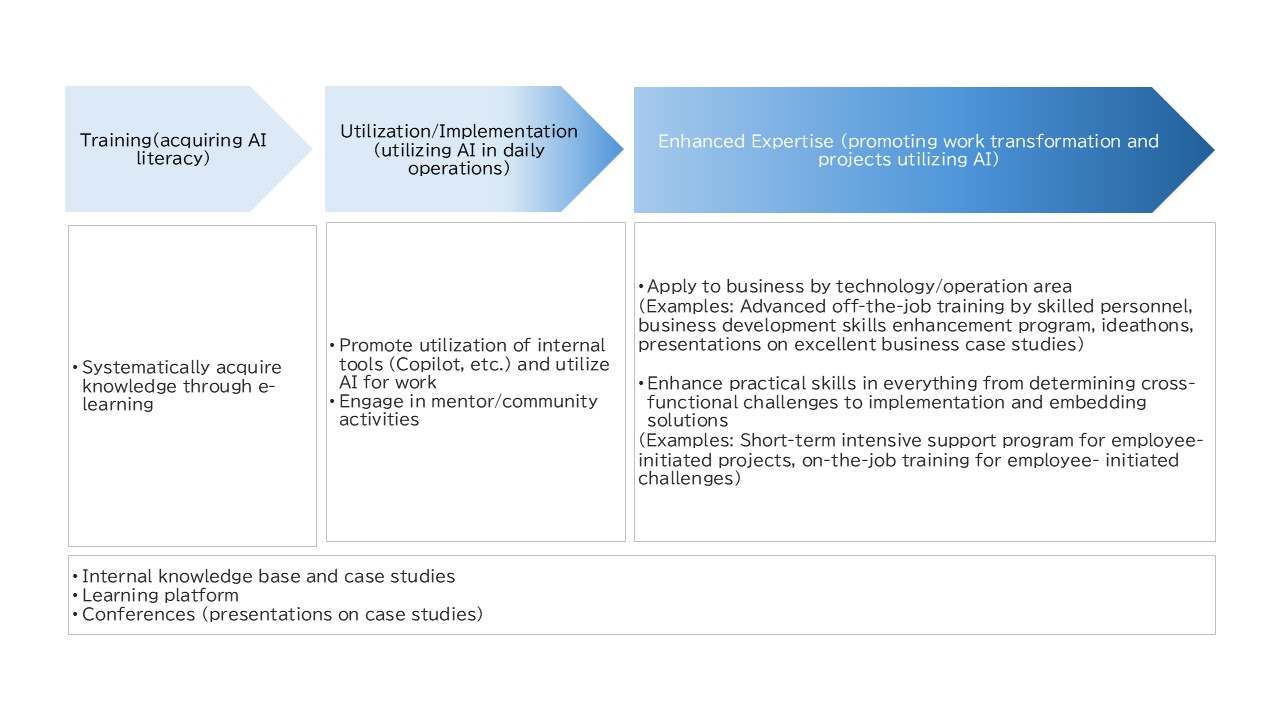
Training Personnel in the Practical Use of AI
■ Ideal personnel and targets by level
■ Development of AI Talent
Society
NTT STORY
WEB media that thinks about the future with NTT