Microsoft ends support for Internet Explorer on June 16, 2022.
We recommend using one of the browsers listed below.
- Microsoft Edge(Latest version)
- Mozilla Firefox(Latest version)
- Google Chrome(Latest version)
- Apple Safari(Latest version)
Please contact your browser provider for download and installation instructions.



March 13, 2026
NTT, Inc.
NTT Develops the World's Highest-Capacity 192-Core Submarine Cable System Using Multicore Optical Fiber
-- Enabling 4× higher transmission capacity without changing the submarine cable system --
News Highlights:
- NTT developed the world's highest-capacity 192-core submarine cable system using multicore optical fiber (MCF), enabling a fourfold increase in transmission capacity without changing the submarine cable system.
- NTT established a lineup of submarine cables and related connection components for commercial deployment in submarine networks.
- This technology enables transmission capacity to be increased fourfold while maintaining a cable system equivalent to conventional optical fibers, which is expected to support cost reductions in cable deployment and promote the economical development and practical deployment of submarine networks.
TOKYO — March 13, 2026 — NTT, Inc. (Headquarters: Chiyoda-ku, Tokyo; President and CEO: Akira Shimada; hereinafter "NTT") has developed a four-core multicore optical fiber (MCF)1 that achieves a fourfold increase in transmission capacity of conventional optical fibers using a single fiber for communications. In addition to a submarine four-core MCF cable, the company also developed a joint box for connecting submarine cables and a terminal rack2 for connecting conventional optical fibers with MCF cables within landing stations, establishing a lineup of equipment required for commercial deployment.
These results are expected to enable the economical development of high-capacity submarine networks capable of meeting the growing demand for transmission capacity.
Part of these results has been accepted as a Top-Scored Paper at the 51st Optical Fiber Communication Conference (OFC), the world's largest international conference on optical communication technologies, to be held in Los Angeles from March 15 to 19, 2026, where it will be presented.
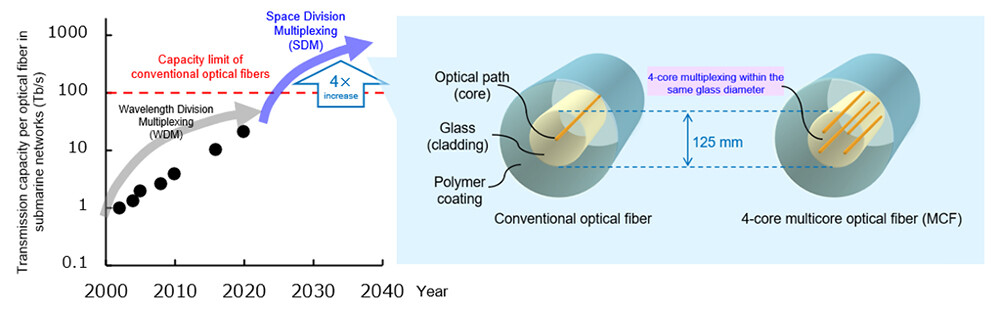 Figure 1 4-core multicore optical fiber exceeding the capacity limit of conventional optical fibers
Background
NTT has been conducting research and development on multicore optical fiber (MCF) as one of the key technologies for realizing the high-capacity optical transmission infrastructure envisioned in the IOWN initiative3. MCF enables transmission capacity beyond the limit of a single conventional optical fiber. To this end, the company has been developing a four-core MCF, which multiplexes four optical paths within a glass fiber of the same diameter as current optical fibers (Figure 1).
For the commercial deployment of four-core MCF in communication networks, submarine cables have been studied as one of the potential application areas. Submarine cables are required to further increase transmission capacity in order to meet the rapidly growing demand for communications driven by the spread of 5G, generative AI, and video streaming services. The installation of submarine cables involves many processes, including marine route surveys, cable design and manufacturing, and cable-laying operations using specialized vessels, all of which require substantial costs. Therefore, if the transmission capacity of a single submarine cable can be increased fourfold, the cable deployment cost could potentially be reduced to one-fourth of the conventional level.
The transmission capacity of submarine cables can be increased by accommodating a greater number of optical fibers. However, the space available within a cable is limited, and current submarine cables have already reached the upper limit of 48 fibers. In addition, submarine cables are designed and manufactured to satisfy multiple stringent requirements, including pressure resistance capable of withstanding depths of up to 8,000 meters, reliability for more than 25 years of operation, and compatibility with installation infrastructure such as cable-laying vessels. As a result, increasing the cable diameter in order to accommodate more optical fibers is difficult.
Against this background, the application of MCF, which can expand transmission capacity without changing the existing submarine cable system, has been highly anticipated (Figure 2).
NTT has previously proposed and realized a four-core MCF that maintains the same fiber diameter as conventional optical fibers, ensuring compatibility with existing cable systems, connection interfaces, and optical compatibility with conventional fibers. However, for the commercial deployment of submarine cables using this MCF, several technical challenges remained. These included the implementation of four-core MCF in submarine cables, the development of connection components for linking submarine cables with terrestrial cables and for connecting submarine cables to each other, and terminal rack equipment within communication facilities to connect transmission equipment to conventional optical fibers.
In this work, NTT developed not only the implementation of four-core MCF in submarine cables, but also a lineup of joint boxes and in-station connection racks required for the construction of submarine cable systems (Figure 3).
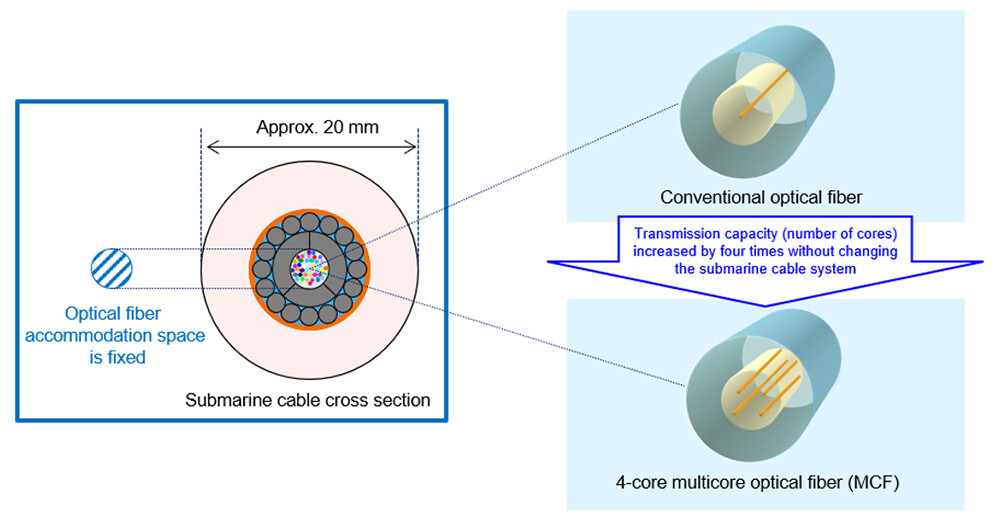 Figure 2 Submarine cable system and capacity expansion using 4-core MCF
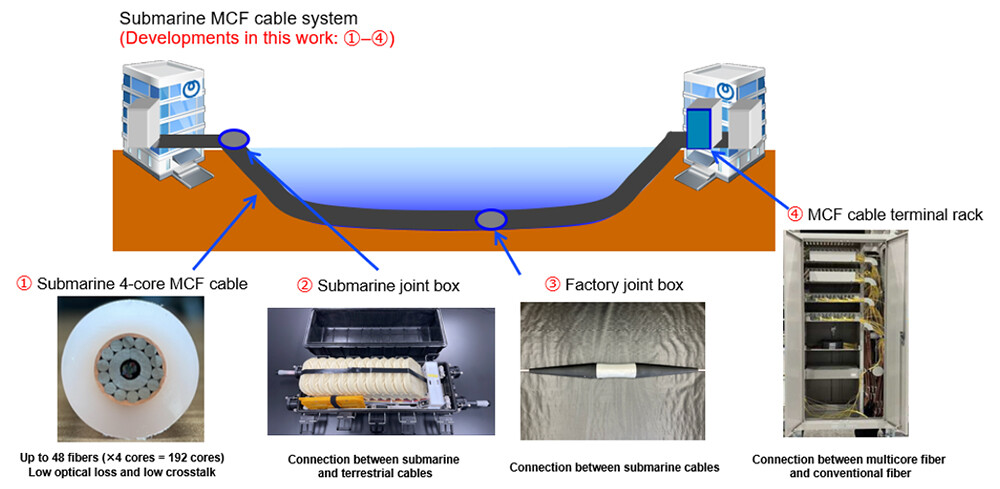 Figure 3 Configuration of the submarine MCF cable system and developed components
Development Overview and Results
The submarine MCF cable system consists of several network infrastructure components, including the submarine cable itself, joint boxes that connect submarine cables to terrestrial cables or connect submarine cables to each other, and terminal racks that connect MCF with conventional optical fibers for connection to transmission equipment within communication facilities. By developing these components to a level suitable for commercial deployment, it becomes possible to economically build high-capacity submarine networks using four-core MCF.
- Submarine 4-core MCF cable:
By implementing up to 48 four-core MCF fibers in a submarine cable with a diameter of approximately 20 mm, the number of cores in a submarine cable, which is normally limited by fiber capacity constraints, can be expanded to 192 cores, representing a fourfold increase (Figure 4).
The four-core MCF is designed and manufactured to achieve low transmission loss and low crosstalk while maintaining optical compatibility with conventional optical fibers. As a result, even when the implementation density is increased to 48 fibers, the cable maintains excellent optical characteristics with low loss and low crosstalk. - Submarine joint box:
This component connects a submarine cable incorporating four-core MCF with a terrestrial cable incorporating conventional optical fibers. - Factory joint box:
This enables the connection of submarine MCF cables to each other on the seabed. The connection is achieved using fusion splicing technologies compatible with MCF, including side-view image alignment technology4. - MCF cable terminal rack:
This equipment enables submarine cables to be routed within communication facilities and connected to existing conventional optical fibers, allowing connection to transmission equipment.
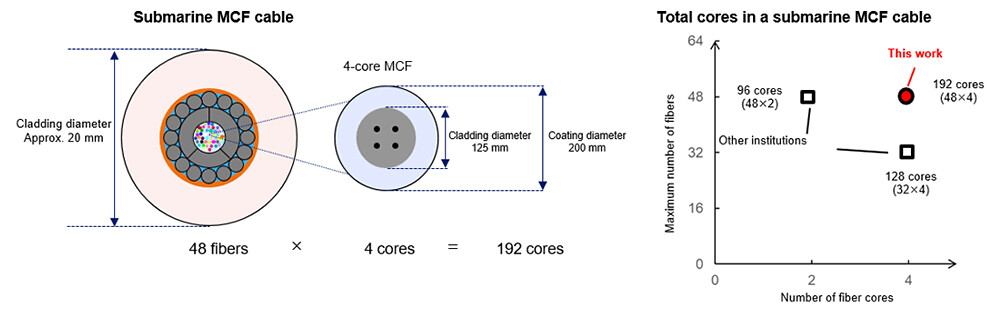 Figure 4 Developed submarine 4-core MCF cable and its accommodated core count
Future Prospects
In this research, NTT developed a 192-core submarine cable system capable of increasing transmission capacity fourfold while maintaining the system of existing submarine cables, together with the related components required for its commercial deployment. This development enables the economical deployment of high-capacity submarine networks.
Looking ahead, NTT aims to achieve practical deployment around 2029 and contribute to the expansion of submarine network capacity and the continued advancement of sustainable communication infrastructure.
Related Press Releases
- August 8, 2017
World's Largest Transmission Capacity with Standard Diameter Multi-Core Optical Fiber
https://group.ntt/en/newsrelease/2017/08/08/170808b.html - November 15, 2024
Lineup of multi-core optical fiber construction, operation, and maintenance technologies that realize four times the capacity with a single optical fiber
https://group.ntt/en/newsrelease/2024/11/15/241115a.html
[Glossary]
1Multicore Optical Fiber
An optical fiber that contains multiple optical paths (cores) within a single fiber. MCF is being actively researched and developed as a next-generation optical fiber technology capable of overcoming the performance limits of conventional optical fibers and enabling ultra-high-capacity optical communications.
Example of research and development: https://group.ntt/en/newsrelease/2017/08/08/170808b.html
2Terminal Rack
A dedicated rack used within communication facilities to accommodate, route, and connect optical fiber cables that are brought in from outside the building.
3IOWN (Innovative Optical and Wireless Network) initiative
https://group.ntt/en/group/iown/
4Research and development of Side-view based angle alignment technique
https://group.ntt/en/newsrelease/2024/11/15/241115a.html
About NTT
NTT is a leading global technology innovator, providing a broad range of services to both consumers and businesses. As a mobile operator and provider of infrastructure, networks, and services, NTT is dedicated to promoting a sustainable future through cutting-edge innovations. Our portfolio includes business consulting, AI-powered solutions, application services, global networks, cybersecurity, data center and edge computing, all supported by our deep global industry expertise. Generating over $90 billion in revenue and employing 340,000 professionals, we allocate 30% of our annual profits to fundamental research and development. With operations spanning more than 70 countries and regions, our clients include over 75% of Fortune Global 100 companies, alongside thousands of enterprises, government organizations, and millions of consumers.
Media Contact
NTT, Inc.
NTT IOWN Integrated Innovation Center
Public Relations
Inquiry Form
Information is current as of the date of issue of the individual press release.
Please be advised that information may be outdated after that point.


NTT STORY
WEB media that thinks about the future with NTT