Microsoft ends support for Internet Explorer on June 16, 2022.
We recommend using one of the browsers listed below.
- Microsoft Edge(Latest version)
- Mozilla Firefox(Latest version)
- Google Chrome(Latest version)
- Apple Safari(Latest version)
Please contact your browser provider for download and installation instructions.



March 19, 2026
NTT, Inc.
Graduate School of Engineering, The University of Tokyo
NTT and the University of Tokyo Demonstrate a New Technology for Detecting "Invisible Deformation" in Large-Scale Structures Using Optical Fiber
—Enabling continuous monitoring of gradual shape changes over distances ranging from several tens of meters to several kilometers in aircraft, offshore power facilities, and more—
News Highlights:
- By applying a novel shape analysis method using a multi-fiber cable, a technology has been demonstrated that expands the detectable curvature radius in optical fiber shape sensing by more than tenfold, enabling the detection of extremely gradual shape changes that were previously undetectable.
- The technology enables sensing of minute defomation in large-scale structures such as aircraft and offshore power facilities, as well as capturing shape information of piping systems extending from several tens of meters to several kilometers in social infrastructure and large-scale pipelines, using sensing optical fiber cables.
- Going forward, the detectable curvature radius will be extended to over 10 meters through structural optimization and improved measurement and shape analysis accuracy, with the goal of establishing a practical shape sensing technology for large-scale structures.
TOKYO — March 19, 2026 — NTT, Inc. (Headquarters: Chiyoda-ku, Tokyo; President and CEO: Akira Shimada; hereinafter "NTT") and the Graduate School of Engineering, The University of Tokyo (Location: Bunkyo-ku, Tokyo; Dean: Yasuhiro Kato; hereinafter "The University of Tokyo") have, for the first time in the world, demonstrated an optical fiber sensing technology capable of detecting extremely gradual shape changes with curvature radii of several meters or more, using sensing optical fiber cables that leverage existing optical fiber cable structures.
Conventional optical fiber shape sensing technologies have been limited to detecting relatively sharp changes, typically with curvature radii on the order of several centimeters to several tens of centimeters, and detection distances of only a few meters, restricting their range of applications. In contrast, the newly demonstrated technology enables remote detection and monitoring of gradual shape changes with curvature radii of several meters or more across large-scale infrastructure systems extending from several tens of meters to several kilometers in length.
This technology makes it possible to detect unintended minute defomation in large structures, as well as to visualize the shape of otherwise invisible infrastructure such as underground pipelines and to digitize their positional information. Looking ahead, by deploying sensing optical fiber cables in large-scale facilities, the technology is expected to support visualization on digital twins of large structures and social infrastructure, as well as enable predictive maintenance of such assets.
Details of this technology have been published in a special issue of the IEEE Journal of Lightwave Technology.
Background
In recent years, optical fiber shape sensing technologies capable of detecting the shape along an optical fiber have been developed. These technologies use so-called multi-core optical fibers, which contain multiple light propagation paths within a single fiber, and estimate the bending and position of the fiber based on differences arising among these optical paths. Because this approach is well suited to applications where precise shape recognition is critical, such as thin instruments and robotic arms, it has been widely utilized in fields including medical applications and robotics.
However, conventional technologies have been limited by constraints such as the performance of measurement instruments. As a result, the detectable length has typically been limited to only a few meters, and the detectable curvature radius to several centimeters or less. This has made it difficult to apply such technologies to large-scale structures where spatial shape changes are extremely gradual.
Meanwhile, in social infrastructure and large-scale facilities, there are many structures that are difficult to observe directly, including pipelines in large plants and underground conduits for power, telecommunications, and sewage systems. Visualization of these structures has relied on camera-equipped robots and radar systems; however, their measurement accuracy is highly susceptible to environmental conditions, and they face challenges in providing continuous monitoring along the full length of such structures.
Furthermore, in large-scale structures, the accumulation of slight shape changes over time can lead to failures, making continuous monitoring essential. Despite this need, conventional technologies have made it difficult to continuously monitor such changes over the entire length of a structure.
To address these challenges, NTT and Professor Hideaki Murayama of the University of Tokyo combined NTT's optical fiber cable design and evaluation technologies, developed for telecommunications infrastructure, with Professor Murayama's shape analysis technology, which infers the installed shape of an optical fiber cable from the distribution of strain generated within the fiber. Through this approach, they have been advancing a new optical fiber shape sensing technology capable of detecting extremely gradual shape changes with curvature radii of several meters or more, over distances extending to several kilometers.
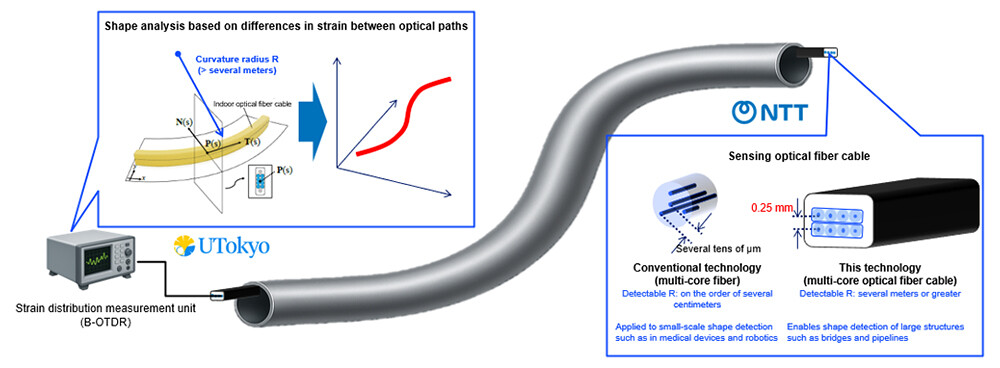 Figure 1: Sensing optical fiber cable and shape sensing technology for detecting the geometry of large-scale facilities
Technical Highlights
(1) Shape analysis of optical fiber cable through sequential analysis of strain distribution
An analytical technique has been developed to enable highly accurate shape estimation by leveraging differences in strain across multiple optical paths, using B-OTDR (Brillouin Optical Time Domain Reflectometry)*1, which measures the longitudinal strain distribution along an optical fiber.
By analyzing the strain generated in multiple optical paths and their positional relationships, the bending direction and magnitude at each point can be estimated. Sequential computation along the longitudinal direction enables reconstruction of the overall shape of the optical fiber cable. In addition, referencing strain distributions obtained under known bending configurations or straight conditions has improved the accuracy of shape estimation.
While conventional shape sensing methods based on OFDR (Optical Frequency Domain Reflectometry)*2 are limited to measurement distances of only a few meters, the B-OTDR-based approach enables long-distance shape measurement over several kilometers.
(2) Multi-fiber cable structure optimized for shape sensing
In optical fiber shape sensing, the installed shape of the fiber is estimated by analyzing differences in signals obtained from multiple optical paths. The detectable curvature radius increases with the distance between these optical paths.
Conventional approaches have used multi-core optical fibers, in which multiple optical paths are embedded within a single fiber. However, the spacing between these paths is limited by the fiber's small diameter to only several tens of micrometers, restricting the detectable curvature radius to several centimeters to several tens of centimeters.
In this work, a multi-fiber cable structure incorporating eight conventional single-core optical fibers arranged and fixed at intervals of 0.25 mm, as used in indoor telecommunications cables, was adopted. This configuration enables detection of curvature radii on the order of several meters or greater. Furthermore, the rectangular cross-sectional shape of the cable is expected to reduce analysis errors caused by unintended twisting.
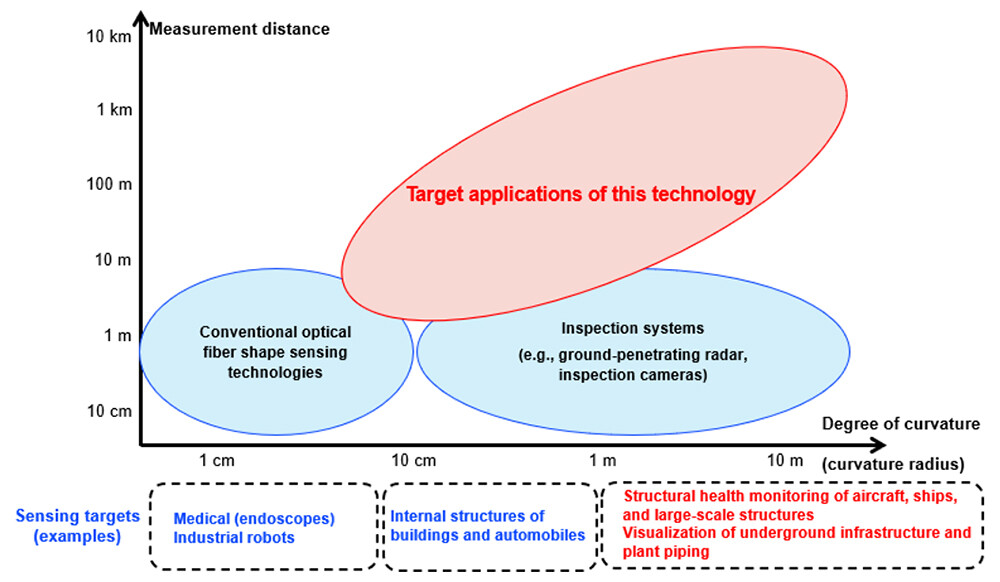 Figure 2: Capability of this technology relative to conventional technologies and its target application range
Experimental Overview
In this experiment, three types of mock conduits with curvature radii of 3 m to 10 m were installed at the NTT Tsukuba R&D Center. The multi-fiber cable was fixed along these conduits, and measurements and analyses were conducted (Figure 3). The strain distribution applied to multiple optical fibers embedded in the cable was acquired using B-OTDR, and the shape of the optical fiber cable was estimated using a sequential shape distribution analysis method developed by Professor Hideaki Murayama of the University of Tokyo.
In experiments using the mock conduit with a curvature radius of 10 m, which represents the largest curvature radius and the most challenging detection condition, the error between the actual conduit shape and the shape estimated from the strain distribution of the optical fiber cable was less than 1%, demonstrating a high level of accuracy (Figure 4: dashed line indicates the actual conduit shape; solid line indicates the estimated shape based on strain distribution). Similarly, high-accuracy detection of bending shapes was confirmed for mock conduits with curvature radii of 3 m and 7 m.
These results demonstrate, for the first time in the world, the ability to detect extremely gradual shape changes with curvature radii on the order of several meters, which were previously undetectable using conventional optical fiber shape sensing technologies.
In this experiment, a proof-of-concept was conducted using planar curved shapes with maximum curvature radii of up to 10 m. Going forward, efforts will focus on extending this work to the detection of three-dimensional shape changes over longer distances, including even more gradual shapes with curvature radii exceeding 10 m.
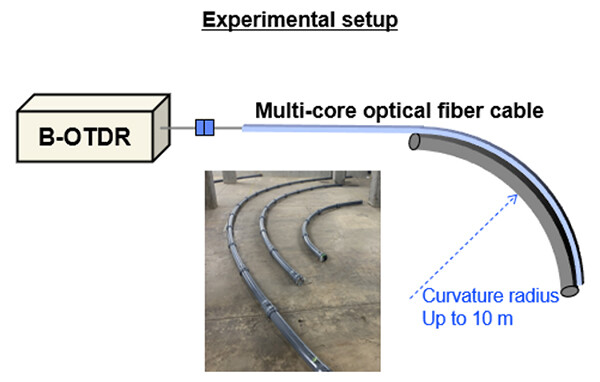 Figure 3: Experimental setup
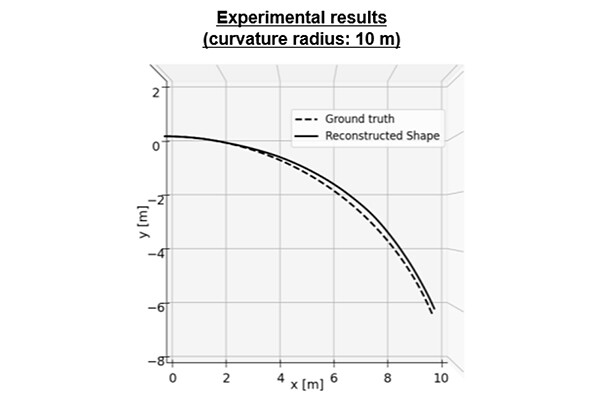 Figure 4: Experimental results (curvature radius of 10 m, the most challenging detection condition)
Potential Applications of the Technology
This technology is expected to be applied to visualization and anomaly prediction for large-scale facilities and social infrastructure where sensing optical fiber cables can be installed or fixed. Representative use cases include the following:
- Large structures and offshore facilities, such as aircraft, ships, radio towers, and offshore wind power installations
Large structures and offshore facilities may experience unintended, slight defomation distributed over surfaces or localized areas, which can lead to failures or damage in the structures themselves or in connected components such as cables. By monitoring shape changes along the length of sensing optical fiber cables, this technology is expected to enable analysis on digital twins for estimating the service life of assets and predicting potential failures. - Pipelines in oil fields and chemical plants, as well as underground conduits for telecommunications, power, and gas
For infrastructure that cannot be directly observed, it is often difficult to accurately determine shape and routing. This technology is expected to enable three-dimensional mapping of such infrastructure and facilitate management on digital twins.
It should be noted that factors such as twisting of the sensing optical fiber cable itself and temperature variations can affect the analysis results. Therefore, depending on the use case, compensation mechanisms for these factors may be required.
Roles and Responsibilities
- NTT: Design of optical fiber cables optimized for shape sensing and construction of the experimental setup
- The University of Tokyo: Development of measurement and analysis technologies for estimating shape from strain distributions in optical fiber cables
Future Outlook
This demonstration enables continuous visualization of "spatial shape changes" along an optical fiber cable. By embedding sensing optical fiber cables along structures such as aircraft, ships, and large-scale plants, or by installing or inserting them into social infrastructure such as telecommunications and power facilities, it becomes possible to remotely detect the overall shape and deformation of entire structures.
This capability is expected to support visualization of otherwise invisible infrastructure, such as subsea and underground facilities, on maps, as well as enable failure prediction based on strain and deformation. As a result, the technology is anticipated to contribute to more advanced preventive maintenance and disaster mitigation for large-scale infrastructure.
Going forward, efforts will focus on optimizing sensing optical fiber cable structures that balance ease of installation with detection accuracy, as well as on validating three-dimensional shape detection over longer distances using mock facilities. Through these efforts, this technology is expected to contribute to the realization of digital twins for large-scale infrastructure and to enhancing infrastructure resilience using sensing optical fiber cables.
[Researchers and Contributors]
The University of Tokyo, Graduate School of Frontier Sciences
Shintaro Nakamoto Master's Student
The University of Tokyo, Graduate School of Engineering
Makito Kobayashi Project Researcher
Hideaki Murayama Professor
NTT Access Network Service Systems Laboratories
Nobutomo Hanzawa Group Leader
Takashi Matsui Group Leader/Distinguished Researcher
Kazuhide Nakajima Fellow
[Publication Information]
Journal: IEEE Journal of Lightwave Technology
Title: Shape Sensing for Detecting Low Curvature Using Indoor Optical Cable
Authors: Shintaro Nakamoto, Makito Kobayashi, Nobutomo Hanzawa, Takashi Matsui, Kazuhide Nakajima and Hideaki Murayama
DOI: 10.1109/JLT.2026.3673315
URL: https://ieeexplore.ieee.org/document/11433602
[Glossary]
*1B-OTDR (Brillouin Optical Time Domain Reflectometry):
A method for measuring the distribution of strain along the longitudinal direction of an optical fiber by detecting and analyzing, in the time domain, backscattered light generated by Brillouin scattering within the fiber.
*2OFDR (Optical Frequency Domain Reflectometry):
A method for measuring longitudinal variations in optical power with very high spatial resolution by analyzing, in the frequency domain, backscattered light generated by Rayleigh scattering within an optical fiber.
About NTT
NTT is a leading global technology innovator, providing a broad range of services to both consumers and businesses. As a mobile operator and provider of infrastructure, networks, and services, NTT is dedicated to promoting a sustainable future through cutting-edge innovations. Our portfolio includes business consulting, AI-powered solutions, application services, global networks, cybersecurity, data center and edge computing, all supported by our deep global industry expertise. Generating over $90 billion in revenue and employing 340,000 professionals, we allocate 30% of our annual profits to fundamental research and development. With operations spanning more than 70 countries and regions, our clients include over 75% of Fortune Global 100 companies, alongside thousands of enterprises, government organizations, and millions of consumers.
About The University of Tokyo
The University of Tokyo is Japan's leading university and one of the world's top research universities. The vast research output of some 6,000 researchers is published in the world's top journals across the arts and sciences. Our vibrant student body of around 15,000 undergraduate and 15,000 graduate students includes over 5,000 international students.
Media Contacts
NTT, Inc.
NTT Information Network Laboratory Group
Public Relations
Inquiry Form
The University of Tokyo
Graduate School of Engineering
Public Relations Office
Tel: 03-5841-0235
E-mail: kouhou@pr.t.u-tokyo.ac.jp
Information is current as of the date of issue of the individual press release.
Please be advised that information may be outdated after that point.


NTT STORY
WEB media that thinks about the future with NTT