Microsoft ends support for Internet Explorer on June 16, 2022.
We recommend using one of the browsers listed below.
- Microsoft Edge(Latest version)
- Mozilla Firefox(Latest version)
- Google Chrome(Latest version)
- Apple Safari(Latest version)
Please contact your browser provider for download and installation instructions.



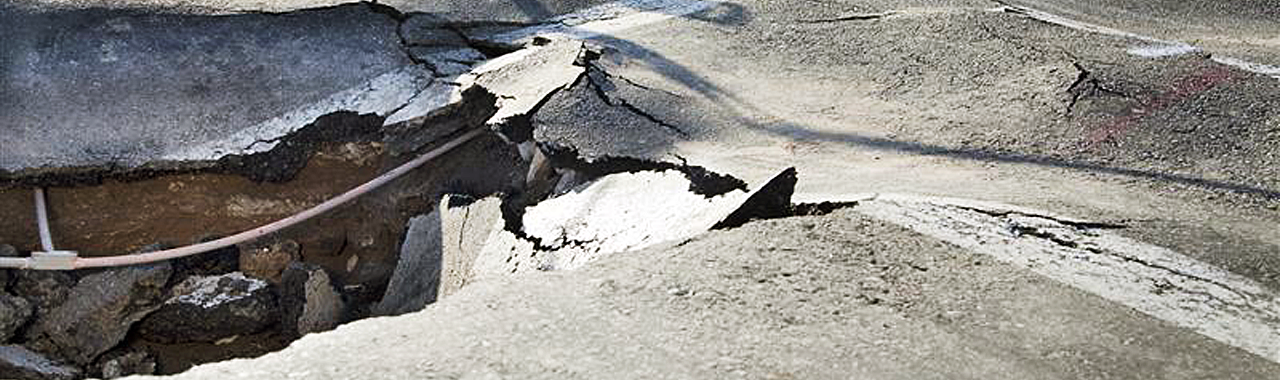
A road looks solid and stable right up until the moment it isn't. In an instant, a sinkhole can open up to swallow trucks and cars, collapse intersections, and force emergency evacuations.
It’s an issue for people all over the world. Wastewater leakage can gradually wash away surrounding soil, creating growing underground voids that remain undetected until the road surface finally collapses. We see sinkholes everywhere, for the same reasons: aging underground infrastructure, persistent water leakage, slow erosion, followed by sudden collapse.
How Cavities Form
Cavities can form under the surface over months or even years. And they form quietly, with few obvious signs until they open up. It's not a new phenomenon and local governments all over the globe face a constant battle to find them before the unthinkable happens. They use ground-penetrating radar to inspect roads and pipes, conduct borehole surveys, and put camera systems into sewer lines. And sure, their precautions work and can often prevent serious incidents.
But the problem is frequency. Road inspections can't be done every day, week or even month. Typically, a section of road might be looked at once a year, or once every several years, depending on how much money is available to the local authority for checks and the perceived risk of each section. Conditions can change between inspections, because water keeps flowing, pipes keep getting older and more corroded, and soil shifts.
Depth is also an issue: some inspection techniques work well for shallow layers, but can't cope with deeper ground conditions. Large-scale excavation surveys can give good answers, but they are also costly and disruptive. Who wants to dig up every road regularly, just to see what's going on beneath the surface? There's no good solution to the problem.
Or is there?
An Alternative to Digging Up Roads
That's what NTT and Japan’s National Institute of Advanced Industrial Science and Technology (AIST) have been trying to discover. They've been wondering: is there anything we could possibly use to inspect roads that is already there, buried underneath most streets? And thinking about it, what they're proposing seems almost obvious.
Optical fiber cables.
You read that correctly. The cables carrying telecommunications data that are a regular, accepted part of our daily life. But what NTT and AIST have discovered is that boring old optical fiber cables can also act as highly sensitive vibration sensors when paired with a new system called Distributed Acoustic Sensing, or DAS.
Using Light to Find Cavities
DAS works by sending pulses of light through an optical fiber and measuring the tiny reflections that return. When the ground vibrates, even if very slightly, those vibrations cause tiny changes in the light signal. By analyzing those changes, it's possible to measure how seismic waves move through the soil. NTT’s refined version is called FDM-DAS. FDM stands for "Frequency Division Multiplexing" and it means that the light signals are split into different frequency channels, which improves clarity and makes the measurements more precise over long distances.
This is how NTT and AIST are working to find cavities: it's to do with how surface waves travel through the ground. Lower-frequency vibrations penetrate deeper. As those waves move, their speed depends on the stiffness of the soil. If soil has been washed away and there's nothing left but a cavity, the mechanical properties change. By measuring how fast different vibrations travel through the ground, engineers can build a picture of how hard or soft the soil is at different depths.
Quick, Regular, Accurate and Inexpensive
One big advantage the NTT/AIST optical fiber cable method has over conventional road inspections is the frequency with which measurements can be made. Instead of having to send out human crews to check what's happening beneath the surface, the fiber already in the ground can record natural microtremors around the clock. Traffic, wind, and everyday urban activity give a steady source of small vibrations; over time, engineers can work out which types of vibration relate to which types of activity and check for anomalies.
The technology is still being refined: signal processing has to be used to filter out noise, and real-time analysis requires both large amounts of computing power and careful calibration against known ground conditions. But it's an interesting concept.
Cities and towns around the world have already invested a lot of money in underground fiber networks. If those same networks could also be used as a distributed monitoring system, roads and infrastructure might be monitored continuously rather than from time to time. We won't be getting rid of sinkholes entirely, but more of them could be identified while they are still small and growing.
Innovating a Sustainable Future for People and Planet
For further information, please see this link:
https://group.ntt/en/newsrelease/2025/10/21/251021a.html
If you have any questions on the content of this article, please contact:
NTT Information Network Laboratory Group
Public Relations
ntt-pr@ntt.com

Daniel O'Connor
Daniel O'Connor joined the NTT Group in 1999 when he began work as the Public Relations Manager of NTT Europe. While in London, he liaised with the local press, created the company's intranet site, wrote technical copy for industry magazines and managed exhibition stands from initial design to finished displays.
Later seconded to the headquarters of NTT Communications in Tokyo, he contributed to the company's first-ever winning of global telecoms awards and the digitalisation of internal company information exchange.
Since 2015 Daniel has created content for the Group's Global Leadership Institute, the One NTT Network and is currently working with NTT R&D teams to grow public understanding of the cutting-edge research undertaken by the NTT Group.
Related Article




Recommended Article
-

March 14, 2024
What is NTT's GX? Our solution brand "NTT G×Inno"
-

March 5, 2024
[Press Conference Information] Launch of "NTT G×Inno," a New Solution Brand to Strengthen Efforts in the GX Field
-

January 15, 2024
Digitization and Digitization for Smart Agriculture
-

November 17, 2023
Realizing a Recycling-Oriented Society through a Data Mining Approach
Search by Tags