Microsoft ends support for Internet Explorer on June 16, 2022.
We recommend using one of the browsers listed below.
- Microsoft Edge(Latest version)
- Mozilla Firefox(Latest version)
- Google Chrome(Latest version)
- Apple Safari(Latest version)
Please contact your browser provider for download and installation instructions.



March 25, 2026
National Institutes for Quantum Science and Technology
NTT, Inc.
World's First Realization of Fast Frequent, Real-Time Communications for Fusion Plasma Prediction and Control
-- QST and NTT Co-Create Communication Technology to Support the Practical Realization of Fusion Energy --
News Highlights:
- Achieved fast frequent, real-time communications essential for the rapid prediction and control of plasma required to sustain fusion-reactor plasmas without disruption.
- Successfully implemented the technology in the control system of the JT-60SA superconducting tokamak experimental device, demonstrating—for the first time in the world—high-frequency communication with a cycle time of less than 1/10,000 of a second (100 microseconds).
- Joint research conducted under the collaboration agreement between QST and NTT has produced results that have gained clear prospective for implementing advanced technologies—starting with IOWN—into JT-60SA. The two organizations will continue to strengthen their partnership and contribute to the advancement of innovative environmental energy technologies.
National Institutes for Quantum Science and Technology (Headquarters: Inage-ku, Chiba City, Chiba; President: KOYASU Shigeo; hereinafter "QST") and NTT, Inc. (Headquarters: Chiyoda-ku, Tokyo; President and CEO: Akira Shimada; hereinafter "NTT") have successfully realized fast frequent, real-time communications essential for the rapid prediction and control of plasma in fusion reactors.
Since signing a collaboration agreement*1 in 2020, QST and NTT have been conducting joint research aimed at creating fusion energy technology—world leading innovative environmental energy.
To stably confine the high-pressure plasma required for a fusion reactor, it is essential to control rapidly growing plasma instabilities within an extremely short timeframe—less than 1/10,000 of a second. At the same time, the expansion of facility scale and the increasing complexity of control logic require longer-distance communication between computers within the control network, along with larger communication data volumes. However, with conventional technologies, achieving such fast frequent real time communication within less than 1/10,000 of a second—over the required distances and with the expected data volumes—has been difficult. For JT-60SA,*2 the world's largest superconducting tokamak experimental device (Fig.1), design efforts have been underway to establish a dedicated network capable of supporting this level of fast frequent real time communication. In this context, deterministic fast frequency communication technology suitable for use within the control system has now been established, and a demonstration test of the technology has been conducted. As a result, fast frequent data communication at intervals shorter than 1/10,000 of a second—previously unattainable with conventional technologies—has been successfully achieved for the first time in the world.
This achievement is indispensable for advancing real-time control of high-pressure plasma in upcoming heating experiments on JT-60SA. Moreover, it represents a groundbreaking step toward real-time predictive control in fusion reactors such as ITER*3 and future DEMO reactor*4, where significantly larger plasmas must be predicted and controlled using a limited number of diagnostic instruments and a large network of control computers. Building on this accomplishment, QST and NTT will further strengthen their collaboration and continue working toward the early realization of fusion energy.
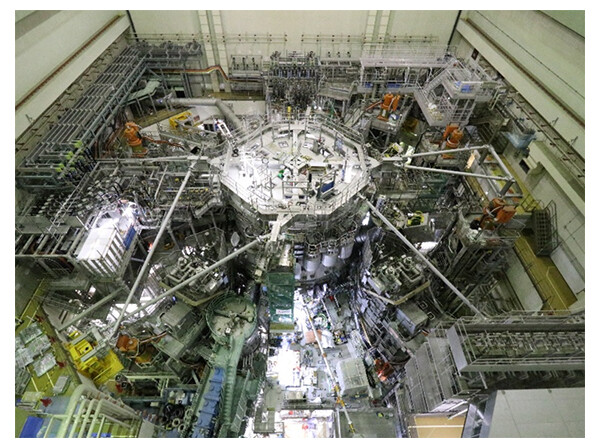 Panoramic view of JT-60SA
1. Background
Toward the realization of a DEMO reactor—an innovative form of environmental energy—the most advanced approach worldwide is the tokamak-type fusion reactor. In such reactors, data on plasma conditions is acquired in real time from various diagnostic instruments. This data is transmitted through the control network to regulate plasma position and shape, suppress instabilities, and control parameters such as density and temperature. Especially in future fusion reactors, including DEMO reactors, it will be necessary to control instabilities that tend to grow rapidly in high-pressure plasma. To achieve this, a key challenge has been the establishment of a method for stable data communication at a high frequency—100 microseconds or less—of data that includes various diagnostic information. To address this challenge, the present joint research has advanced the design of a dedicated network for fast frequent data communication in JT60SA, the world's largest superconducting tokamak experimental device. The objective has been to utilize this network in the realtime control system of JT 60SA and to conduct research and development on communication technology that simultaneously achieves both high frequency and high stability— capabilities that were not attainable with conventional technologies.
2. Technical Approach and Results
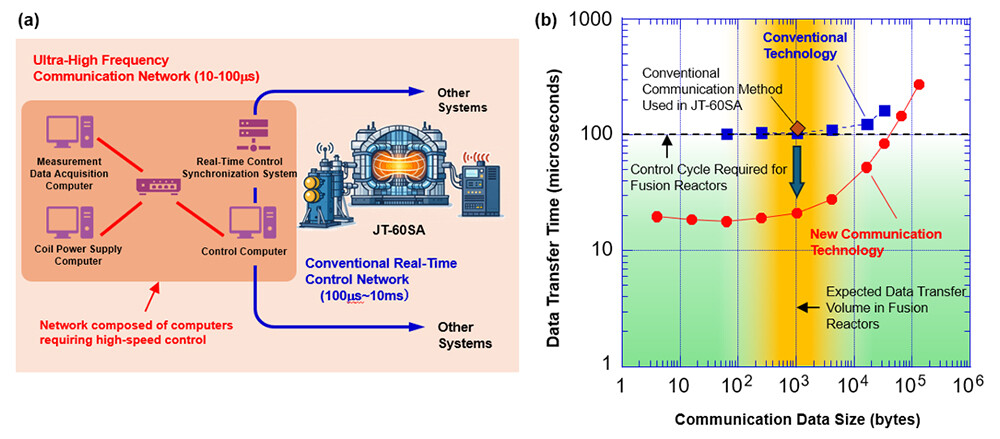 Fig 1. (a) Design of the Ultra-High-Frequency Communication Network in JT-60SA (b) Variation in transmission time relative to communication data size achieved with the proposed technology. The system successfully enables fast frequent data communication—less than 100 microseconds for a data payload of 1 kByte, which is the scale anticipated for fusion-reactor operations.
Communication within a fusion reactor's control network follows a sequence of operations: collection of diagnostic data, evaluation of the relevant physical quantities to be controlled and calculation of the corresponding control values, and transmission of commands to actuators such as power-supply systems. The time required to complete this sequence is determined by the growth timescale of the instabilities being controlled. In fusion reactors, instabilities that can grow rapidly in high-pressure plasma may occur, requiring fast control within a very short timeframe of 100 microseconds. Consequently, to secure sufficient time for calculating control quantities, the communication of measurement data must occur at very high frequency, within only several tens of microseconds.
In future fusion reactors, including DEMO reactors, the expansion of plant scale due to associated systems is expected to increase communication distances between computers within the control network to several 100m. In addition, predictive control calculations for plasma instabilities require the transfer of data sets of approximately one kilobyte, including three-dimensional information. However, conventional technologies have been unable to achieve data communication within 100 microseconds under the constraints of the distances and data volumes anticipated in fusion plants.
To address these challenges, the present joint research has advanced the design of a dedicated network in JT 60SA, as shown in Fig.1(a), to support the control of instabilities that tend to arise in high-pressure plasma. In this network, diagnostic data—including magnetic field information—are transferred from the diagnosticdata acquisition computer to the control computer. The control computer performs predictive plasma calculations and computes control command values, which are then transmitted to the coil powersupply computer, enabling rapid plasma control. The design of this dedicated control-network configuration for JT-60SA, intended to support stable and fast frequent data communication at the level required for future fusion reactors. In parallel, an ultra-high-frequency deterministic communication technology has been established, capable of completing data transfer within a strictly defined timeframe—specifically, at intervals of 100 microseconds or less. An evaluation environment was constructed in which this technology was integrated into computers separated by 400 meters within the JT 60SA control network, and data transfer performance was assessed through demonstration testing. As shown in Figure 1(b), the tests achieved—for the first time in world—data communication at an extremely high frequency required for fusion reactors, with periodicity below 100 microseconds. This achievement represents a significant advance toward the sophisticated control of instabilities expected in high-pressure plasma in future fusion reactors and greatly enhances the prospects for long-duration operation in DEMO reactor development. Going forward, evaluation within the full control network—comprising numerous computers—will be conducted in preparation for JT-60SA heating experiments, with application to real-time control of high-pressure plasma planned.
● Ultra-High Frequent Deterministic Communication Technology
In the real-time control of fusion reactors, it is essential to achieve extremely high-frequency communication with a periodicity of 100 microseconds or less, despite constraints on both communication distance and data volume. Equally important is deterministic performance, ensuring data transfer is reliably completed within the specified time window. To realize such communication, two technical requirements must be met:
- Reduction of latency within the control computers
- Reduction of latency variation—i.e., jitter—within the network connecting the control computers
Within the control computers, it is necessary to shorten the time required for data transfer and achieve communication that is both extremely high-frequency and low-latency. To address this, the developed technology focuses on the periodic nature of real-time control communication—specifically, the fact that data are transmitted repeatedly at fixed intervals—and optimizes the exchange of communication-control information. This characteristic is common not only to real-time control of fusion reactors but also to many other deterministic-communication use cases. As shown in Fig. 2(a), conventional technologies exchange communication-control information immediately before each data transmission to accommodate all types of communication. Because the details of the next data transmission cannot be determined until just before sending, the communication-control information cannot be generated in advance. While this approach is applicable for general-purpose communication, the time required for this control-information exchange makes it difficult to support extremely high-frequency communication. To overcome this limitation, the present technology restricts the target use case to periodic communication and predetermines the communication-control information. This enables communication at extremely high frequencies and has been implemented as a communication library. Specifically, the acknowledgment sent from the receiving device to the transmitting device includes the communication-control information to be used for the next transmission cycle. The transmitting device then performs the next data transmission based on this information. As a result, the exchange of communication-control information immediately before data transmission becomes unnecessary, enabling fast frequent data transfer.
Fig. 2(b) illustrates an example of reducing latency variation within the network. When numerous control computers are connected to the network, data congestion may occur at points where multiple data streams converge, potentially causing transfer delays. In conventional Ethernet networks, for example, such delays could arise within network devices such as Ethernet switches, resulting in latency fluctuations. By incorporating mechanisms that control transmission timing—such as those used in TSN*5—latency variation can be avoided, enabling deterministic communication on the microsecond scale.
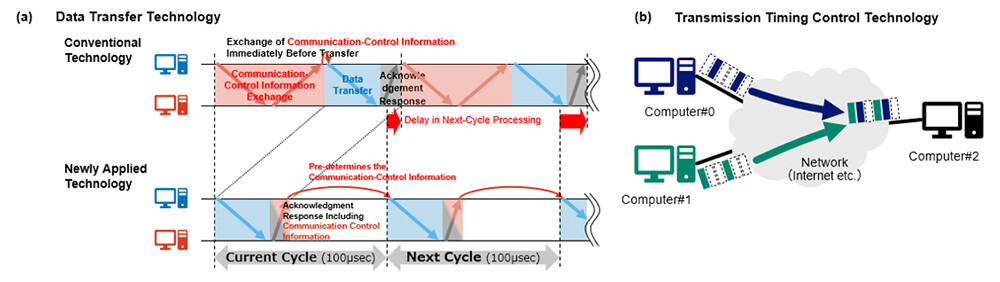 Fig. 2 (a) Data-transfer technology enabling high-frequency, low-latency communication. (b) Transmission-timing control technology for reducing latency jitter (latency fluctuation).
3. Roles of Each Organization
- QST: Design and development of the real time control network for high speed plasma predictive control in JT 60SA; integration and evaluation of the ultra high frequency deterministic communication technology within the control network.
- NTT: Research and development of the ultra high frequency deterministic communication technology.
4. Outlook
This achievement is indispensable for real-time control aimed at sustaining high-pressure plasma for extended durations in upcoming JT-60SA heating experiments. It also represents a groundbreaking advancement toward plasma-control capabilities required for steady-state operation in DEMO reactors, where larger plasmas must be controlled using a limited number of diagnostic instruments. Building on this outcome, QST and NTT will further strengthen their collaboration. By applying advanced technologies—including IOWN*6, proposed by NTT—to fusion research and development, continued efforts will be directed toward the early realization of fusion energy. These initiatives will contribute to the creation of a green and sustainable society.
[Glossary]
- Details of the Collaboration Agreement between NTT and QST
URL: https://www.qst.go.jp/site/press/45578.html (Japanese)
URL: https://group.ntt/jp/newsrelease/2020/11/06/201106a.html (Japanese) - JT-60SA (JT-60 Super Advanced)
As a joint project of the satellite tokamak jointly implemented by Japan and Europe as a Broader Approach (BA) activity and the tokamak domestic priority device project that has been under consideration in Japan, the device was constructed at the QST facility in Naka City, Ibaraki Prefecture, Japan. This is the world's largest tokamak-type superconducting plasma experimental device as of today. Its purpose is to support research for ITER to achieve its technological goals and supplementary research for ITER toward DEMO reactors and human resource development. JT-60SA uses powerful superconducting coils cooled to approximately -269 degrees Celsius (absolute temperature approximately 4K) to confine plasma that can reach 100 million degrees Celsius of temperature.
URL: https://www.qst.go.jp/site/jt60/5150.html (Japanese) - ITER Project
With the international cooperation of seven Parties: Japan, Europe, Russia, the United States, China, Korea, and India—the project aims to demonstrate the scientific and technological feasibility of fusion energy through the construction and operation of ITER. The target of the project is to obtain fusion energy that is 10 times larger than the input energy of the external heating system (Q≧10). Currently, the site is in Saint-Paul-les-Durance, France, and the ITER Organization, an international organization for the project implementation, is leading the construction of buildings and the assembly of components for the start of operation. Also, the manufacturing of various ITER component devices has been advanced by each of the seven parties.
URL: https://www.fusion.qst.go.jp/ITER/ (Japanese) - DEMO Reactor
A DEMO reactor is a next-generation device that will be constructed based on the achievements of JT-60SA and ITER and will demonstrate the power generation and economic feasibility of fusion energy. Currently, conceptual designs for DEMO reactors are being developed in various countries around the world. - TSN
TSN (Time-Sensitive Networking) is a set of international technical standards designed to ensure real-time performance in Ethernet communications. Key standards include IEEE 802.1AS and IEEE 802.1Qbv. By combining these standards, TSN minimizes latency and latency variation to the greatest extent possible, enabling guaranteed real-time communication. - IOWN
The IOWN (Innovative Optical and Wireless Network) concept refers to a network and information processing infrastructure, including devices, capable of providing high-speed, high-capacity communications and vast computing resources by optimizing individuals and the entire system based on all kinds of information and utilizing innovative technologies centered on optics. For details, please visit the following website.
■ What is the IOWN concept?
URL: https://www.rd.ntt/e/iown/
Contact Us
National Institutes for Quantum Science and Technology (QST)
For research-related inquiries:
Naka Institute for Fusion Science and Technology, Department of Advance Plasma Research Director SUZUKI Takahiro
TEL: +81-29-277-4294 E-mail: suzuki.takahiro@qst.go.jp
For press inquiries:
International and Public Relations Division, International and Public Relations Department
TEL: +81-43-206-3026 E-mail: info@qst.go.jp
NTT
Information Network Laboratory Group
Public Relations
Inquiry Form
Information is current as of the date of issue of the individual press release.
Please be advised that information may be outdated after that point.


NTT STORY
We introduce various fields that NTT Group is working on and collaborations with partners.