Microsoft ends support for Internet Explorer on June 16, 2022.
We recommend using one of the browsers listed below.
- Microsoft Edge(Latest version)
- Mozilla Firefox(Latest version)
- Google Chrome(Latest version)
- Apple Safari(Latest version)
Please contact your browser provider for download and installation instructions.



April 7, 2026
NTT, Inc.
Kumejima Town
Waseda University
NTT, Waseda University, and Kumejima Town to Demonstrate a Circular "Water, Food, Energy, and Health" Model
-- NTT, Waseda University, and Kumejima Town Conclude a Comprehensive Partnership Agreement --
News Highlights:
- NTT and Waseda University have been advancing joint research in the fields of food, energy, sports and health, and quantum technology under a shared vision of "Love of the Earth" and realizing a sustainable society. As part of efforts to achieve this vision, they have entered into a comprehensive partnership agreement with Kumejima Town to address social challenges in island regions.
- Under this comprehensive partnership agreement, the parties will demonstrate a new social framework, the "BlueSphere Model," developed with the cooperation of Kumejima Town.
- Looking ahead, the parties aim to position the outcomes from Kumejima Town as a pioneering model to help address common challenges faced by island communities around the world.
TOKYO — April 7, 2026 — NTT, Inc. (Headquarters: Chiyoda-ku, Tokyo; President and CEO: Akira Shimada; hereinafter "NTT"), Kumejima Town (Mayor: Hideo Tobaru), and Waseda University (Shinjuku-ku, Tokyo; President: Aiji Tanaka) have agreed to provide mutual support and cooperation in areas including educational and research activities, with the aim of addressing social challenges in island regions and realizing a carbon-neutral society. Accordingly, the parties concluded a comprehensive partnership agreement on April 6, 2026.
Under this agreement, the parties will demonstrate the "BlueSphere Model*1," an integrated circular framework for water, food, energy, and health in island communities, and will initiate efforts to create a sustainable future island society that is self-sufficient in food and energy while achieving healthy longevity.
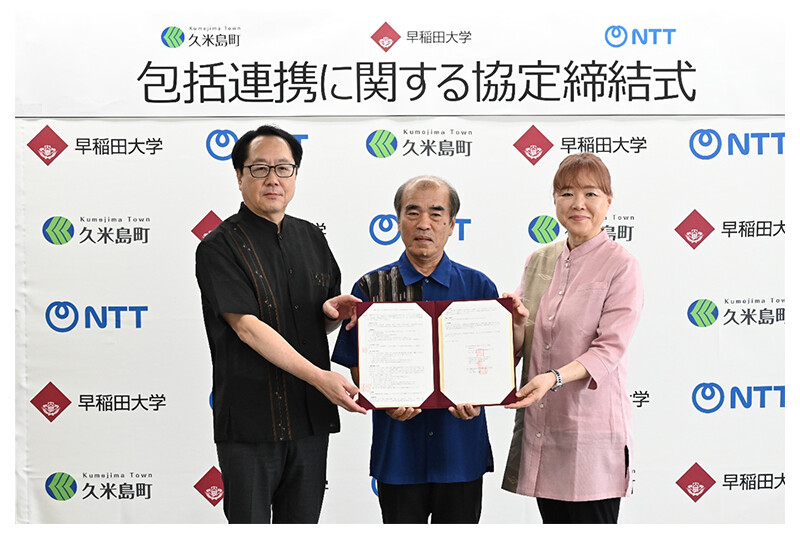 Photo 1: Signing Ceremony
(From left: Yuji Maeda, Head of NTT Space Environment and Energy Laboratories; Hideo Tobaru, Mayor of Kumejima Town; Haruko Takeyama, Associate Director of Waseda Center for a Carbon Neutral Society)
Background
In recent years, global challenges such as climate change, energy issues, and food security have become increasingly severe, underscoring the need to realize a sustainable society.
In response to these urgent challenges, efforts around the world are accelerating to seek fundamental solutions rather than merely maintaining the status quo or preventing further deterioration. Against this backdrop, NTT and Waseda University have been conducting vision-driven joint research since 2024. The parties will launch an initiative in Kumejima Town aimed at fostering a sustainable future society.
Challenges Facing Kumejima Town and Conclusion of the Comprehensive Partnership Agreement
Located approximately 100 km west of Okinawa Main Island, Kumejima Town is a remote island rich in natural resources and unique culture. The town has established a regional circular and symbiotic framework known as the "Kumejima Model," centered on its local resource of deep ocean water. This resource is utilized across a wide range of applications, including ocean thermal energy conversion (OTEC*2), aquaculture, and agriculture.
While such initiatives leveraging local resources have progressed, Kumejima Town, like many other island communities, faces the following social challenges:
- Food (Agriculture and Fisheries)・ Heavy reliance on imports from outside the island, leading to shortages when supply chains are disrupted by typhoons or other factors・ Aging workforce, labor shortages, productivity constraints due to small and dispersed farmland, and exposure to climate-related risks・ Declining soil fertility due to monoculture, as well as delays in diversification and higher value-added production
- Energy・ Dependence on diesel power generation typical of island grids, creating exposure to fuel price fluctuations・ Risk of equipment damage and prolonged power outages during typhoons
- Health and Medical Care・ Shortage of medical professionals leading to strained working conditions and challenges in providing adequate healthcare services・ Limited access to advanced medical care and specialists, requiring travel to Okinawa Main Island・ Increasing importance of prevention and early detection of lifestyle-related diseases amid an aging population
The population of Kumejima Town has declined significantly from a peak of 10,303 in 1990 to 6,972 as of October 2025. The tourism sector also faces challenges, including aging facilities, labor shortages, and seasonal fluctuations in visitor numbers. Island municipalities tend to experience structural challenges such as population decline and aging, climate change impacts, and high logistics costs more acutely than other regions.
In light of these issues, the parties believe that new initiatives are needed to carry forward and further develop the "Kumejima Model" that has been cultivated to date.
NTT, Kumejima Town, and Waseda University have therefore agreed to provide mutual support and cooperation in areas including food, energy, and health, as well as in educational and research activities, with the aim of addressing social challenges in island regions, and have concluded a comprehensive partnership agreement.
As a preliminary step in this initiative, the parties conducted an assessment of the current state of the Kumejima Model and identified community-level challenges. Based on these findings, a new social model has been developed. Moving forward, the parties will proceed with validation in real-world environments and aim to implement the model in stages.
Overview of the Initiative
The "BlueSphere Model" (Figure 2), a vision for a future society, will be introduced in Kumejima Town through this joint research initiative. The model aims to realize a sustainable island community in which culture and health are maintained through integrated cycles of water, food, and energy.
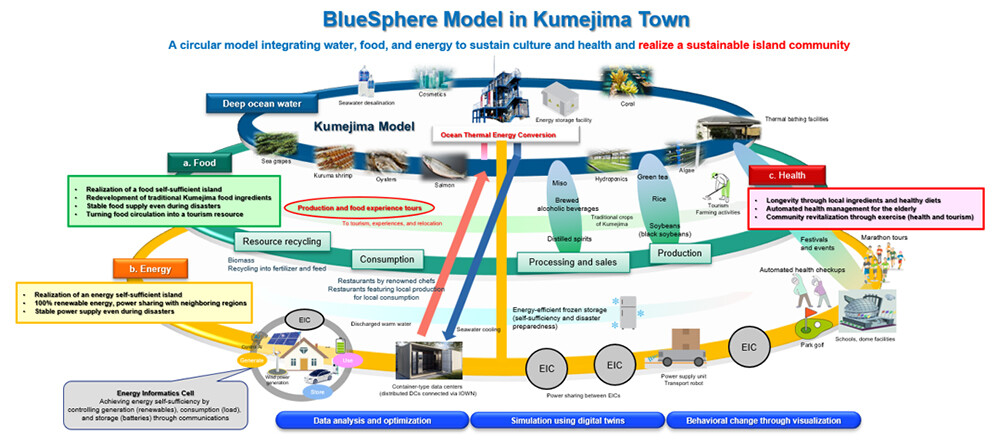 Figure 2: Conceptual Diagram of the BlueSphere Model
- Food Self-Sufficiency:
To improve food self-sufficiency, the parties will promote the redevelopment of traditional local ingredients and food resources unique to Kumejima Town. They will build a system capable of ensuring stable food supply even during disasters and will also create new value by leveraging "food circulation" as a tourism resource. To date, NTT and Waseda University have planned new agricultural technologies and, with the cooperation of local farmers, conducted soil analyses to identify suitable crops. The initiative will establish food production technologies that proactively adapt to environmental conditions, maximize the efficient use of local resources, and contribute to higher productivity and added value. - Energy Self-Sufficiency:
Aiming to achieve 100% renewable energy, the parties will build a resilient energy infrastructure capable of ensuring stable power supply even during disasters, including potential power interchange with neighboring regions. Previous joint research has focused on the realization of Energy Informatics Cell (EIC)*3. Going forward, the parties will demonstrate the effectiveness of energy management based on actual energy consumption at facilities in Kumejima Town and verify the equipment and technologies required for energy self-sufficiency. - Sports and Health:
The initiative will include the development of healthy diets using local ingredients and the introduction of automated health management systems for elderly residents. These efforts aim to address challenges such as shortages of healthcare workers, the aging of primary industry workers, and increasing healthcare and long-term care burdens, while contributing to healthy longevity.
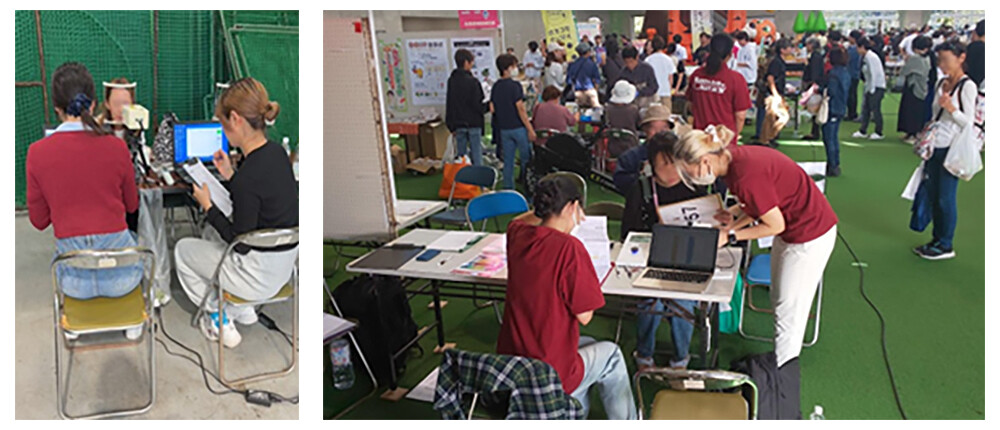 Figure 3: Demonstration Experiment at the Kumejima Industry Festival
As a specific example, initiatives will promote community revitalization through sports, contributing to both health and tourism. At the Kumejima Industry Festival in December 2025, preliminary surveys were conducted, including measurements of facial blood flow and skin moisture levels of residents (Figure 3). In the future, the initiative aims to provide feedback on how ultraviolet exposure affects different areas of the face and various indicators, contributing to improved skin and facial protection.
The realization of the BlueSphere Model will be further accelerated by digital twin technologies under the IOWN initiative promoted by NTT. By integrating diverse data obtained from field demonstrations in the areas of energy, food, and the environment, the parties will construct a "regional environmental digital twin" that reproduces the conditions of Kumejima Town in virtual space.
In addition, the parties will explore the use of compact data centers, including container-type data centers, and consider distributed data centers across remote islands connected via IOWN APN*5. These efforts will contribute to disaster recovery (DR)*6 measures utilizing island regions and to the realization of sustainable data centers. The initiative will also examine the use of ocean thermal energy conversion (OTEC) and deep ocean water for data center energy and cooling systems, while linking with food and energy self-sufficiency efforts to create new industries and validate business models.
Waseda University brings strengths not only in science and engineering fields such as nano-energy, quantum/ICT, and engineering, but also in the humanities and social sciences, including political science, economics, law, business administration, literature, and linguistics. It is expected to contribute to the social implementation of research outcomes through interdisciplinary collaboration. NTT is advancing research and development of next-generation communication infrastructure based on photonics and information processing technologies under the IOWN initiative.
By leveraging their respective strengths, NTT and Waseda University will collaborate with Kumejima Town to promote research aimed at achieving food and energy self-sufficiency across the entire island. Furthermore, they will work toward solving broader social challenges, including health and medical care, through interdisciplinary approaches that incorporate insights from economics, finance, and marketing to support real-world implementation.
Expected Outcomes
The initiative is expected to deliver the following outcomes:
- Agriculture and Fisheries: By leveraging future forecasting to adapt to changing environmental conditions and maximizing the use of local resources such as deep ocean water and biomass, the initiative will enhance food productivity and enable higher value-added production.
- Energy: Through the realization of an energy self-sufficient EIC, the initiative aims to achieve 100% renewable energy and uninterrupted power supply, contributing to grid stability and the decarbonization of the entire island.
- Sports and Health: The initiative will help address challenges such as shortages of healthcare professionals, the aging of workers in primary industries, and increasing healthcare and long-term care burdens associated with an aging population, while contributing to healthy longevity.
- Economy and Employment: By fostering the creation of new businesses and advancing existing industries, the initiative will generate diverse employment opportunities that are attractive to younger generations.
In addition, this initiative goes beyond conventional research by promoting the integration of primary, secondary, and tertiary industries with tourism, education, IT, and big data, advancing a "seventh-sector industrialization" model. Through efforts such as building regional brands around traditional local products like soybeans, rice, and tea, creating new restaurant businesses, and developing local innovation talent, the initiative will contribute to the sustainable development of the community and help address labor shortages caused by population decline in Kumejima Town.
Roles of Each Party in the Comprehensive Partnership
- NTT: Research and development in the fields of food, energy, sports, and quantum technology; provision of IT technologies based on the IOWN initiative; provision of technologies for assessing interactions between the natural environment and local communities using a regional environmental digital twin; and provision of crop breeding technologies to support adaptation to future environmental conditions.
- Waseda University: Research and development in the fields of food (including the application of results from the Moonshot Agriculture, Forestry and Fisheries R&D Program), energy, sports, and quantum technology; provision of expertise in finance, economics, and marketing; and promotion of research, education, and human resource development through academic exchange.
- Kumejima Town: Provision of demonstration and experimental fields; coordination with relevant stakeholders; promotion of community engagement and participation in demonstration projects; and provision of data related to electricity, agriculture, forestry, and fisheries.
Future Initiatives
Going forward, the parties will establish the effectiveness of the "BlueSphere Model" through demonstration projects in Kumejima Town while co-creating a community-based social system through ongoing dialogue with residents. In the future, they aim to disseminate the outcomes from Kumejima Town as a pioneering model for addressing common challenges faced by island communities worldwide.
This initiative will deepen collaboration among NTT, Waseda University, Kumejima Town, and other stakeholders, while also considering alignment with national-level programs. The goal is to achieve operational self-sufficiency within five years. Beyond demonstration experiments, the parties will establish sustainable business frameworks and create new employment opportunities, thereby contributing to regional revitalization.
Related Announcements
- June 5, 2024
"Fostering "Love of the Earth" and Realizing a Sustainable Society through Protective and Proactive Sustainability"
– Start of joint research based on a shared vision between Waseda University, IOWN, NTT –
https://group.ntt/en/newsrelease/2024/06/05/240605a.html
[Glossary]
*1BlueSphere Model:
This name refers to a conceptual social model and is not a service name.
*2Ocean Thermal Energy Conversion (OTEC):
A form of renewable energy generation that converts the temperature difference between warm surface seawater heated by solar energy and cold deep seawater into electricity using a turbine generator.
http://otecokinawa.com/en/OTEC/index.html
*3Energy Informatics Cell (EIC):
A concept for achieving energy self-sufficient cells (such as villages or districts) by controlling energy generation (renewables), consumption (loads), and storage (batteries) through communications technologies.
*4IOWN (Innovative Optical and Wireless Network):
A next-generation communications infrastructure concept promoted by the IOWN Global Forum, a global organization advancing the development of IOWN technologies and use cases.
https://iowngf.org/
*5 All-Photonics Network (APN):
A network architecture that introduces photonics-based technologies into everything from devices to networks and aims to realize extremely low power consumption, high speed, high capacity, and low latency transmission through wavelength networks that provide end-to-end optical wavelength paths.
■ What is the All-Photonics Network?
https://group.ntt/en/group/iown/function/apn.html
*6Disaster Recovery (DR):
The restoration and recovery of systems, or the systems themselves, when continued operation becomes impossible due to disasters such as earthquakes or tsunamis.
About NTT
NTT is a leading global technology innovator, providing a broad range of services to both consumers and businesses. As a mobile operator and provider of infrastructure, networks, and services, NTT is dedicated to promoting a sustainable future through cutting-edge innovations. Our portfolio includes business consulting, AI-powered solutions, application services, global networks, cybersecurity, data center and edge computing, all supported by our deep global industry expertise. Generating over $90 billion in revenue and employing 340,000 professionals, we allocate 30% of our annual profits to fundamental research and development. With operations spanning more than 70 countries and regions, our clients include over 75% of Fortune Global 100 companies, alongside thousands of enterprises, government organizations, and millions of consumers.
Media Contacts
NTT, Inc.
NTT Information Network Laboratory Group
Public Relations
Inquiry Form
Kumejima Town
Planning and Finance Division
TEL: 098-985-7122
FAX: 098-985-7080
Email: kizai@town.kumejima.lg.jp
Waseda University
Waseda Center for a Carbon Neutral Society
Inquiry Form: https://my.waseda.jp/application/noauth/application-detail-noauth?param=HRECSE5ovYav0O0FIOasQw
Information is current as of the date of issue of the individual press release.
Please be advised that information may be outdated after that point.


NTT STORY
WEB media that thinks about the future with NTT