Microsoft ends support for Internet Explorer on June 16, 2022.
We recommend using one of the browsers listed below.
- Microsoft Edge(Latest version)
- Mozilla Firefox(Latest version)
- Google Chrome(Latest version)
- Apple Safari(Latest version)
Please contact your browser provider for download and installation instructions.



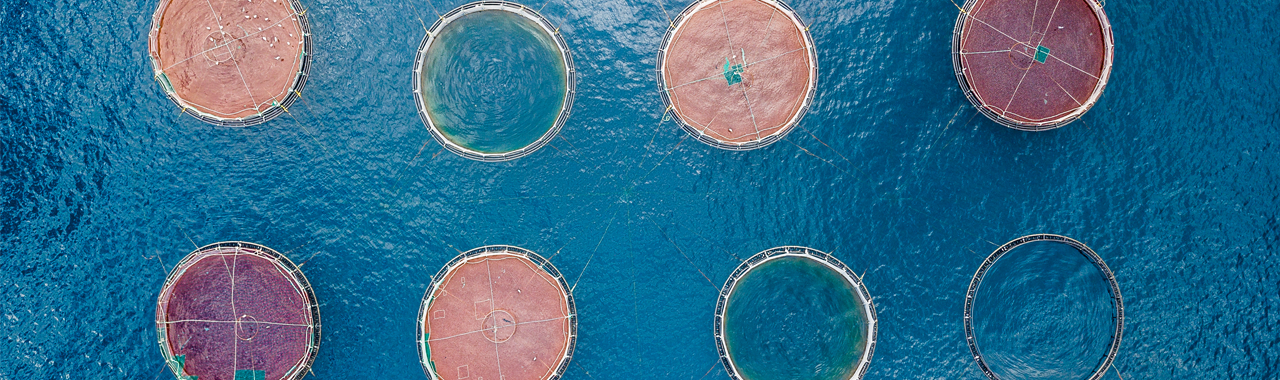
Salmon for dinner tonight. Nice and simple, maybe grilled and served with a bit of butter and soy sauce. Delicious.
As you eat your dinner, your mind starts to wander. What do farmed fish eat? Do we actually feed them?
So, to answer your question, yes, we do feed them. But that’s not the question you should be asking. What you should be asking is: do we feed them sustainably? The answer may disappoint you.
Fish Eating… Fish
Much of the feed used in fish farming still contains fishmeal and fish oil produced from small, wild-caught fish. As the world's population grows and seafood consumption continues to rise, aquaculture has become increasingly important and now supplies around 60% of the world's seafood. But the industry depends heavily on harvesting wild fish to feed farmed fish. That’s why finding a more sustainable alternative has become an important goal for researchers.
Here’s one possible solution: microscopic algae known as diatoms.
Diatoms?
Diatoms are single-celled algae that live naturally in oceans and freshwater. Although tiny enough to be almost invisible, they have long been used as feed for shellfish and fish larvae in aquaculture. They also produce fatty acids, molecules that are essential for healthy growth and development.
Among these are DHA and EPA, two omega-3 fatty acids that are particularly important in aquaculture. Diatoms also produce other fatty acids that contribute to growth, immunity and normal physiological function. The problem is that naturally occurring diatoms just don’t produce enough of these nutrients to replace fish-derived feed ingredients on a commercial scale.
Which makes you think: just breed a diatom that produces more DHA and EPA. Right?
But it’s not as simple as you might think.
Boosting DHA and EPA
The different fatty acids inside a cell are produced through interconnected biological pathways. Increasing one often causes another to decrease, making it difficult to improve the algae's overall nutritional value. Previous breeding approaches have focused on boosting individual fatty acids, sometimes at the expense of the overall nutritional balance needed for aquaculture feed.
Researchers at NTT are taking a different approach.
Rather than trying to maximize a single nutrient, they are aiming to increase several important fatty acids at the same time while still maintaining a balanced nutritional profile.
A Different Type of Breeding
The research team has been working with Chaetoceros gracilis, a marine diatom already widely used in aquaculture. They first exposed large populations of the algae to neutron irradiation, producing a population of cells with different characteristics. They then used an NTT-developed screening method to identify the rare cells with the highest overall fatty acid content, rather than looking for increases in just one nutrient.
And it worked. The resulting strain showed simultaneous increases in DHA, EPA and several other important omega-3 and omega-6 fatty acids. Both DHA and EPA increased by around 1.8 times, while three other key fatty acids also rose significantly.
Mutation Breeding
Another interesting aspect of the research is the breeding method itself. Although the algae were deliberately improved, the researchers didn’t use genetic modification. Instead, they used mutation breeding and then selected the strains with the characteristics they were looking for. This means that the resulting strain is not subject to regulations governing genetically modified organisms in Japan, which could make future commercialization more straightforward.
NTT’s immediate goal is to develop more sustainable aquaculture feed that relies less on fishmeal and fish oil. Looking further ahead, the research team believes the same breeding technology could be applied to other species of microalgae to produce high-value materials for nutritional supplements, agriculture and industry.
NTT’s research began with a single species of algae. But more than that, it has demonstrated a breeding platform that could help develop a new generation of sustainable biological materials for a wide range of applications.
Will that make your salmon dinner taste and feel a bit more wholesome next time?
Innovating a Sustainable Future for People and Planet
For further information, please see this link:
https://group.ntt/en/newsrelease/2026/07/07/260707a.html
If you have any questions on the content of this article, please contact:
Public Relations
NTT Information Network Laboratory Group
https://tools.group.ntt/en/news/contact/index.php

Daniel O'Connor
Daniel O'Connor joined the NTT Group in 1999 when he began work as the Public Relations Manager of NTT Europe. While in London, he liaised with the local press, created the company's intranet site, wrote technical copy for industry magazines and managed exhibition stands from initial design to finished displays.
Later seconded to the headquarters of NTT Communications in Tokyo, he contributed to the company's first-ever winning of global telecoms awards and the digitalisation of internal company information exchange.
Since 2015 Daniel has created content for the Group's Global Leadership Institute, the One NTT Network and is currently working with NTT R&D teams to grow public understanding of the cutting-edge research undertaken by the NTT Group.
Related Article

Recommended Article
-

March 14, 2024
What is NTT's GX? Our solution brand "NTT G×Inno"
-

March 5, 2024
[Press Conference Information] Launch of "NTT G×Inno," a New Solution Brand to Strengthen Efforts in the GX Field
-

January 15, 2024
Digitization and Digitization for Smart Agriculture
-

November 17, 2023
Realizing a Recycling-Oriented Society through a Data Mining Approach
Search by Tags