Microsoft ends support for Internet Explorer on June 16, 2022.
We recommend using one of the browsers listed below.
- Microsoft Edge(Latest version)
- Mozilla Firefox(Latest version)
- Google Chrome(Latest version)
- Apple Safari(Latest version)
Please contact your browser provider for download and installation instructions.



When you select a year, you can see the list of articles for the selected year.
May 8, 2026
CEO Press Conference
Financial Results for the Fourth Quarter of FY2025 ended March 31, 2026
Representative Member of the Board, President and CEO Akira Shimada
(Attendees)
Senior Vice President, Head of Finance and Accounting Toshihiko Nakamura
Senior Vice President, Head of Corporate Strategy Planning Akitoshi Hattori
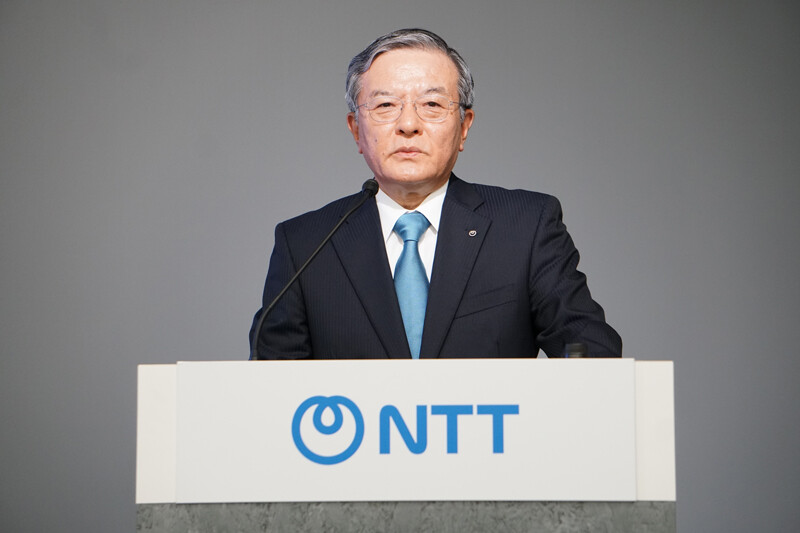


(President Shimada)
I would like to explain our financial results for fiscal year 2025 and our earnings forecast for fiscal year 2026. Following the review of our financial results, I will discuss our initiatives aimed at driving medium-term profit growth.
First, let me explain our consolidated financial results for fiscal year 2025. Revenue and profit both increased year on year, and operating revenue reached a record high.
Operating revenue increased by ¥704.4 billion year on year to ¥14.4091 trillion, driven by the expansion of enterprise businesses across the Group, growth in the Smart Life business, and increased revenue associated with the REIT conversion of data centers.
With regard to profit, although NTT DOCOMO made investments to strengthen its customer base and implemented measures to improve mobile network quality, EBITDA increased by ¥184.0 billion year on year to ¥3.4233 trillion, supported by profit growth resulting from the expansion of enterprise businesses across the Group, increased earnings from the Smart Life business, and the REIT conversion of data centers. Operating profit increased by ¥56.7 billion year on year to ¥1.7062 trillion. Profit attributable to NTT increased by ¥37.0 billion year on year to ¥1.0370 trillion, mainly due to the increase in operating profit.
Next, I will explain revenue and profit by segment.
In the Integrated ICT Business Segment, although the consumer communications business declined due to lower mobile communications service revenue, revenue increased year on year due to growth in the Smart Life business, particularly financial services, and growth in the enterprise business. Although the Smart Life business and enterprise business recorded profit growth, profit declined year on year due to cost investments associated with initiatives to strengthen the customer base and improve network quality. As a result of our efforts to strengthen the customer base, MNP improved compared with the previous year and was positive except in the second quarter, which was affected by the discontinuation of low-data-allowance plans.
In the Global Solutions Business Segment, foreign exchange fluctuations had a negative impact of approximately ¥35.0 billion on revenue. However, revenue and profit increased year on year due to business growth both in Japan and overseas, as well as contributions from the REIT conversion of data centers.
In the Regional Communications Business Segment, although revenue from legacy businesses declined, revenue and profit increased year on year due to growth in enterprise business revenue and optical business revenue. In addition, net additions of optical services increased year on year due to strengthened sales of 10 Gbps plans and building-wide subscription plans for condominium properties.
In Other Businesses (Real Estate, Energy and Others), although the housing business at Urban Solutions expanded, profit declined year on year due to the recognition of impairment losses at Anode Energy reflecting changes in the external environment, including rising interest rates and construction costs. As a result, revenue increased while profit decreased year on year.
Next, I would like to explain our earnings forecast for fiscal year 2026.
For fiscal year 2026, we are forecasting year-on-year growth in revenue, EBITDA, and operating profit, while profit attributable to NTT is expected to decline year on year.
We are planning for revenue growth across all segments, led by the Integrated ICT Business and Global Solutions Business Segments, and we would like to achieve another record high in operating revenue. Although network revenue is expected to continue declining, we are forecasting year-on-year growth in EBITDA and operating profit due to the expansion of the enterprise business and the Smart Life business, particularly financial services. As for profit attributable to NTT, we are forecasting a year-on-year decline due to factors including higher interest expenses.
Turning to revenue and profit by segment, in the Integrated ICT Business segment, although mobile communications service revenue is expected to decline, revenue is expected to increase year on year due to the expansion of the Smart Life business, particularly financial services, and growth in the enterprise business. As for profit, we would like to maintain it at roughly the same level as the previous fiscal year. At the same time, we will continue to strengthen initiatives aimed at improving network quality. On the sales side, we intend to build a strong customer base centered on long-term users through initiatives such as acquiring subscribers to DOCOMO MAX.
In the Global Solutions Business Segment, although revenue and profit growth driven by business expansion in Japan and overseas is expected to continue, profit is expected to decline year on year due to factors including the absence of the positive impact from the data center REIT conversion implemented in the previous fiscal year.
In the Regional Communications Business Segment, although revenue from legacy businesses is expected to decline, revenue and profit are expected to increase year on year due to growth in optical service revenue and lower costs resulting from the reversal of burden-reduction measures implemented in Western Japan in the previous fiscal year.
In Other Businesses (Real Estate, Energy and Others), we are planning for year-on-year growth in both revenue and profit due to revenue growth from the expansion of the data center engineering business at Urban Solutions, as well as the absence of impairment losses recognized by Anode Energy in the previous fiscal year.
Next, I would like to explain shareholder returns. At today's Board of Directors meeting, we resolved to set the year-end dividend for fiscal year 2025 at ¥2.65 per share, in line with our dividend forecast. We also resolved to set the annual dividend forecast for fiscal year 2026 at ¥5.40 per share, an increase of ¥0.10 from the previous fiscal year. As a result, we are planning to increase dividends for the 16th consecutive year since fiscal year 2011. In addition, in order to improve capital efficiency and further enhance shareholder returns, we resolved to repurchase our own shares with a maximum acquisition amount of ¥200 billion.
Next, I would like to explain our initiatives aimed at driving medium-term profit growth. The agenda is as shown.
First, I would like to explain the revision of our medium-term financial targets aimed at driving medium-term profit growth. With regard to our current medium-term financial target of achieving EBITDA of ¥4 trillion in fiscal year 2027, profits in our growth areas have expanded steadily through proactive investments and the realization of their benefits. On the other hand, in our existing businesses, profits have declined as we responded to changes in the business environment, including efforts to strengthen the customer base and increases in traffic volume. As a result, consolidated EBITDA has fallen below the level we had anticipated, and it has become difficult to achieve our fiscal year 2027 target.
In light of these changes in the business environment, we will redefine what we previously referred to as our Growth Areas as the Value Domain, placing AI, where further business expansion can be expected, at the center of this domain and driving significant profit growth. At the same time, as a near-term initiative, we will rename our Existing Businesses as the Connectivity Domain and, while maintaining cash generation capability through profit stabilization, transform them into the AI-native infrastructure platform AIOWN. Through the combined contributions of the Value Domain and the Connectivity Domain, we aim to achieve EBITDA of ¥4 trillion in fiscal year 2030.
In addition, in areas where future growth is expected, we will continue strategic upfront investments in order to realize sustainable profit growth.
Next, I would like to explain seven specific initiatives across three categories: the Value Domain, the Connectivity Domain, and strategic upfront investments for continued growth, all aimed at achieving EBITDA of ¥4 trillion in fiscal year 2030.
First, I will explain the three initiatives in the Value Domain.
The first initiative is the expansion of our domestic enterprise business through maximizing customer value. As AI advances rapidly, business models are expected to shift from traditional models that depend on human resources to models centered on the value delivered to customers. In response to this change, we will deploy human resources created through AI adoption at NTT DATA to customers of NTT DOCOMO Business, which has a broader customer base than NTT DATA. This will enable us to provide higher value-added integration services to a larger number of customers. In addition, by combining the products and services of NTT DATA and NTT DOCOMO Business and providing sovereign-compliant full-stack AI solutions, we will expand businesses that are driven by customer value. Through these initiatives, we aim to achieve EBITDA of ¥1.21 trillion in our domestic enterprise business by fiscal year 2030.
Next, I would like to explain the acceleration of overseas business growth centered on AI and data centers. In the IT services business, we will create AI-native businesses utilizing NTT DATA AIVista while promoting inorganic capability expansion, particularly in AI-related areas. In the data center business, in light of strong demand, we will continue growth investments focused on cloud and AI inference, primarily targeting hyperscale customers. Through these initiatives, we aim to achieve EBITDA of ¥600 billion in our overseas enterprise business by fiscal year 2030.
As the third initiative, I would like to explain the further expansion of our personal business centered on financial services. Centered on NTT DOCOMO Financial Group, which is scheduled to be established in July this year, we will grow our financial customer base through payment and banking services and expand revenue by promoting the use of investment, lending, and other financial services. In addition, by combining AI with usage data from d ACCOUNT members, one of the largest membership bases in Japan, and the vast amount of data generated daily across our networks, we will strengthen the competitiveness of personal agents and marketing solutions. Through these initiatives, we aim for financial services to become the primary growth driver of the Smart Life business and contribute EBITDA of ¥510 billion by 2030.
Next, I would like to explain our initiatives in the Connectivity Domain.
First, I would like to explain our vision for the transition to AI-native next-generation infrastructure. Going forward, AI computing workloads are expected to shift from being centered on training to being centered on real-time inference. At the same time, communications will expand beyond person-to-person interactions to machine-to-machine, AI-to-AI, and robot-to-robot communications, resulting in an explosive increase in transactions. In response to these changes, NTT will optimize various resources, including GPUs, networks, and power, and realize the transition to AIOWN, an AI-native infrastructure platform that provides secure environments extending to the edge and integrated operations. Through this transition, we aim to pursue full-scale business deployment.
Next, I would like to explain our initiatives to realize the AI-native next-generation infrastructure, AIOWN. Under the IOWN concept, we have been working on the social implementation of the All-Photonics Network (APN) and photonics-electronics convergence devices. We will expand IOWN APN to all prefectural capitals by fiscal year 2027 in line with equipment renewal cycles for existing services. Looking toward 2030, we aim to expand nationwide as demand emerges across various industries. In addition, by collaborating with a wide range of partners that possess strengths and competitiveness in their respective fields, we will expand the ecosystem surrounding photonics-electronics convergence devices and accelerate the social implementation of IOWN.
Next, I would like to explain our near-term initiative in the Connectivity Domain, maintaining cash generation capability through profit stabilization in the telecommunications business. In the consumer communications business, we aim to maintain profit levels by strengthening customer touchpoints, enhancing products and services, maintaining subscriber numbers, improving ARPU, and increasing productivity through AI utilization.
In the regional communications business, despite declining revenue from legacy services such as fixed-line telephony, we will secure stable profits through AI-driven operational transformation and by strengthening our optical business, enterprise business, and new business areas. In addition, with regard to the migration to alternative services using optical and mobile technologies for fixed-line telephone services, which began in certain areas in April this year, we will continue to provide careful support to ensure a smooth transition.
Finally, I would like to explain our strategic upfront investments for continued growth. As new business areas, we will focus on Mobility, Space, and Photonic Quantum Computing and work toward early commercialization. In the mobility field, we will expand services such as autonomous driving support through NTT Mobility and accelerate initiatives aimed at realizing infrastructure-coordinated mobility AI platforms in collaboration with Toyota Motor Corporation. In the space field, we will establish communications and observation technologies utilizing IOWN technologies and build social infrastructure that integrates space and terrestrial environments, with a focus on disaster prevention and national security. In the field of photonic quantum computing, we will collaborate with OptQC to develop one of the world's leading photonic quantum computers and pursue early commercialization. By continuing strategic growth investments in these areas, we will strive to achieve sustainable profit growth beyond fiscal year 2030.
Our medium-term financial targets are as shown. As I mentioned earlier, we aim to achieve EBITDA of ¥4 trillion by fiscal year 2030 as our primary financial target. In addition, we will establish a ROIC target excluding financial services and work to improve capital efficiency. There will be no changes to our sustainability-related non-financial targets.
With respect to shareholder returns, we will maintain our current policy, under which continuous dividend growth remains our basic approach, while improving capital efficiency through flexible share repurchases.
Although interest-bearing debt has increased recently due to growing funding requirements, we intend to maintain an appropriate level of financial soundness over the medium term. By fiscal year 2030, we aim to reduce the ratio of interest-bearing debt to EBITDA, excluding financial services, to approximately 3.5 times through enhanced cash generation. EBITDA by business segment is shown.
Finally, following this revision, the NTT Group's medium-term management strategy will move forward under the banner of "New Value Creation & Sustainability 2030 powered by 'A'IOWN."
This concludes my presentation. Thank you very much.
Q&A Session
-
Regarding the forecast decline in profit attributable to NTT next fiscal year and the postponement of the medium-term financial targets, I believe NTT DOCOMO's weak performance is one of the reasons. Could you share your view of NTT DOCOMO's current situation and performance, and tell us which areas you would particularly like to focus on going forward in order to achieve a recovery?
It is true that changes in the mobile business environment led us to revise the medium-term financial targets this time. Over the past several years, NTT DOCOMO has been making investments to strengthen its customer base and improve quality, and as a result profits have declined somewhat.
In this earnings forecast, while there are factors that will reduce profit in the consumer business itself, we expect those impacts to be covered by profit growth in the enterprise business and Smart Life business, resulting in overall positive growth. In that sense, I think it is fair to say that we have hit the bottom.
We would like to launch a turnaround from here. However, I believe that we have fallen behind by at least about two years. -
Could you explain the impact that rising costs may have on the NTT Group? Interest rates are trending upward, and with the worsening situation in the Middle East, inflation is expected to accelerate. How do you see these factors affecting the NTT Group in fiscal year 2026? In particular, I believe rising electricity costs, equipment costs, and labor costs are areas of concern. I would appreciate your views on this.
As you pointed out, I can only hope that peace returns to the Middle East as soon as possible. However, when considering the risks, I believe the impact of developments in the Middle East is significant.
With regard to electricity, we cannot afford to be optimistic. However, power generation is primarily based on LNG, and oil is used very little for electricity generation. In that sense, I believe the impact may be somewhat limited, but it is something we need to monitor carefully.
In addition, not only energy costs but also labor costs and facility-related costs are rising. Our current medium-term management strategy does not incorporate price increases or cost pass-through measures. Since costs are increasing, we will need to consider how and when those costs should be borne by customers. However, such measures are not reflected in our current plan. -
IOWN has been positioned as a focus area in your medium-term management strategy. Part of it may already be included in the existing data center business, but could you provide any quantitative information regarding its contribution to revenue growth or incremental revenue? Also, with regard to the new target of achieving EBITDA of ¥4 trillion by fiscal year 2030, could you tell us what portion is expected to come from IOWN?
It is difficult for me to quantify the revenue impact of IOWN. As for IOWN 1.0, as I mentioned earlier, it has already been incorporated into APN and has begun operation, so it will be deployed as infrastructure and monetized over time.
As for photonics-electronics convergence devices, there has been a great deal of news recently, and I believe we are finally reaching the point where the industry must transition to optical devices. I see fiscal years 2026 and 2027 as the starting point of that transition.
There are various estimates regarding the size of the optical device market, but it is generally said to be around ¥1 trillion in the near term. We would first like to secure an appropriate share of that market. In any case, this is still an emerging market, and we intend to make a strong commitment to photonics-electronics convergence devices. In that sense, we would like to ensure that meaningful revenue begins to materialize toward the latter stages of this medium-term management strategy.
I believe digital twins will develop in a similar manner, and going forward the market for AI-enabled digital twins is likely to expand. Since IOWN consists of those three components, I believe the revenue contribution is still ahead of us. -
Regarding photonics-electronics convergence, overseas players appear to be becoming increasingly aggressive, with companies such as NVIDIA announcing investments one after another. Given that data center operators and semiconductor companies ultimately decide which devices to adopt, what position is NTT aiming to establish in the photonics-electronics convergence device market, and what is your strategy?
I believe the primary users of photonics-electronics convergence devices will likely be hyperscalers. Both the hyperscalers themselves and the various vendors surrounding them have begun making efforts based on the belief that the era of optics is coming.
With respect to the products developed by NTT Innovative Devices, they are already functioning in practice. The reality is that there are still very few products operating in the market today. In that sense, although I cannot be specific, there are parties that have already evaluated our technology, and we intend to establish a strong position in the market. -
It was announced that NTT Executive Vice President Hiroi will become President of NTT DOCOMO Financial. Financial services are expected to be a growth area under the medium-term management strategy. Could you explain the rationale behind this appointment?
As I mentioned earlier when discussing the revision of our medium-term financial targets, we plan to grow the financial services business by approximately three times on an EBITDA basis by fiscal year 2030. It will therefore become one of our key growth drivers.
Mr. Hiroi has extensive expertise in the financial sector, which is why we selected him for the position. -
It was also announced that NTT DATA Group President Sasaki will succeed NTT Executive Vice President Hiroi. Could you explain the rationale behind that appointment?
With respect to expanding our domestic enterprise business, there are approximately 2,000 companies in Japan with annual revenue of more than ¥100 billion. Of those, NTT DATA serves approximately 500 companies, while roughly 90% are customers of NTT DOCOMO Business. NTT DOCOMO Business also generates a similar level of revenue from major corporate customers.
In that sense, NTT DATA has very deep relationships with the customers it serves. While there is some overlap, so the numbers cannot be viewed in simple terms, NTT DATA still has at least three times the market opportunity remaining. Unfortunately, we have not always been able to secure sufficient resources to support those customers, which has been a challenge.
By making even greater use of AI, we believe it will become possible to secure additional systems engineering capacity and expand our business to customers that we have not previously been able to serve. I expect Mr. Sasaki to lead those efforts.
He understands the business better than anyone, and it is also critically important to determine how we connect our domestic and global businesses. Since this would be difficult to accomplish from within NTT DATA alone, we wanted him to join the holding company and drive these initiatives forward. -
In the medium-term management strategy announced in 2023, you referred to ¥8 trillion in growth investments. The current announcement does not include a specific investment amount. What scale of investment are you considering, and is there a reason why no figure was included?
There is no particular reason why the figure was not included. To explain verbally, we are planning to invest approximately ¥12 trillion between 2026 and 2030.
Of that amount, we expect to invest approximately ¥7.5 trillion to ¥8 trillion in the Value Domain. For the Connectivity Domain, because we need to transform the infrastructure foundation, we plan to invest approximately ¥4 trillion to ¥4.5 trillion. In total, we are assuming investment of around ¥12 trillion. -
Regarding the financial results, operating profit is expected to remain essentially flat while net profit is projected to decline. Could you explain why profit attributable to NTT is expected to decrease?
Debt has increased somewhat, and interest payments are becoming more of a burden.
That said, we intend to manage the business in a way that increases operating profit as much as possible and avoids a decline in profit attributable to NTT. While our current forecast assumes lower profit attributable to NTT at the bottom line, we will work hard to deliver profit growth. -
I would like to ask about the mobility, space, and photonic quantum computing fields that were identified as areas for early commercialization. Some of these can potentially be pursued independently, while others, particularly in the space sector, appear difficult to realize without collaboration. Could you share your vision for future partnerships in these areas?
In order to further increase communications capacity in space, I believe it will be necessary to introduce optical communications technologies, such as optical data relay, into the space domain.
In this area, we have established a joint venture with Sky Perfect JSAT called Space Compass, which will take the lead in promoting these initiatives. Naturally, this cannot be achieved by those two companies alone, so we intend to collaborate with satellite-related companies and hardware vendors that provide equipment necessary for optical communications, and build a strong ecosystem.
In addition, NTT DATA has established a company called Marble Visions, which provides Earth observation satellite services. In any case, it would be difficult for the NTT Group to develop the space business entirely on its own, and we intend to move forward through collaboration with a wide range of companies. -
Regarding the expansion of the domestic enterprise business, you mentioned providing sovereign-compliant full-stack AI solutions. It sounded as though financial institutions may be a target market. Do you have any specific targets for the financial sector?
At present, we do not have any specific targets for financial institutions.
Of course, financial institutions are one of the sectors we have in mind when discussing sovereign solutions. However, government agencies, public-sector organizations, local governments, and private enterprises also have needs to ensure that data specific to their organizations does not leave their control. In that sense, we would like to develop sovereign AI solutions that address the needs of a broad range of industries. -
Are you considering REIT conversion of any domestic assets other than data centers?
We would like to add our domestic data centers to the Singapore REIT that we established. The REIT we launched last year mainly consists of data centers in Singapore and the United States, and as an NTT Group REIT, I believe it should also include assets in Japan and data centers in Europe.
I believe investors would welcome such developments, and we would like to pursue those initiatives going forward. Last year represented the initial launch, so it was executed on a relatively large scale. However, we intend to continue contributing assets to the REIT on an ongoing basis.
END
Corporate


NTT Group Medium-Term Management Strategy
NTT STORY
WEB media that thinks about the future with NTT