Microsoft ends support for Internet Explorer on June 16, 2022.
We recommend using one of the browsers listed below.
- Microsoft Edge(Latest version)
- Mozilla Firefox(Latest version)
- Google Chrome(Latest version)
- Apple Safari(Latest version)
Please contact your browser provider for download and installation instructions.



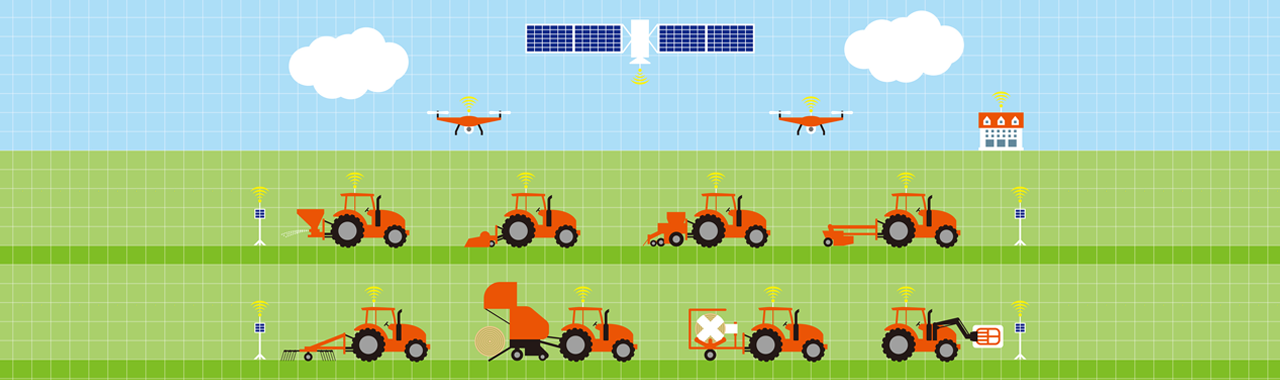
Farming. It’s something we’ve done for thousands of years—you could even make an argument that the start of agriculture was responsible for the coming together of people to form communities and cities before the beginning of recorded history.
Farming Relies on Technology
But if you thought of it as a traditional, unchanging part of our human tradition, you’d be wrong. Agriculture today relies heavily on modern technology and connectivity. Tractors stream positioning data, sensors monitor soil and crop conditions in real time, and farming equipment grows ever-more autonomous. Around the world, agricultural vehicles already operate with minimal human intervention.
… And Stable Networks
And that’s actually a problem: what happens when a wireless signal fails?
Signal failure is a regular difficulty for farms in mountainous or rural regions and it’s why NTT, Kubota, and NTT DOCOMO have been working together to come up with a solution.
The research partners focused on the remote operation of agricultural vehicles traveling between fields in hilly terrain, an environment where trees, ridges, and spotty cellular coverage can interfere with communications. Remote driving systems depend on continuous video feeds—operators have to be able to see roads, obstacles, surrounding conditions, and vehicle movement in real time. Think of it as trying to drive while looking through a live video call. Any kind of stutter or frozen image and safe operation gets tricky.
To tackle the problem, the team came up with an assumption that might surprise you: communications instability is an unavoidable rule rather than an exception.
Instability is the Default
Taking instability as a given, the partners realized that instead of relying on a single connection, the project would have to combine conventional mobile communications with satellite connectivity. When terrestrial networks weakened, satellite communications could help maintain continuity.
Predicting Wireless Quality
The system also used an NTT-developed technology called Cradio, which predicts wireless quality before conditions deteriorate severely. Rather than waiting for a connection to fail and then reacting to it, the system was set up to anticipate degradation in advance and distribute data traffic across multiple communication paths accordingly. Data could then be directed across mobile and satellite links in the most effective way for current conditions.
The project also addressed another practical issue: video transmission uses up enormous amounts of bandwidth. When communications weaken, traditional systems will typically compress the entire image uniformly, reducing overall quality. But that doesn’t make sense; some parts of a remote driving image are far more important than others. A tree way off in the background matters less than a pedestrian, an approaching vehicle, or the edge of a narrow mountain road.
Focusing on What’s Important
To deal with this, the research partners used dynamic image control technology that prioritizes visually important regions within the video feed. In practice, it means that critical areas required for remote driving remain sharp and clear, while less important areas are compressed more aggressively. It’s all about preserving the operator’s ability to drive safely under changing network conditions.
Based on the results of their testing, the partners believe the system is now usable at a practical level.
All Remote Operation Could Benefit
The technology’s potential is plain to see and not just confined to agriculture. Construction equipment, infrastructure inspection systems, remote industrial machinery, and disaster-response vehicles all have similar communication challenges. Many of them have to operate in places where networks are not always reliable. They could all benefit from a network environment where systems are able to adapt when connectivity fluctuates.
So it’s not just about operating tractors remotely; it’s about designing communication systems that can function reliably in imperfect real-world environments where signals fade, terrain gets in the way, and conditions are always changing. Network variability is assumed as the default, which helps to make it predictable and manageable.
Innovating a Sustainable Future for People and Planet
For further information, please see this link:
https://group.ntt/en/newsrelease/2026/05/25/260525b.html
If you have any questions on the content of this article, please contact:
Public Relations
NTT IOWN Integrated Innovation Center
https://tools.group.ntt/en/news/contact/index.php

Daniel O'Connor
Daniel O'Connor joined the NTT Group in 1999 when he began work as the Public Relations Manager of NTT Europe. While in London, he liaised with the local press, created the company's intranet site, wrote technical copy for industry magazines and managed exhibition stands from initial design to finished displays.
Later seconded to the headquarters of NTT Communications in Tokyo, he contributed to the company's first-ever winning of global telecoms awards and the digitalisation of internal company information exchange.
Since 2015 Daniel has created content for the Group's Global Leadership Institute, the One NTT Network and is currently working with NTT R&D teams to grow public understanding of the cutting-edge research undertaken by the NTT Group.
Related Article

Recommended Article
-

March 14, 2024
What is NTT's GX? Our solution brand "NTT G×Inno"
-

March 5, 2024
[Press Conference Information] Launch of "NTT G×Inno," a New Solution Brand to Strengthen Efforts in the GX Field
-

January 15, 2024
Digitization and Digitization for Smart Agriculture
-

November 17, 2023
Realizing a Recycling-Oriented Society through a Data Mining Approach
Search by Tags