Microsoft ends support for Internet Explorer on June 16, 2022.
We recommend using one of the browsers listed below.
- Microsoft Edge(Latest version)
- Mozilla Firefox(Latest version)
- Google Chrome(Latest version)
- Apple Safari(Latest version)
Please contact your browser provider for download and installation instructions.



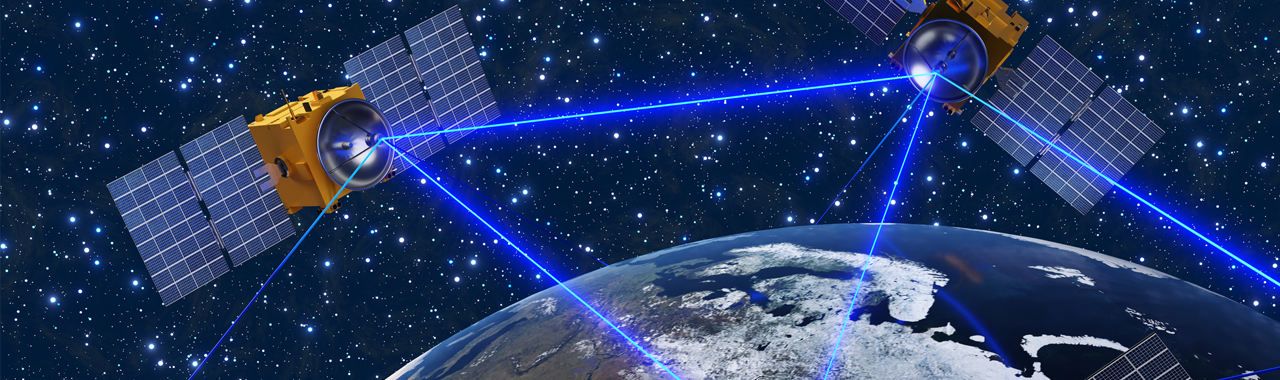
Satellites have become a crucial part of how the world stays connected.
Large groups of satellites, sometimes numbering in the thousands, have been launched to provide internet access, map the Earth, and support navigation services. As these networks grow, satellites need to talk to each other, not just to people on the ground. Finding a way to move massive amounts of data between them quickly has become a huge challenge.
The Limits of Radio
Historically, satellites have used radio signals to talk to one another. This makes sense, because radio is a proven technology that works over long distances. However, it also has its limits. There's only so much available radio spectrum, and as more and more satellites go up, they start to interfere with each other. To address the problem, researchers are exploring optical communication, which uses precise laser beams instead of radio waves.
Laser communication can carry much more data than radio. The main difficulty, however, is building equipment that can stay accurately aligned with a laser beam while satellites are moving at high speeds, all while processing a huge flow of information.
IOWN in Space?
NTT is exploring whether technology developed for terrestrial internet networks could also work in space. They are adapting tools from the Innovative Optical and Wireless Network (IOWN) initiative—which usually runs through fiber-optic cables on the ground—to see if they can work above the Earth.
One of the company's most important ideas is the Optical Inter-Satellite Link, or OISL. In NTT's proposed setup, satellites use laser transmitters and receivers called "optical terminals." These terminals send data across the vacuum of space using light, creating a high-speed bridge between satellites orbiting at different heights.
Digital Coherent Transmission
To reach these high speeds, researchers are using a method called digital coherent transmission. It's the same tech used in long-distance fiber-optic cables, but instead of just flickering light on and off, it encodes data using the light's wave shape and direction. On the receiving end, digital signal processing reconstructs the signal and corrects distortions. This kind of processing allows the system to carry much more data than standard light signals.
Using IOWN tech in space adds a new twist: speed. Because satellites fly so fast, the frequency of the light signal changes as they move toward or away from each other (the "Doppler effect"). If the system doesn't account for the shift, the connection breaks. A big part of NTT's research is making sure the hardware can automatically adjust to these shifts to keep the link stable.
The hardware itself is another hurdle. Satellite equipment has to be tiny and use very little electricity, because space and power are scarce on a spacecraft. To reduce size and power consumption, NTT is looking at integrating processors, optical circuits, and amplifiers into a single compact unit. By keeping these parts close together, the signal travels a shorter distance, which saves energy and makes the whole device lighter.
Everywhere is Connected
NTT's end goal is to have a layered communications network connecting ground stations, stratospheric platforms, and satellites in different orbital regions. For example, satellites orbiting 1,000 km up could beam data to geostationary satellites about 36,000 km above Earth. These laser links would allow data to zip through space before finally being sent down to users on Earth.
The technology is still being tested. NTT's current timeline suggests development over the course of 2026, with possible commercialization toward the end of the decade. It could potentially be used for the military, national defense, and global internet providers.
Satellite networks are changing fast, and the demand for data is only going one way: up. By taking advanced optical communication technology used on Earth and moving it into orbit, NTT researchers are working to create a fiber-optic network in the sky that links satellites in space, much as fiber-optic cables link networks on Earth.
NTT is moving the network into space.
Innovating a Sustainable Future for People and Planet
For further information, please see this link:
https://www.rd.ntt/forum/2025/doc/E09-e.pdf
If you have any questions on the content of this article, please contact:
NTT C89
https://tools.group.ntt/en/aerospace/contact/

Daniel O'Connor
Daniel O'Connor joined the NTT Group in 1999 when he began work as the Public Relations Manager of NTT Europe. While in London, he liaised with the local press, created the company's intranet site, wrote technical copy for industry magazines and managed exhibition stands from initial design to finished displays.
Later seconded to the headquarters of NTT Communications in Tokyo, he contributed to the company's first-ever winning of global telecoms awards and the digitalisation of internal company information exchange.
Since 2015 Daniel has created content for the Group's Global Leadership Institute, the One NTT Network and is currently working with NTT R&D teams to grow public understanding of the cutting-edge research undertaken by the NTT Group.
Related Article




Recommended Article
-

March 14, 2024
What is NTT's GX? Our solution brand "NTT G×Inno"
-

March 5, 2024
[Press Conference Information] Launch of "NTT G×Inno," a New Solution Brand to Strengthen Efforts in the GX Field
-

January 15, 2024
Digitization and Digitization for Smart Agriculture
-

November 17, 2023
Realizing a Recycling-Oriented Society through a Data Mining Approach
Search by Tags