Microsoft ends support for Internet Explorer on June 16, 2022.
We recommend using one of the browsers listed below.
- Microsoft Edge(Latest version)
- Mozilla Firefox(Latest version)
- Google Chrome(Latest version)
- Apple Safari(Latest version)
Please contact your browser provider for download and installation instructions.



When you select a year, you can see the list of articles for the selected year.
August 6, 2026
CEO Press Conference
Financial Results for the First Quarter of FY2026
Representative Member of the Board, President and CEO Akira Shimada
(Attendees)
Senior Vice President, Head of Finance and Accounting Toshihiko Nakamura
Senior Vice President, Head of Corporate Strategy Planning Akitoshi Hattori
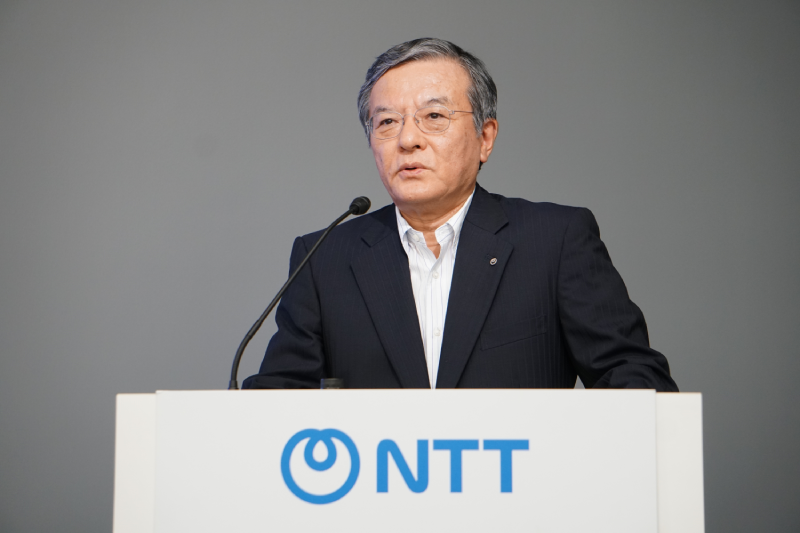


(President Shimada)
Thank you all for taking the time to join us today. I am Akira Shimada, President and CEO of NTT.
First, I would like to express my deepest sympathies to everyone affected by the recent Kumamoto Earthquake. Working closely with other telecommunications carriers and local governments, we are making every effort to restore communications infrastructure and provide support to the affected areas to help ensure the earliest possible recovery and reconstruction.
Mobile services were temporarily disrupted in two municipalities but were restored in approximately two days. During this period, we worked to maintain communications through measures including the rapid deployment of JAPAN Roaming. We are also continuing to provide support at evacuation centers through the "Tsunagu × Kaeru Project," in cooperation with other telecommunications carriers and battery manufacturers. We will continue to do everything we can to contribute to the earliest possible recovery and reconstruction.
I would now like to explain our financial results for the first quarter of fiscal 2026.
Consolidated results for the first quarter showed year-on-year increases in both revenue and profit, with operating revenues reaching a record high for a first quarter.
Operating revenues increased by ¥355.7 billion year on year to ¥3.6177 trillion, driven by business growth in Japan and overseas at the NTT DATA Group and an increase in Smart Life business revenues at NTT DOCOMO, particularly in the financial services area. Of this increase, approximately ¥75 billion was attributable to foreign exchange effects.
In terms of profit, although we increased costs to strengthen the customer base and improve mobile network quality at NTT DOCOMO, EBITDA increased by ¥34.8 billion year on year to ¥836.2 billion, mainly due to higher profits from the Smart Life business and business growth at the NTT DATA Group. Operating profit increased by ¥20.0 billion to ¥425.1 billion.
To achieve our full-year plan, we will continue working to expand our corporate business in Japan and overseas as well as our Smart Life business.
Profit attributable to shareholders increased by ¥15.1 billion year on year to ¥274.8 billion, mainly reflecting the increase in operating profit.
Next, I will explain revenue and profit by segment. All segments recorded year-on-year increases in both revenue and profit.
First, in the Integrated ICT Business segment, although we increased costs to strengthen the customer base and improve network quality, revenue and profit increased year on year, driven mainly by the expansion of the Smart Life business, particularly in financial services.
As a result of our efforts to strengthen the customer base, MNP performance has been strong and has improved from the previous year. ARPU has also improved, supported by strong sales of docomo MAX, and the year-on-year decline in mobile communications service revenues is steadily narrowing. We will continue our efforts to return to year-on-year revenue growth.
Next, the Global Solutions Business segment. Revenue and profit increased year on year, driven by business growth in Japan and overseas as well as foreign exchange effects.
In the Regional Communications Business segment, despite a decline in legacy business revenues, revenue increased year on year, mainly due to higher optical business revenues, while profit remained approximately at the previous year's level. Net additions for optical services were also approximately at the same level as the previous year.
Finally, in the Other segment, which includes real estate and energy businesses, revenue and profit increased year on year, mainly due to growth in the real estate business at NTT Urban Solutions.
Next, I would like to discuss four topics.
First, I will explain our global expansion of IOWN.
To further expand the IOWN business, we are accelerating its global deployment with support from governments.
In Chile, we have begun research and field trials aimed at improving and streamlining the remote operation of heavy machinery using APN to address challenges such as improving working conditions at copper mines operated by CODELCO, Chile's state-owned copper mining company.
In India, we have also begun a feasibility study on achieving significant power savings and reducing communication latency by deploying switches equipped with PEC-2, a photonics-electronics convergence device, at APN-connected data centers. This initiative is being pursued with partners including financial institutions, with the aim of enabling energy-efficient large-scale distributed processing.
Going forward, we will steadily expand use cases across a wide range of countries and industries and advance the social implementation of photonics-electronics convergence devices. Through these efforts, we aim to further accelerate the global expansion of IOWN.
Next, I will explain the provision of a distributed GPU test environment using the IOWN APN.
In July, we began providing the GPU over APN Testbed, a nationwide, wide-area distributed GPU test environment using APN. This provides a collaborative environment where customers can experience the use of distributed GPU resources.
By combining the low latency and high-capacity communications provided by APN with GPUs distributed across eight locations nationwide, customers can test advanced AI workloads, including distributed AI training, distributed AI inference, and high-capacity data transfers between locations.
Through this test environment, we aim to accelerate the realization of AI-native infrastructure, AIOWN, by creating use cases and gaining insights through co-creation with customers.
Third, I would like to explain our initiatives toward sustainable operation of social infrastructure.
Social infrastructure, including water supply and sewerage systems and waste treatment facilities, is facing increasingly serious challenges such as aging facilities and labor shortages. New mechanisms are needed to ensure sustainable operation.
To address these challenges, in the water supply and sewerage sector, NTT is working with Metawater through a business partnership to improve operational efficiency through digital transformation of water purification plants and sewage treatment plants.
As part of this initiative, we have also acquired shares in Metawater with a view to establishing a long-term collaborative relationship.
Building on this initiative, we will expand our efforts into areas such as renewable energy, roads, and disaster prevention. By pursuing cross-sectoral and wide-area social infrastructure management, we aim to contribute to the development of sustainable social infrastructure together with local governments and communities.
As for our Medium-Term Management Strategy, the progress of our initiatives since May is as shown here.
That concludes my presentation. Thank you very much.
Q&A Session
-
NTT DOCOMO Financial Group was launched in July, and you mentioned that NTT DOCOMO's financial services business contributed to the company's results this quarter. Could you once again explain your expectations for NTT DOCOMO Financial Group?
NTT DOCOMO Financial Group was launched on July 1, creating a structure that enables us to provide comprehensive financial services spanning banking, securities, loans, and insurance.
Starting from this major milestone, we aim to build a platform that combines services such as d POINT to provide customers with high-quality financial services and develop them into a comprehensive financial services offering.
Among these businesses, banking is the largest. We recently changed the corporate name to docomo SMTB Net Bank. The brand name for banking services for individual customers is "docomo no Ginko," and expectations for docomo no Ginko are extremely high.
There are approximately 2,000 DOCOMO shops nationwide. As of the end of August, around 200 shops can provide support for opening bank accounts, and around 200 can provide support for securities accounts. In addition, approximately 80 locations outside DOCOMO shops are able to provide such support.
By the end of this fiscal year, we aim to enable approximately 1,000 DOCOMO shops to support the opening of bank accounts, with around half of those shops also able to provide support for securities accounts. We also intend to increase the number of franchise locations offering these services.
During this fiscal year, we aim to establish a solid network of staffed locations where customers can receive support. -
Regarding the impact of the Kumamoto Earthquake, it appears to have had a relatively limited impact compared with previous major earthquakes. Could you explain the factors that helped mitigate the impact? Also, four companies worked together on recovery efforts, including through JAPAN Roaming. Could you tell us what went smoothly operationally and whether there were any challenges that remain to be addressed?
The Kumamoto Earthquake first affected mobile networks. In the case of NTT DOCOMO, two cities were affected, but we were able to restore services within just two days by using measures including Starlink.
Normally, networks between prefectures and within prefectures have redundant routes. However, there are some locations where we are currently operating with only one route. In one case, cables had been routed across a bridge, and the bridge itself was damaged, resulting in a cable disconnection. We are currently maintaining connectivity by routing traffic around the affected section, so there are no issues with communications services, including fixed-line services. We were able to restore services at an early stage.
Compared with the 2024 Noto Peninsula Earthquake, the Noto Peninsula presented significant challenges in terms of routes and other factors because of its geographical characteristics as a peninsula. In that sense, I believe the conditions for restoration were relatively favorable this time.
In addition, the participating companies were able to use JAPAN Roaming, allowing us to support one another. Under the "Tsunagu × Kaeru Project," we also coordinated in advance the areas around evacuation centers where each company would provide support and divided responsibilities among the four companies. This enabled us to provide support efficiently.
We were also able to provide mobile batteries at an early stage with the cooperation of battery manufacturers, so I believe the broader support framework proceeded very smoothly.
We never know when another disaster may strike, so we will review the lessons from this earthquake and continue to prepare accordingly. -
S&P downgraded NTT's credit rating in May, and in July you issued foreign-currency bonds totaling approximately ¥1.6 trillion. Could you explain the impact this may have on your management strategy, including future capital investment and acquisitions?
We had already anticipated the S&P downgrade when we were in the process of making NTT DATA a wholly owned subsidiary, so this is not something that happened unexpectedly. Moody's and the two Japanese credit rating agencies have maintained their previous ratings. We believe the actual impact is very limited.
There was some impact on interest rates, but it was less than 0.1 percentage point. Overall, the impact has been limited, and our rating remains stable even at the BBB level. Therefore, we do not currently expect this to have a significant impact on future capital investment or investments in other companies. -
Regarding mobile communications services, could you explain your thinking on reviewing prices for existing plans and increasing revenue?
Consumer mobile communications service revenue declined by approximately ¥14 billion last year. NTT DOCOMO will provide more details later, but this year we expect the decline to be approximately ¥1.4 billion, meaning that the decline has narrowed to about one-tenth of last year's level.
ARPU has increased by approximately ¥70, and MNP has remained positive. Although we have been affected by the shutdown of 3G services, I believe the overall business is recovering.
At the same time, personnel expenses and other costs are generally trending upward, traffic continues to grow by more than 20%, and we are continuing to invest in our network. Therefore, at some point, NTT DOCOMO will need to consider ways to cover these costs. I believe this is an issue that NTT DOCOMO will need to consider going forward.
Regarding ahamo, we recently added 10 GB to the existing 30 GB data allowance. I understand from NTT DOCOMO that we introduced this change because customers' data usage needs are gradually increasing, and the company wants to see how customers actually use the additional capacity and evaluate the response from a marketing perspective. We will consider our approach going forward while monitoring these customer responses. -
SoftBank announced that it would invest in Seven & i Holdings and move forward with integrating PayPay and its ID platform. Regarding financial services operated by telecommunications companies, what are NTT Group's strengths and points of differentiation from other companies?
Regarding convenience stores, we have always maintained open relationships with various companies and have been working with Seven & i Holdings on a range of businesses.
The same applies to KDDI's investment in Lawson. From the perspective of customer convenience, suddenly making it impossible to pay with d PAY would basically be a negative for the store. Customers can currently earn and use d POINT at Lawson and FamilyMart, but they cannot use it at 7-Eleven. So even though Seven & i Holdings has entered into a capital partnership with SoftBank, we would appreciate it if d POINT could also be made available from the customer's perspective.
From the perspective of IDs and marketing, NTT DOCOMO itself has relationships with a wide range of customers and also owns CARTA, a marketing company, so I do not believe there will be any impact. -
Regarding NTT DOCOMO Financial Group, is it correct to understand that the number of DOCOMO shops able to provide banking support will be increased to 1,000 by the end of this fiscal year? If so, this appears to be ahead of the plan previously announced by NTT DOCOMO. Could you explain the background to bringing the target forward, including the extent to which the holding company's leadership played a role?
We are aiming for 1,000 shops by the end of this fiscal year. Regarding the plan for the number of shops, President Hiroi already stated when he held a press conference for NTT DOCOMO Financial Group in July that we would increase the number to 1,000 by the end of this fiscal year.
-
What is your view of the economic policies of the Takaichi administration? Also, do you have any requests regarding monetary policy or interest rates?
Regarding the 17 strategic fields being promoted by the Takaichi administration, I believe they are absolutely necessary for Japan to rebuild and achieve renewed growth.
AI will become fundamental going forward, so the networks connecting AI systems also need to be advanced through technologies such as APN. The power needed to support these systems must also be distributed regionally through the integration of power and communications, or "Watt-Bit Collaboration."
At the same time, from the perspective of economic security, there are issues such as strengthening submarine cables both in Japan and overseas. We would like the government to take leadership in these areas, and we would like to participate fully in these efforts.
Regarding APN in Japan, deployment between major cities and data centers is progressing based on customer demand. However, to expand APN geographically into regional areas, we need to first promote public-sector use, such as by government agencies, which can then serve as a catalyst for subsequent private-sector demand.
In this respect, I believe it is important for us to work together to create new use cases and support frameworks. I believe this will become a foundation for the growth of Japan's national strength. It is not simply a matter of increasing our own business. From the perspective of industrial policy, strengthening infrastructure is extremely important.
Regarding monetary policy, I am not in a position to comment. If inflation needs to be brought under control, it is common sense that interest rates need to be raised. As a private company, we would naturally prefer lower interest rates, but inflation is an even greater concern. I hope the relevant economic and financial authorities will make appropriate decisions and take the necessary measures.
It is also important for the foreign exchange market to remain stable, so I would appreciate measures to avoid extreme movements toward either a weaker or stronger yen. -
Regarding NTT DOCOMO Financial Group, President Hiroi recently said that he would like to make use of the group's assets, including its employees and sales resources. Could you comment on this initiative?
As we have entered an environment in which interest rates are present, competition to attract deposits has begun among all banks and online banks, as well as megabanks.
I believe that docomo no Ginko can achieve new business growth by actively competing to attract deposits.
We can inform group employees about the service, but we cannot force them to open accounts. I would be pleased if we could promote the service properly and encourage group employees to open bank accounts and, ideally, securities accounts as well. -
How do you view the impact of longer lead times and rising prices for semiconductor procurement?
We do not procure semiconductors directly. Rather, semiconductors are incorporated as components in equipment. Therefore, in some cases, we are asking equipment vendors to procure components at an earlier stage than usual.
We have also been asked to place orders earlier for optical-related components that will be supplied by companies such as NTT Innovative Devices. We are taking these factors into consideration and, in some cases, placing orders earlier than usual so that we do not inconvenience customers or compromise the quality of our services.
Regarding prices, we cannot expect to receive discounts that are available only to us, so we will procure components at prices appropriate to market conditions. -
You mentioned when explaining your financial results that operating revenues increased due in part to foreign exchange effects. Could you explain the approximate impact on your business if the yen moves by ¥1 against the U.S. dollar?
Currently, the NTT Group's overseas sales total approximately ¥3 trillion annually.
Based on this scale, a ¥1 depreciation of the yen would have an upward impact of approximately ¥20 billion on revenue. The impact on profit would be approximately one-tenth of that amount. -
NTT DOCOMO's domestic market share is currently around 33%. What level of market share do you expect going forward?
Regarding DOCOMO's domestic market share, I previously mentioned a target of 35%. That was intended as a message that we should not allow our market share to decline any further. First, I would like to see it increase to around 35%.
On the other hand, when MVNO subscribers are included, we currently have around 40% of the market. I believe we need to maintain that level firmly.
As for our domestic market share, I do not want it to decline any further, so we intend to stop the decline here and move forward. -
Following the Kumamoto Earthquake, are you planning to review your disaster preparedness measures? Also, will there be any impact on the schedule for retiring metal-based networks?
I do not expect there to be any impact on the retirement of metal-based networks.
Regarding our BCP, we are constantly reviewing it. We have not yet completed a full review of the lessons from the Kumamoto Earthquake, so we will review any areas that need improvement based on the results of that review.
Whenever a disaster or incident occurs, we continually review our preparedness and response measures.
END
Corporate


NTT Group Medium-Term Management Strategy
NTT STORY
WEB media that thinks about the future with NTT