Microsoft ends support for Internet Explorer on June 16, 2022.
We recommend using one of the browsers listed below.
- Microsoft Edge(Latest version)
- Mozilla Firefox(Latest version)
- Google Chrome(Latest version)
- Apple Safari(Latest version)
Please contact your browser provider for download and installation instructions.



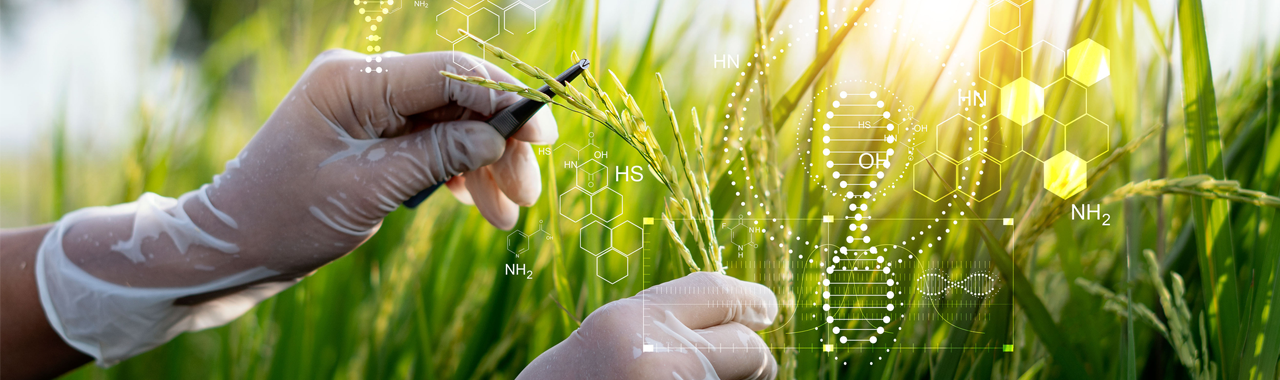
"Population, when unchecked, increases in a geometrical ratio.
Subsistence increases only in an arithmetical ratio."
— Thomas Robert Malthus, An Essay on the Principle of Population (1798)
Can we keep producing enough food for everyone?
In 1798, English economist, cleric and scholar Thomas Malthus argued that our population had the potential to grow more rapidly than the food supply, which led him to a depressing conclusion: famine and hardship would always act as checks on human numbers.
The Green Revolution
More than a century later, science changed the equation. During the 20th century, the Green Revolution combined advances in plant breeding with irrigation, fertilizers, pesticides and improved farming practices. And the results of using new technology were dramatic, with crop yields increasing around the world and helping food production keep pace with a rapidly growing global population.
Producing more food remains essential in the 21st century, now that global population has topped eight billion. Our added challenge is to keep doing so while reducing agriculture's environmental burden and helping crops withstand increasingly difficult growing conditions.
NTT Green Innovation toward 2040
That’s one of the aims of NTT Green Innovation toward 2040, the environmental and energy vision first announced in September 2021. As part of that work, NTT and Tokyo Metropolitan University are developing plant breeding technologies intended to create crops with higher yields and useful properties, greater CO₂ absorption capacity, and lower requirements for chemical fertilizers and pesticides.
Their latest research concerns a limitation that has shaped plant breeding for generations. Let’s get into it.
Plant Hybridization vs. Polyploidization
Plant hybridization is the process of crossing different plant varieties to produce offspring that combine desirable traits from both. The offspring can sometimes display hybrid vigor, including stronger growth, higher yields or greater tolerance to environmental stress.
Another technique is polyploidization, which increases the number of sets of genetic information within a plant. This can result in larger plant organs, greater stress tolerance or increased levels of useful compounds.
Both approaches have limitations. Conventional hybridization doesn’t increase the number of genome sets. For its part, polyploidization generally just duplicates the genome of a single variety, rather than combining the characteristics of several different parents.
NTT and Tokyo Metropolitan University thought: can’t we do both things at once and get the best of both worlds?
The research team used a form of plant in vitro fertilization (IVF), isolating egg and sperm cells from four rice varieties: Nipponbare, Taichung 65, Kasalath and IR26. They then fused the cells using electrical stimulation, and cultured the resulting fertilized eggs into plants.
Quad
Genetic analysis confirmed that the plants contained genomes from all four parent varieties in approximately equal proportions. They also possessed twice the usual number of genome sets, making them “tetraploid.” The researchers named the resulting four-parent rice hybrid Quad. They also introduced the term polyparental hybrid for a polyploid organism containing genomes from three or more genetically distinct parents of the same species.
So what happened?
Quad grew vigorously. Its seeds were longer, wider and thicker than those of all four parents. The weight of ten brown rice grains was approximately 1.7 times the parental average and was also significantly greater than that of a tetraploid hybrid created from two of the varieties.
Stronger, More Abundant Crops… Potentially
But let’s not pop all the champagne corks at once! This doesn’t yet mean that farmers can harvest 1.7 times as much rice from any given field. NTT and Tokyo Metropolitan University researchers still need to examine overall yield, environmental stress tolerance, eating quality and other characteristics, and to test the plants outdoors.
But think of the potential and the possibilities. Combining several genetically different parents may eventually help breeders bring together characteristics related to productivity, resilience, quality and environmental performance in ways that conventional methods simply cannot.
Keeping the Green Revolution Alive
Back at the end of the 18th century, Malthus warned that food production would fail to keep pace with humanity. The Green Revolution showed how scientific knowledge could alter that relationship. The research undertaken by NTT and Tokyo Metropolitan University is part of that same effort: finding better ways to grow the food people need in the environmental conditions the future will bring.
Innovating a Sustainable Future for People and Planet
For further information, please see this link:
https://group.ntt/en/newsrelease/2026/08/20/260820a.html
If you have any questions on the content of this article, please contact:
Public Relations
NTT Information Network Laboratory Group
https://tools.group.ntt/en/news/contact/index.php

Daniel O'Connor
Daniel O'Connor joined the NTT Group in 1999 when he began work as the Public Relations Manager of NTT Europe. While in London, he liaised with the local press, created the company's intranet site, wrote technical copy for industry magazines and managed exhibition stands from initial design to finished displays.
Later seconded to the headquarters of NTT Communications in Tokyo, he contributed to the company's first-ever winning of global telecoms awards and the digitalisation of internal company information exchange.
Since 2015 Daniel has created content for the Group's Global Leadership Institute, the One NTT Network and is currently working with NTT R&D teams to grow public understanding of the cutting-edge research undertaken by the NTT Group.
Related Article


Recommended Article
-

March 14, 2024
What is NTT's GX? Our solution brand "NTT G×Inno"
-

March 5, 2024
[Press Conference Information] Launch of "NTT G×Inno," a New Solution Brand to Strengthen Efforts in the GX Field
-

January 15, 2024
Digitization and Digitization for Smart Agriculture
-

November 17, 2023
Realizing a Recycling-Oriented Society through a Data Mining Approach
Search by Tags