Microsoft ends support for Internet Explorer on June 16, 2022.
We recommend using one of the browsers listed below.
- Microsoft Edge(Latest version)
- Mozilla Firefox(Latest version)
- Google Chrome(Latest version)
- Apple Safari(Latest version)
Please contact your browser provider for download and installation instructions.



March 27, 2026
NTT, Inc.
NTT Achieves Dynamic Radio Wave Propagation Control Using a Transmissive Metasurface with the World's Thinnest Liquid Crystal Layer
~Technology expected to expand wireless service coverage through installation on window glass~
Key Points:
- NTT developed a transmissive liquid crystal metasurface1 that dynamically controls the direction of transmitted radio waves using the world's thinnest liquid crystal layer, less than one-tenth the thickness of conventional designs. The technology was demonstrated to arbitrarily control the propagation direction and focal position of radio waves in the sub-terahertz band (115 GHz).
- NTT's proprietary structure can be applied across a wide range of frequency bands. Because it can be fabricated with a liquid crystal layer comparable in thickness to that used in liquid crystal displays, it is well suited for large-area implementation and high-speed response.
- By applying this technology to window glass and other transparent surfaces, transmitted radio waves can be dynamically controlled to improve wireless coverage in areas where signals are typically difficult to reach. The technology is expected to enable cost-effective, low-power expansion of high-frequency wireless service coverage.
Tokyo, Japan, March 27, 2026 — NTT, Inc. (Headquarters: Chiyoda-ku, Tokyo; President and CEO: Akira Shimada; hereinafter "NTT") has developed a transmissive metasurface device with the world's thinnest liquid crystal layer that controls radio wave propagation when installed in wireless environments. The device was demonstrated to dynamically control both the direction of transmitted radio waves and their focal position. Incorporating NTT's proprietary metasurface structure, the device can be fabricated with a liquid crystal layer only 3.5 μm thick, comparable to that used in liquid crystal displays, while enabling designs for a wide frequency range from microwave to sub-terahertz bands. This enables large-area metasurface devices to be manufactured more easily. In the future, the ultrathin liquid crystal layer is also expected to provide faster response times, allowing radio waves to be dynamically controlled to track moving wireless devices. By installing the device on window glass and other transparent surfaces, the technology is expected to enable cost-effective, low-power expansion of 6G wireless service coverage.
The research results were published in the journal Communications Engineering on March 9, 2026.
Background
To realize ultra-high-speed wireless communications that support diverse 6G use cases, the use of radio waves in the FR3 band (7 GHz to 24 GHz) and the sub-terahertz band (100 GHz to 300 GHz)2, both of which provide wide bandwidth, is under discussion. As radio frequency increases, radio waves exhibit propagation characteristics that more closely resemble those of light. As a result, diffraction becomes weaker and signals are more susceptible to blockage by obstacles. This is particularly challenging for outdoor-to-indoor communications, where propagation paths are largely limited to windows and other openings, making it easier for coverage dead zones to form.
To address this issue, there is growing interest in reconfigurable intelligent surface (RIS)3 technology, which uses large-area metasurface devices to direct radio waves to desired locations. For example, previous studies have demonstrated that installing metasurface devices on window glass can improve indoor wireless coverage.4 If the direction and other properties of radio waves transmitted through these metasurface devices can be dynamically controlled, it will become possible to steer radio waves to track moving wireless devices.
Various approaches have been investigated for dynamically controlling metasurface devices, including methods that combine metasurface structures with semiconductor materials and those that incorporate mechanical mechanisms. Among these approaches, liquid crystal technology is considered particularly promising because manufacturing technologies for large-area liquid crystal displays are already well established. However, conventional liquid crystal metasurfaces require the liquid crystal layer thickness to scale with the operating wavelength. Because radio waves have much longer wavelengths than visible light, radio-frequency applications require liquid crystal layers that are significantly thicker than those used in displays, making large-area fabrication difficult. In addition, the response speed of liquid crystals decreases as the layer becomes thicker, limiting the operating speed of the device.
NTT has been conducting research and development on a new liquid crystal-based transmissive metasurface device to enable dynamic radio wave control that can track moving wireless devices located in the environment where direct signals from base stations cannot reach. In this work, NTT developed a proprietary liquid crystal metasurface structure that enables an ultrathin liquid crystal layer even for high-frequency radio waves in the FR3 and sub-terahertz bands. The resulting transmissive metasurface achieves the world's thinnest liquid crystal layer relative to the operating wavelength, less than one-tenth the thickness of previous transmissive liquid crystal metasurfaces (Figure 1).
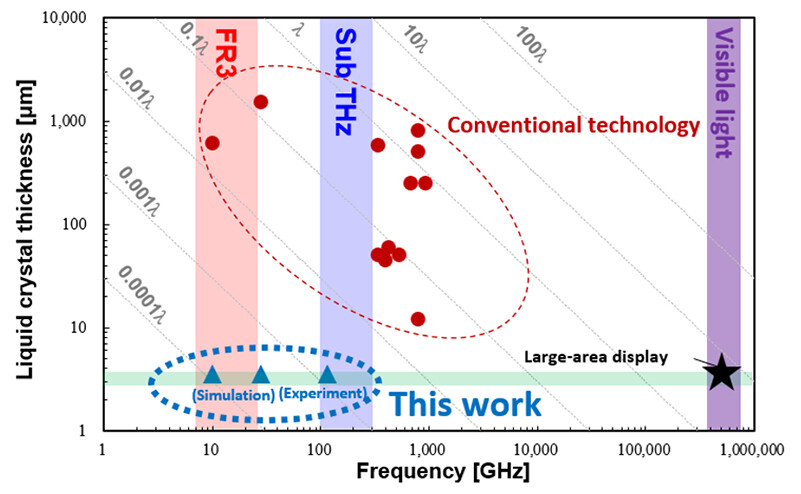 Figure 1. Trend in liquid crystal layer thickness versus operating frequency for transmissive liquid crystal metasurfaces. Whereas previous designs required a liquid crystal layer thickness of at least 0.02λ5 (where λ is the radio wavelength), the proposed device achieves a thickness of 0.002λ or less, reducing the liquid crystal layer thickness to less than one-tenth that of conventional designs.
Technical Highlights
NTT's metasurface device (Figure 2a), which achieves the world's thinnest liquid crystal layer for radio-frequency applications, incorporates the following technical innovations.
1. Resonator cell structure that decouples liquid crystal layer thickness from frequency design
Conventional liquid crystal metasurfaces employ a structure in which the liquid crystal layer is sandwiched between two resonator layers. When the liquid crystal layer is made thinner, however, the magnetic resonance confinement effect6 degrades the resonant characteristics.
To maximize control of transmitted radio waves through changes in the orientation of liquid crystal molecules, NTT developed a new resonator structure that uses electric resonance to concentrate the local electric field within the liquid crystal layer (Figure 2b). This design decouples the liquid crystal layer thickness from the operating frequency, enabling the world's thinnest liquid crystal layer across frequency bands ranging from the FR3 band to the sub-terahertz band.
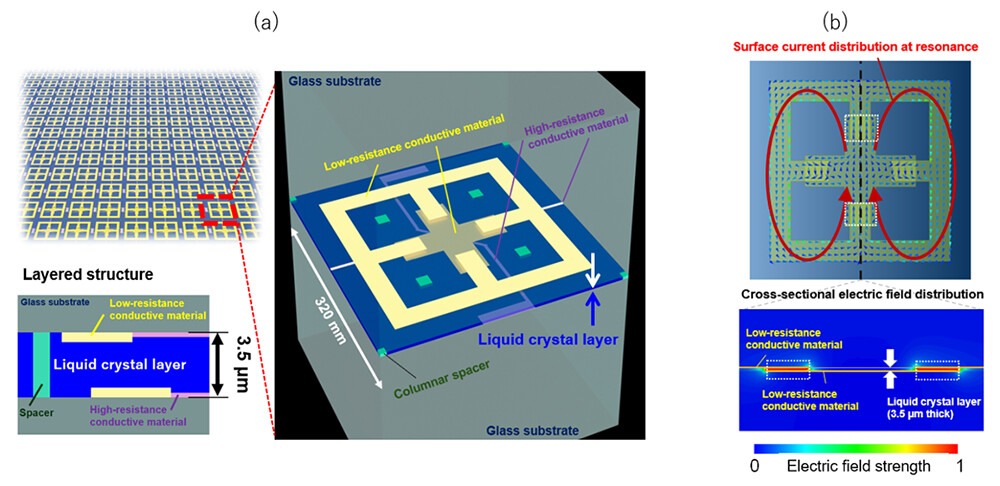 Figure 2. (a) Unit cell structure of NTT's proprietary liquid crystal metasurface. (b) Electromagnetic simulation results showing the surface current at resonance and the cross-sectional local electric field distribution. The liquid crystal layer is positioned between metal pattern 1 and metal pattern 2.
2. Rotationally symmetric structure with integrated control wiring using multiple conductive materials
In conventional metasurface designs, both the resonator structure and the integrated control wiring are formed from a single conductive material. In such designs, the two-dimensional control wiring interferes with the coupling between the resonator and high-frequency signals.
To overcome this challenge, NTT constructed the metasurface using two conductive materials with different electrical conductivities. This approach allows high-frequency signals to couple only with the resonator structure, even in the presence of two-dimensional control wiring, enabling two-dimensional control of transmitted radio waves. In addition, because the overall structure, including the wiring, is rotationally symmetric at high frequencies, the device supports both vertical and horizontal linear polarizations used in mobile wireless communications.
Research Results
NTT fabricated a prototype transmissive liquid crystal metasurface incorporating these technologies for operation at 115 GHz in the sub-terahertz band. The prototype features the world's thinnest liquid crystal layer, measuring 3.5 μm (Figure 3).
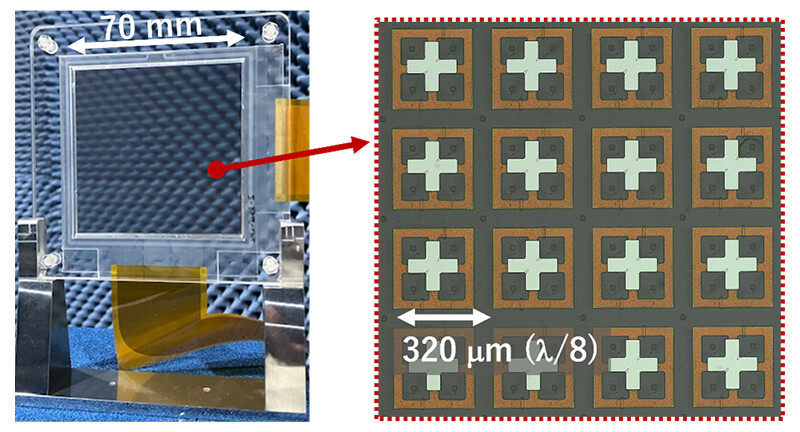 Figure 3. Prototype transmissive liquid crystal metasurface.
Sub-terahertz waves at 115 GHz were incident on the prototype device, and control signals corresponding to the desired propagation characteristics were applied. Measurements of the transmitted signal strength confirmed that both the propagation direction and the focal position of the transmitted waves could be dynamically controlled as designed (Figure 4).
The proposed structure also achieves a unit cell size of less than one-eighth of the wavelength, making it possible to generate complex beam patterns that are difficult to realize with conventional phased-array antennas7.
Although the prototype was demonstrated at 115 GHz, the proposed structure decouples liquid crystal layer thickness from frequency design. Consequently, a liquid crystal metasurface using the same 3.5 μm liquid crystal layer can also be designed and fabricated for lower-frequency bands, such as the 10 GHz band within FR3.
In the future, as illustrated in the application example in Figure 4, this liquid crystal metasurface device, which can be fabricated to be transparent to visible light, is expected to be installed on window glass and other transparent surfaces without affecting the surrounding landscape, enabling flexible control of radio wave propagation.
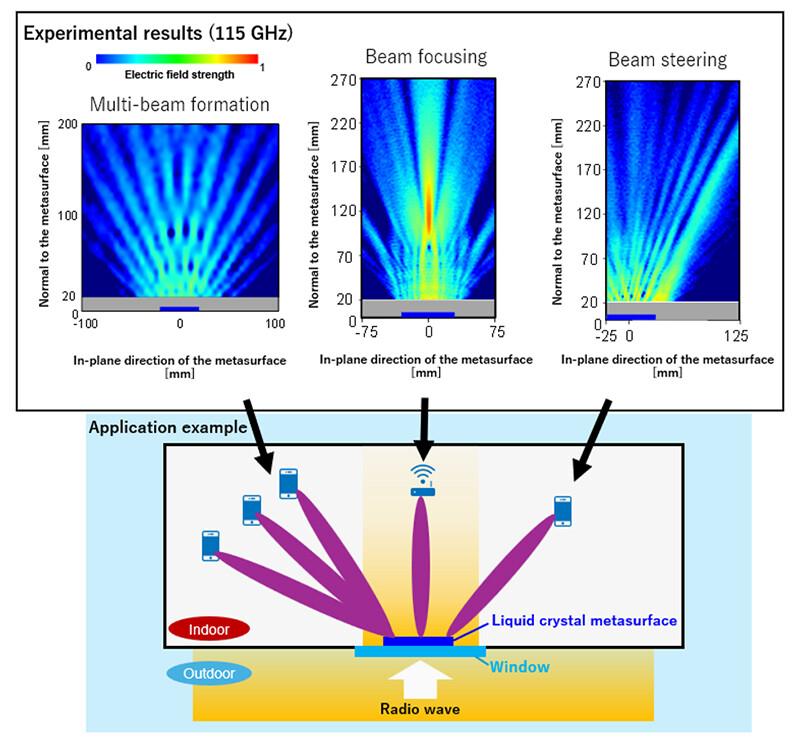 Figure 4. Measured electric field intensity distributions of transmitted waves and a conceptual application example showing improved radio wave propagation from an outdoor environment to an indoor space.
Future Outlook
This technology is expected to enable the cost-effective, low-power expansion of 6G wireless coverage by dynamically controlling outdoor-to-indoor radio wave propagation and delivering signals to areas where wireless coverage is easily degraded by obstacles, reducing the need for additional base stations and other network infrastructure.
Going forward, NTT will further strengthen collaboration within and beyond the NTT Group to evaluate practical applications in real-world environments and operational systems. NTT will also continue advancing the technology to enhance its functionality and performance while expanding its potential use cases.
Publication
Journal: Communications Engineering
Title: Transmissive metasurface with 3.5-μm-thick liquid crystals for subterahertz-wave dynamic beamforming
Authors: Daisuke Kitayama, Hibiki Kagami, Adam Pander, Yuto Hama, Hiroyuki Takahashi
DOI: https://doi.org/10.1038/s44172-026-00635-2
URL: https://www.nature.com/articles/s44172-026-00635-2
Glossary
1Transmissive liquid crystal metasurface
A metasurface is an engineered structure consisting of a large number of subwavelength elements periodically arranged on a planar surface to achieve desired electromagnetic responses. A transmissive liquid crystal metasurface electronically controls the direction of transmitted radio waves by applying voltage to the liquid crystal layer.
2FR3 band (7 GHz to 24 GHz) and sub-terahertz band (100 GHz to 300 GHz)
High-frequency radio bands expected to be used in sixth-generation (6G) mobile communication systems.
3Reconfigurable Intelligent Surface (RIS)
A general term for metasurfaces whose reflection and transmission characteristics can be electrically controlled. By dynamically controlling the propagation direction of radio waves according to the surrounding environment, RIS technology can expand wireless coverage and improve communication quality.
4"DOCOMO and AGC Use Metasurface Lens to Enhance Radio Signal Reception Indoors
— New technology efficiently guides millimeter waves to target locations indoors —" (January 26, 2021)
https://www.docomo.ne.jp/english/info/media_center/pr/2021/0126_00.html
5Xu, S.-T., et al. "Terahertz resonance switch induced by the polarization conversion of liquid crystal in compound metasurface." Optics Letters 44, 2450 (2019).
6Magnetic resonance confinement effect
In conventional liquid crystal metasurfaces, magnetic dipole resonances are formed within the liquid crystal layer. As the liquid crystal layer becomes thinner, these magnetic dipoles become more strongly confined, increasing the influence of conductor and dielectric losses in the metasurface materials and degrading resonant performance. Because the proposed structure does not rely on magnetic resonance, it is less susceptible to material losses even when the liquid crystal layer is made extremely thin.
7Phased-array antenna
An antenna consisting of multiple antenna elements arranged in an array, enabling electronic control of the direction of radio wave transmission and reception.
About NTT
NTT is a leading global technology innovator, providing a broad range of services to both consumers and businesses. As a mobile operator and provider of infrastructure, networks, and services, NTT is dedicated to promoting a sustainable future through cutting-edge innovations. Our portfolio includes business consulting, AI-powered solutions, application services, global networks, cybersecurity, data center and edge computing, all supported by our deep global industry expertise. Generating over $90 billion in revenue and employing 340,000 professionals, we allocate 30% of our annual profits to fundamental research and development. With operations spanning more than 70 countries and regions, our clients include over 75% of Fortune Global 100 companies, alongside thousands of enterprises, government organizations, and millions of consumers.
Media Contact
NTT, Inc.
NTT Science and Core Technology Laboratory Group
Public Relations
Inquiry form
Information is current as of the date of issue of the individual press release.
Please be advised that information may be outdated after that point.


NTT STORY
We introduce various fields that NTT Group is working on and collaborations with partners.