Microsoft ends support for Internet Explorer on June 16, 2022.
We recommend using one of the browsers listed below.
- Microsoft Edge(Latest version)
- Mozilla Firefox(Latest version)
- Google Chrome(Latest version)
- Apple Safari(Latest version)
Please contact your browser provider for download and installation instructions.



May 12, 2026
NTT, Inc.
NTT Develops World's First Illusion Technique for Conveying Softness and Stickiness Without Physical Contact
~Enhancing User Experiences by Enabling Material Qualities to Be Conveyed Remotely Using Everyday Devices~
Highlights:
- NTT has developed an illusion-based technique that enables users to perceive material qualities such as softness and stickiness without physical contact by manipulating how virtual objects deform in augmented reality (AR).
- The technique enables users to perceive material qualities by combining hand movements captured by a PC or smartphone camera with visual feedback on a display, eliminating the need for dedicated devices such as controllers or haptic equipment.
- The technology could enable a new form of communication that allows material qualities to be conveyed remotely using PCs and smartphones, enhancing user experiences in various applications.
TOKYO, May 12, 2026 — NTT, Inc. (Headquarters: Chiyoda-ku, Tokyo; President and CEO: Akira Shimada; hereinafter "NTT") has developed an illusion technique that enables users to perceive material qualities such as softness and stickiness without physical contact by interacting with virtual objects that deform in response to hand movements in an augmented reality (AR) environment.
Through this research, NTT demonstrated that the perceived softness of an object is influenced by the spatial extent of deformation when the object is pressed, while the perceived stickiness is determined by the degree to which the object appears to stretch in response to finger movements. Previous approaches typically required input devices such as mice or controllers. In contrast, the new technique combines camera-based hand tracking with visual feedback on a display, enabling users to manipulate virtual objects and experience different material qualities by controlling deformation parameters, including the spatial extent of deformation and stretch length.
This approach makes it possible to convey material qualities to remote users without requiring specialized hardware, opening opportunities for applications in e-commerce*1 and remote communication.
Part of this research has been published in IEEE Transactions on Visualization and Computer Graphics [1]. A demonstration of the technology will be exhibited at the Communication Science Laboratories Open House 2026*, which will be held from May 20, 2026.
*Communication Science Laboratories Open House 2026
https://www.kecl.ntt.co.jp/openhouse/2026/index_en.html
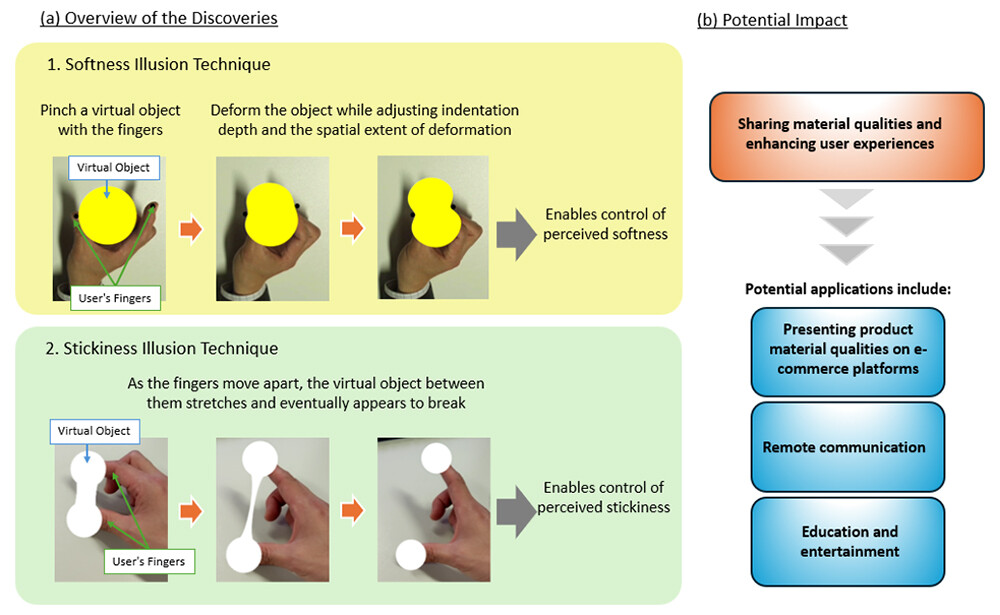 Figure 1. Overview of the discoveries and potential impact of this research.
(a) Overview of the discoveries:
Softness illusion technique: Users pinch a virtual object displayed on a screen using an image of their own fingers. By presenting deformation while adjusting the amount of indentation and the spatial extent of deformation, the perceived softness of the object can be controlled.
Stickiness illusion technique: Users separate their thumb and index finger displayed on the screen. By stretching the virtual object displayed between the fingers and presenting it as if it breaks apart at a certain point, the perceived stickiness of the object can be controlled.
(b) Illustration of potential impact:
Based on the proposed illusion techniques, the research aims to enable the sharing of material qualities and enhance interactive experiences. Potential future applications include presenting product qualities on e-commerce platforms, enriching remote communication, and supporting educational and entertainment experiences.
Background
Recent advances in virtual reality (VR) and augmented reality (AR) technologies have expanded opportunities for sharing experiences across distances and presenting products in online environments. However, haptic qualities such as softness and stickiness have traditionally been difficult to convey without specialized hardware such as virtual reality controllers. As a result, users often cannot intuitively assess how a product feels in situations such as online shopping, making purchasing decisions more challenging.
At the same time, it is well known that people can perceive material qualities such as softness and weight based solely on visual information. This has drawn increasing attention to the possibility of presenting material qualities through non-contact, vision-based approaches. Previous studies have shown that visual cues, including the amount of indentation, can influence the perception of softness. However, the specific visual information that systematically governs material perception has not been fully understood.
To address this challenge, this research focused on the deformation of virtual objects and aimed to identify the visual parameters that enable non-contact communication of material qualities such as softness and stickiness.
Technical Highlights
(1) Softness: Represented Through Control of the Spatial Extent of Deformation
The proposed method manipulates the perceived softness of a virtual object by controlling the spatial extent of deformation; that is, how broadly the deformation spreads when the object is pressed (see Figure 1(a), Softness Illusion Technique). Experimental results revealed that perceived softness varies depending on the extent of deformation, with a specific range producing the strongest sensation of softness. By applying this parameter to the deformation of virtual objects in an AR environment, the method enables the non-contact presentation of softness using visual information alone.
(2) Stickiness: Represented Through Control of Object Elongation (Break Distance)
The proposed method manipulates the perceived stickiness of a virtual object by controlling the length to which the object stretches before breaking in response to finger movements (see Figure 1(a), Stickiness Illusion Technique). Experimental results showed that the longer the object stretches, the stronger the perceived stickiness. This approach enables the non-contact visual presentation of stickiness, which has traditionally been difficult to achieve.
(3) Real-Time Control of Material Perception Based on Hand Movements
NTT also developed a technique that controls these deformation parameters in real time based on hand movements captured by a camera and presents the resulting visual feedback on a display. This enables users to interact with virtual objects while simultaneously experiencing material qualities, without requiring dedicated haptic devices or other specialized hardware.
Experimental Results
(1) Softness Evaluation Experiment: Investigating the Effects of Indentation Depth and Spatial Extent of Deformation on Perceived Softness
In this experiment, NTT investigated the visual factors that influence softness perception using videos of a virtual object being pressed by a needle-like object. Specifically, the researchers systematically varied two visual parameters: indentation depth, corresponding to how deeply the object was pressed, and the spatial extent of deformation, indicating how far the deformation spread across the surrounding area (Figure 2(a)). Participants (N = 130) viewed each video and rated the perceived softness of the object on a seven-point scale.
The results showed that perceived softness depends not only on indentation depth but also strongly on the spatial extent of deformation, with the two factors interacting to determine softness perception (Figure 2(b)). In other words, even when the indentation depth remained constant, the perceived softness changed depending on how the deformation spread. The object was perceived as softest when the deformation range fell within a specific range (approximately 16–32 pixels). These findings suggest that the way deformation spreads is itself an important visual cue for softness perception.
Based on these findings, NTT further confirmed that perceived softness in an augmented reality environment can be manipulated by controlling both the spatial extent of deformation and indentation depth of virtual objects (Figure 2(c)).
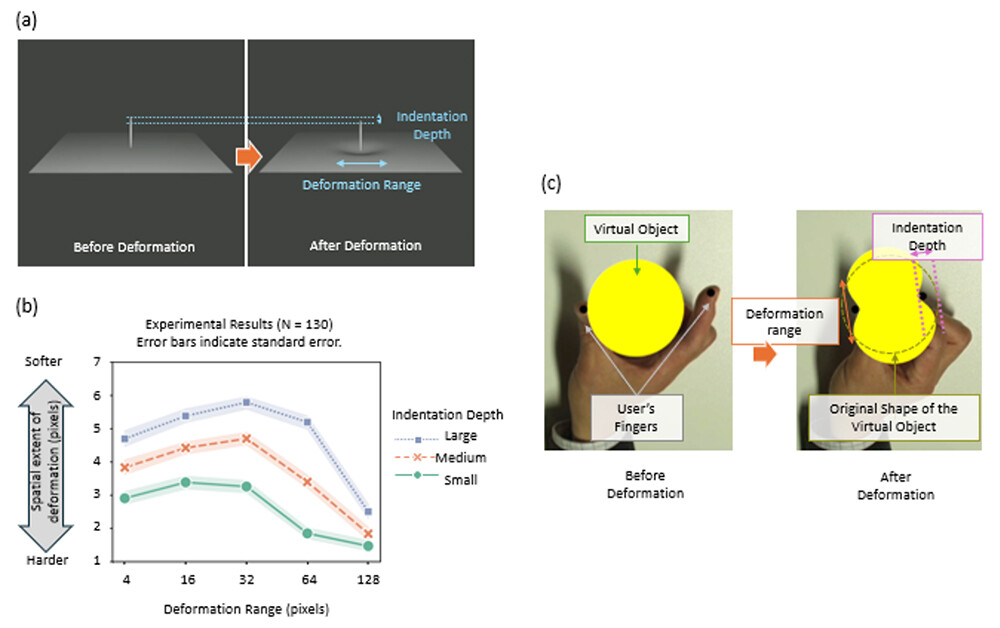 Figure 2. (a) Examples of experimental stimuli used to investigate softness perception and illustrations of the visual parameters manipulated in the study (indentation depth and spatial extent of deformation). (b) Experimental results for softness ratings. (c) Application of the findings in an augmented reality environment. Users pinch a circular virtual object displayed on a screen using their thumb and index finger. By presenting deformation while controlling the indentation depth and deformation range relative to the object's original circular shape, the system can induce the illusion of softness.
(2) Stickiness Evaluation Experiment: Investigating the Effects of Object Elongation (Break Distance) on Perceived Stickiness
In this experiment, NTT investigated the visual factors that influence stickiness perception by presenting a virtual object that deformed in response to users' finger movements in an augmented reality environment. Specifically, the researchers systematically varied the break distance, defined as the distance the object stretched before appearing to break apart when the fingers moved apart (Figure 3). Participants directly interacted with the virtual object and rated the perceived stickiness on a seven-point scale (laboratory experiment: N = 31; online experiment: N = 57).
The results consistently showed that perceived stickiness increased as the break distance became longer (Figure 3). This trend was observed both in a laboratory environment using a personal computer and in an online environment using smartphones, demonstrating that the effect was robust across different devices and experimental settings. These findings indicate that the length of continued elongation before breakage serves as a primary visual cue for stickiness perception.
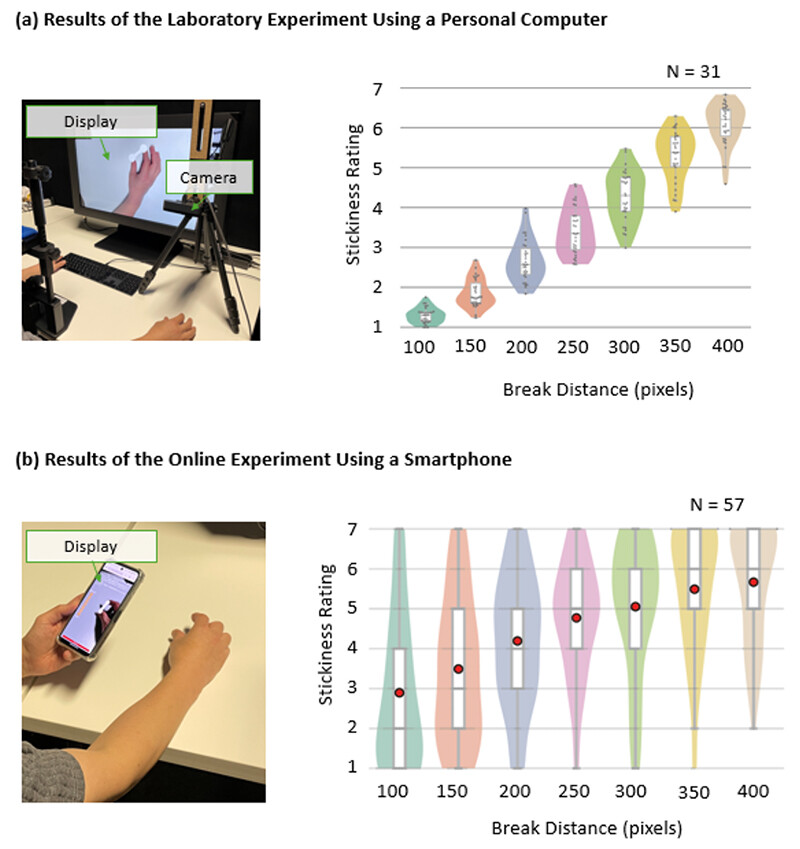 Figure 3. Results of the stickiness evaluation experiment. (a) Results from the laboratory experiment using a personal computer. (b) Results from the online experiment conducted using smartphones.
Future Outlook
The proposed technology addresses the uncertainty that arises when users cannot physically touch a product by supplementing the experience with visual information and interactive feedback. By enabling users to intuitively perceive material qualities through their own hand movements, the technology has the potential to improve product understanding and support purchasing decisions in online environments.
Because the technique does not require specialized haptic devices and can be implemented using commonly available PCs and smartphones, it offers a practical and scalable approach that can be deployed to a broad range of users with relatively low implementation costs.
In particular, the technology could enhance online experiences in product categories where material qualities play an important role in purchasing decisions, such as food, apparel, and consumer goods, by visually conveying characteristics such as softness and stickiness (Figure 1(b)). Beyond e-commerce applications, the technology could also be applied to experience sharing in remote communication, intuitive learning and skill development in education and training, and new forms of interactive expression in entertainment. In these areas, the ability to share material experiences without physical contact has the potential to create new value and enrich user experiences.
Going forward, NTT will evaluate the effects of usage environments, device differences, and communication latency on user experience with an eye toward real-world deployment. The company will also assess the effectiveness of the technology in actual purchasing scenarios. In parallel, NTT plans to collaborate with industry partners to conduct proof-of-concept trials based on specific use cases and accelerate efforts toward practical implementation.
NTT will further expand the framework of visual parameters identified through this research and investigate its applicability to other material qualities, including perceived weight and temperature. Through these efforts, NTT aims to establish a comprehensive framework for vision-based material presentation technologies.
Related News Releases
- September 18, 2024: "Shiseido and NTT begin joint research to develop technology to experience the tactile sensations of cosmetics remotely"
https://group.ntt/en/newsrelease/2024/09/18/240918a.html - May 13, 2025: "Creating Realistic Haptic Sensations in Mid-Air Using Ultrasound--No Wearable Devices Required"
https://group.ntt/en/newsrelease/2025/05/13/250513b.html
Publication Information
[Glossary]
*1Electronic Commerce (EC): A system for buying and selling products and services over the Internet.
About NTT
NTT is a leading global technology innovator, providing a broad range of services to both consumers and businesses. As a mobile operator and provider of infrastructure, networks, and services, NTT is dedicated to promoting a sustainable future through cutting-edge innovations. Our portfolio includes business consulting, AI-powered solutions, application services, global networks, cybersecurity, data center and edge computing, all supported by our deep global industry expertise. Generating over $90 billion in revenue and employing 340,000 professionals, we allocate 30% of our annual profits to fundamental research and development. With operations spanning more than 70 countries and regions, our clients include over 75% of Fortune Global 100 companies, alongside thousands of enterprises, government organizations, and millions of consumers.
Media Contact
NTT, Inc.
NTT Science and Core Technology Laboratory Group
Public Relations
Inquiry Form
Information is current as of the date of issue of the individual press release.
Please be advised that information may be outdated after that point.


NTT STORY
WEB media that thinks about the future with NTT