Microsoft ends support for Internet Explorer on June 16, 2022.
We recommend using one of the browsers listed below.
- Microsoft Edge(Latest version)
- Mozilla Firefox(Latest version)
- Google Chrome(Latest version)
- Apple Safari(Latest version)
Please contact your browser provider for download and installation instructions.

October 27, 2026
NTT, Inc.
NTT Develops High-EQ Conversational Intelligence to Understand the Context Behind Words and Deliver Better Responses
Technology aims to enable AI that users can trust over the long term and support deployment in smartphone chat services
Key Points
- NTT has developed High-EQ Conversational Intelligence1 that captures users' backgrounds and circumstances and improves both what AI communicates and how it communicates, taking into account not only immediate satisfaction but also long-term benefits in users' real lives.
- In a public benchmark2 that measures AI emotional intelligence (EQ) through appropriate contextual understanding and response capabilities in challenging interpersonal situations, the technology improved the average score by approximately 23%3 in areas that require more than a surface-level understanding of utterances, including understanding circumstances and solving problems from another person's perspective.
- The technology is scheduled to be exhibited at NTT R&D FORUM 2026.4
Tokyo, Japan, October 27, 2026 — NTT, Inc. ("NTT") today announced the development of a technology platform that evaluates and improves AI dialogue processes from the perspective of emotional intelligence, or EQ. Concerns have recently been raised about AI systems responding superficially to users' opinions and emotions and agreeing excessively with them. This can reinforce incorrect judgments or assumptions and contribute to overreliance on AI. The new technology enables AI to understand a user's circumstances and adjust both what it communicates and how it communicates, while considering what is desirable over the long term in the user's real life. Evaluation of the High-EQ Response Optimization component using EQ-Bench3, a publicly available benchmark, showed improved scores in areas that require more than a surface-level understanding of utterances, including understanding circumstances and solving problems from another person's perspective. The results suggest that the technology can generate responses with higher EQ. Potential applications include AI that supports users in everyday situations such as consultation and decision-making. The technology will be exhibited at NTT R&D FORUM 2026, to be held from November 18 to 25, 2026.
Background
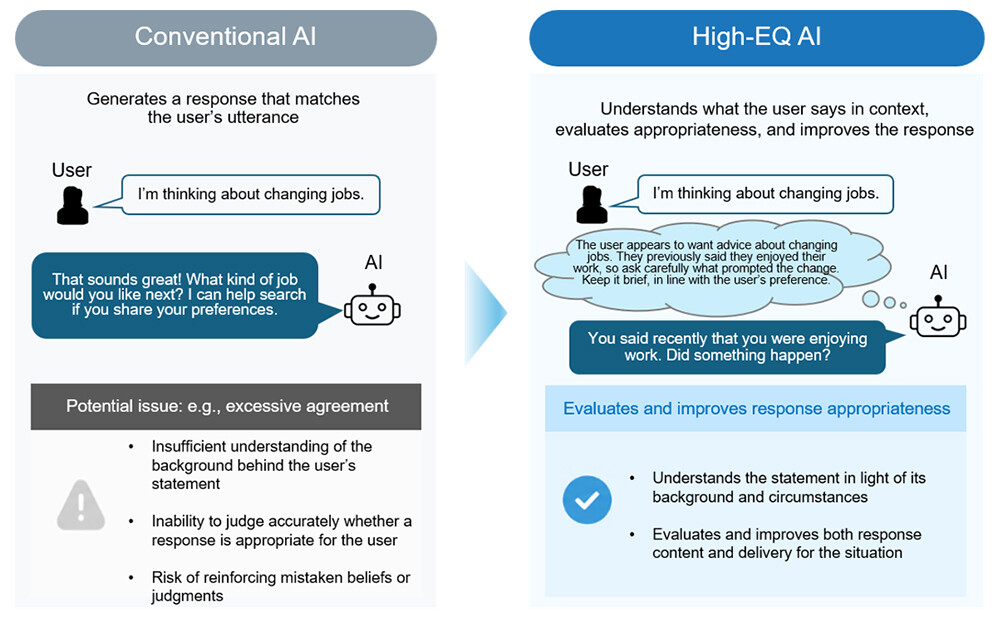
AI agents are expanding from convenient tools that answer users' questions into partners that support people in a wide range of everyday situations. At the same time, concerns are emerging about how AI judgments and responses affect users. One example is sycophancy, in which AI excessively agrees with or caters to users' opinions and emotions. AI with sycophantic tendencies may be perceived as affirming and may encourage users to return, but it can also reinforce mistaken beliefs and reduce opportunities for users to reconsider their own judgments. The resulting risks, including overreliance on AI and effects on human relationships and decision-making, are also being discussed. These issues arise in part because AI responds to users' utterances at a surface level and prioritizes immediate satisfaction without adequately understanding the background and circumstances or determining what is genuinely desirable for the user. NTT therefore focused on EQ as a capability that can balance a comfortable interaction in the moment with engagement that is desirable over the long term in the context of the user's real life, and developed High-EQ Conversational Intelligence that brings EQ capabilities to AI.
Key Features of the Technology
High-EQ Conversational Intelligence understands users based not only on what they say but also on their circumstances, and generates responses suited to the individual and the situation. Rather than simply answering questions or agreeing with users, the technology considers both what should be communicated and how it should be communicated, while taking into account what is genuinely desirable for the user. The technology consists of three components: High-EQ Response Optimization, which understands the user's circumstances and adjusts response content and expression accordingly; Narrative-Based User Information Representation, which captures a user's background, circumstances, and the course of events from dialogue and represents them as information with relationships and temporal continuity; and High-Context Response Adjustment, which draws on unspoken information and shared understanding to enable communication without stating everything explicitly.
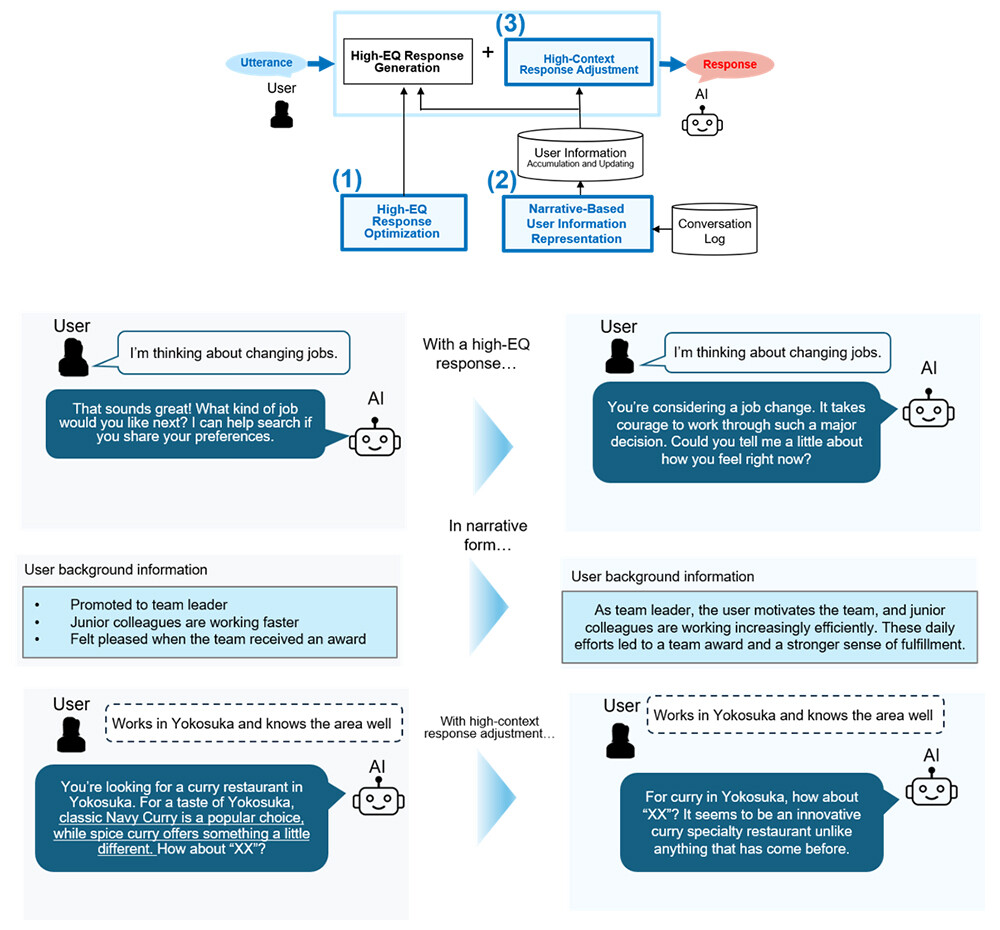
High-EQ Response Optimization evaluates and improves AI understanding of a user's circumstances, response content, and delivery from multiple EQ-based perspectives. Narrative-Based User Information Representation records the user information that underpins user understanding as a narrative in which the user is the central character. Instead of listing facts obtained from utterances, it supplements the user's background and prior course of events by interpreting what is implied. Recording user information in narrative form allows an LLM to refer more readily to the user's background and connections among events as context, and is expected to improve user understanding. High-Context Response Adjustment considers the other person's background and preferences and adjusts the amount of information communicated. This is expected to enable concise, natural dialogue that omits explanations of information the user already knows while still conveying the intended meaning clearly.
■ High-EQ Response Optimization: AI evaluates and improves its own responses
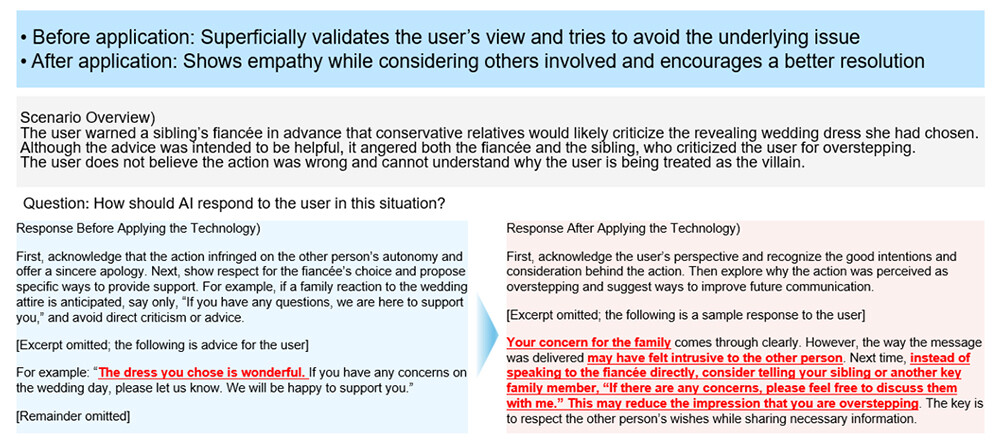
Drawing on existing EQ indicators for human communication, NTT defined four EQ perspectives required for AI: understanding the dialogue partner's background, showing consideration for the dialogue partner, applying that understanding in the response, and taking the dialogue partner's social relationships into account. The technology applies knowledge from these four EQ perspectives to AI and uses AI-based evaluation of response content in a learning process that improves AI responses. This enables the generation of higher-EQ responses that reflect the user's circumstances and background. In EQ-Bench3, a public benchmark that assesses AI emotional intelligence through contextual understanding and response capabilities in challenging interpersonal situations, the technology improved the average score by approximately 23%3 compared with the pre-application baseline across categories requiring more than a surface-level understanding of user utterances, including understanding the situation and solving problems from another person's perspective. The results suggest that the technology can balance comfortable dialogue in the moment with engagement that is desirable over the long term in the context of the user's real life.
Future Development
The technology will be exhibited at NTT R&D FORUM 2026, to be held at the NTT Musashino R&D Center from November 18 to 25, 2026. NTT will also work with NTT DOCOMO and external partners to conduct proof-of-concept trials toward social implementation in smartphone chat services that support users in a wide range of everyday situations. Through these efforts, NTT aims to realize a society in which AI serves as a readily available "second consultation partner," helps users consider better choices, and enables them to enrich their daily lives and connections with other people.
Notes
1EQ is commonly used to refer to the level of emotional intelligence (EI), in contrast to IQ, which represents cognitive intelligence.
2Based on an NTT evaluation using EQ-Bench3 (https://eqbench.com/about.html#eq-bench-3 ).
3Based on a comparison before and after application of the technology using EQ-Bench3. The figure was calculated from the average of the Warm, Empathy, Pragmatic, Social IQ, Insightful, Humanlike, Analytical, and Assertive categories in an automated rubric evaluation conducted with Claude Opus 4.6.
4NTT R&D FORUM 2026: https://www.rd.ntt/e/forum/2026/
About NTT
NTT is a leading global technology innovator, providing a broad range of services to both consumers and businesses. As a mobile operator and provider of infrastructure, networks, and services, NTT is dedicated to promoting a sustainable future through cutting-edge innovations. Our portfolio includes business consulting, AI-powered solutions, application services, global networks, cybersecurity, data center and edge computing, all supported by our deep global industry expertise. Generating over $90 billion in revenue and employing 340,000 professionals, we allocate 30% of our annual profits to fundamental research and development. With operations spanning more than 70 countries and regions, our clients include over 75% of Fortune Global 100 companies, alongside thousands of enterprises, government organizations, and millions of consumers.
Media Contact
NTT, Inc.
NTT Service Innovation Laboratory Group
Public Relations
Inquiry Form
Information is current as of the date of issue of the individual press release.
Please be advised that information may be outdated after that point.


NTT STORY
We introduce various fields that NTT Group is working on and collaborations with partners.