Microsoft ends support for Internet Explorer on June 16, 2022.
We recommend using one of the browsers listed below.
- Microsoft Edge(Latest version)
- Mozilla Firefox(Latest version)
- Google Chrome(Latest version)
- Apple Safari(Latest version)
Please contact your browser provider for download and installation instructions.



May 26, 2026
NTT, Inc.
NTT Achieves World's First Integration of End-to-End Optical Network Visualization into Coherent DSP Chip
~Enabling Optical Transceivers to Autonomously Detect Network Anomalies Without Dedicated Measurement Equipment~
News Highlights:
- Integrates an in-service, end-to-end optical network monitoring function into a coherent DSP chip, enabled by NTT's proprietary algorithm that reduces computational load to 1/100 of conventional methods.
- Automatically localizes network anomalies over a 1,000-km link using only a receiver-side pluggable transceiver — without any dedicated measurement equipment or service interruption.
- Delivers continuous end-to-end visibility into optical networks supporting the AI era, significantly improving network operations and maintenance efficiency.
TOKYO — May 26, 2026 — NTT, Inc. (Headquarters: Chiyoda-ku, Tokyo; President and CEO: Akira Shimada; hereinafter "NTT") has successfully integrated, for the first time in the world, an in-service, end-to-end optical network visualization into a coherent DSP chip. The function operates using only a receiver-side pluggable transceiver without dedicated measurement equipment or service interruption. The technology enables continuous end-to-end visibility into optical networks supporting the AI era, significantly improving network operations and maintenance efficiency.
The results were accepted and presented as a post-deadline paper [1], the most prestigious category of presentation sessions, at OFC 2026, an international conference on optical communications held in Los Angeles, California, USA, from March 15 to March 19, 2026.
Background
In recent years, rapid growth in AI demand has accelerated the expansion of both the capacity and geographic scale of inter-data-center optical networks and backbone optical networks. IOWN APN (All-Photonics Network) (*1), promoted by the NTT Group, represents next-generation infrastructure supporting this trend by leveraging photonics-electronics convergence device technology (*2) to achieve high-capacity, low-latency, and low-power communications. As high-capacity optical networks continue to expand, the importance of stable network operation has become increasingly critical.
To ensure stable operation of optical networks, it is essential to monitor optical signal power across the entire network and quickly detect and identify locations with abnormal loss. Conventionally, such monitoring required dedicated measurement equipment such as OTDR (Optical Time Domain Reflectometer) (*3), resulting in substantial operational and maintenance costs and making continuous end-to-end monitoring during live communication difficult.
To address this challenge, NTT has previously developed a technology capable of visualizing optical signal power across the entire optical network using only communication signals received by optical transceivers, without relying on dedicated measurement equipment [2,3,4]. However, because the technology required enormous computational resources, previous demonstrations were limited to proof-of-concept experiments using external computing systems. Widespread deployment in practical optical networks therefore required implementation within commercial optical transceivers.
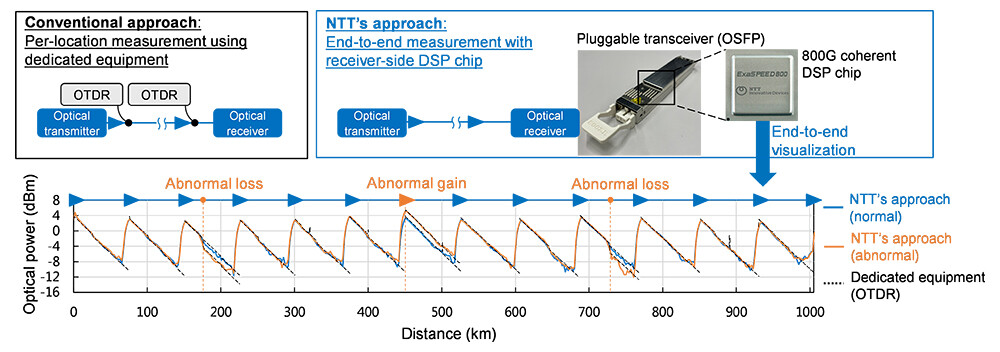 Figure 1. Visualization of the entire optical network spanning more than 1,000 km using a coherent DSP chip
Research Results
In this research, NTT integrated an unprecedented function of visualizing the entire optical network during live communication into a coherent DSP chip [5] (*4) inside an optical transceiver, and successful operation was demonstrated (Figure 1).
A newly developed proprietary technology reduced the computational processing required for visualization to 1/100 of conventional methods, enabling implementation in coherent DSPs and compact optical transceivers, where power consumption and footprint are tightly constrained. As a result, the world's first optical transceiver capable of locating anomalies within an optical network was realized.
Measurement results obtained using the proposed technology showed close agreement with those from dedicated equipment (OTDR), confirming that the technology provides sufficient accuracy for identifying abnormal locations.
![Figure 2. 800G coherent DSP chip used in this experiment (Developed by NTT Innovative Devices Corporation [5]).](img/260526ab.jpg) Figure 2. 800G coherent DSP chip used in this experiment (Developed by NTT Innovative Devices Corporation [5])
Figure 2. 800G coherent DSP chip used in this experiment (Developed by NTT Innovative Devices Corporation [5])
Experiment
NTT implemented the network visualization technology in a coherent DSP chip [5] developed by NTT Innovative Devices Corporation (Figure 2). Using a compact pluggable optical transceiver equipped with the DSP (OSFP: Octal Small Form Factor Pluggable) (*5), the technology successfully demonstrated the ability to locate multiple optical power anomalies across optical networks spanning up to 1,005 km by simply receiving and processing standard-compliant optical signals (800ZR+/400ZR+ (*6)) (Figure 1).
The technology was also confirmed to operate properly when receiving optical signals from transceivers manufactured by other vendors, demonstrating applicability to real-world optical network environments, including multi-vendor deployments. In addition, the study confirmed that the technology does not affect communication quality or power consumption during measurement, demonstrating the feasibility of distributed monitoring across the entire optical network while communication services remain active.
Future Outlook
This achievement marks the world's first integration of an end-to-end network visualization into a communications DSP chip and compact optical transceiver — a breakthrough capability not available in conventional optical transceivers. By enabling optical transceivers to autonomously detect network anomalies, the technology is expected to significantly improve the efficiency of optical network operation and maintenance.
NTT will continue advancing implementation of the technology in optical networks, including IOWN APN, and accelerate research and development toward continuous monitoring and autonomous operation of high-capacity optical networks supporting the AI era.
Other Information
Part of this research was supported by the National Institute of Information and Communications Technology (NICT) under the commissioned research project "Research and Development Project on Compact and Low-Power Wavelength and Format Conversion Technologies for Reducing Power Consumption in Optical Networks" (JPJ012368G60201).
Related Announcements
[Glossary]
*1IOWN APN (All-Photonics Network):
An innovative optical network that introduces photonics-based technologies throughout the entire system, from terminals to networks, and provides end-to-end optical paths to achieve ultra-low power consumption, ultra-high-capacity transmission, and low latency.
https://group.ntt/en/group/iown/function/apn.html
*2Photonics-electronics convergence device technology:
A core technology supporting the IOWN initiative that integrates optical and electrical functions to enable high-capacity, low-latency, and low-power signal processing and transmission. The coherent DSP chip described in this achievement represents one example of this core technology.
*3OTDR (Optical Time Domain Reflectometer):
A device that measures distributed optical fiber loss by injecting test light from one end of an optical fiber and measuring the time required for reflected light to return.
*4Coherent DSP:
A digital signal processing chip that electronically processes received optical communication signals and accurately reconstructs information contained in optical amplitude and phase to correctly recover transmitted data.
*5OSFP (Octal Small Form Factor Pluggable):
One of the industry-standard form factors for compact pluggable optical transceiver modules that can be inserted into and removed from communication equipment ports.
*6800ZR+/400ZR+:
Specifications for 800 Gbps/400 Gbps-class optical communication systems intended for long-distance, high-capacity communications such as inter-data-center and metro-area networks, as defined by organizations including OIF, OpenZR+ MSA, and OpenROADM.
About NTT
NTT is a leading global technology innovator, providing a broad range of services to both consumers and businesses. As a mobile operator and provider of infrastructure, networks, and services, NTT is dedicated to promoting a sustainable future through cutting-edge innovations. Our portfolio includes business consulting, AI-powered solutions, application services, global networks, cybersecurity, data center and edge computing, all supported by our deep global industry expertise. Generating over $90 billion in revenue and employing 340,000 professionals, we allocate 30% of our annual profits to fundamental research and development. With operations spanning more than 70 countries and regions, our clients include over 75% of Fortune Global 100 companies, alongside thousands of enterprises, government organizations, and millions of consumers.
Media Contact
NTT, Inc.
NTT Science and Core Technology Laboratory Group
Public Relations
Inquiry Form
Information is current as of the date of issue of the individual press release.
Please be advised that information may be outdated after that point.


NTT STORY
WEB media that thinks about the future with NTT