Microsoft ends support for Internet Explorer on June 16, 2022.
We recommend using one of the browsers listed below.
- Microsoft Edge(Latest version)
- Mozilla Firefox(Latest version)
- Google Chrome(Latest version)
- Apple Safari(Latest version)
Please contact your browser provider for download and installation instructions.



September 14, 2026
NTT, Inc.
NTT Achieves World's Fastest 2 Tbit/s Wireless Transmission over 100 Meters in the Sub-THz Band
Analog signal processing delivers low latency and power efficiency, offering a new option for AI data center and base station networks in the IOWN and 6G era
Key Points
- NTT demonstrated 2 terabit-per-second (2 Tbit/s) high-capacity wireless transmission over a practical distance of 100 meters, the world's fastest transmission in the sub-terahertz (sub-THz) band, which spans frequencies from 100 to 300 GHz.
- The system achieved 22 spatially multiplexed streams, among the largest numbers demonstrated in the sub-THz band, primarily through low-power analog signal processing. New circuit design, antenna gain enhancement, and alignment technologies substantially increased both transmission speed and distance.
- With wireless speeds comparable to next-generation 800G and 1.6T optical communications, the technology is expected to support flexible network deployment for distributed computing in and between AI data centers, backhaul for sixth-generation mobile communications systems (6G), and temporary relay links. Its wireless flexibility enables rapid activation, relocation, and time-limited operation.
Tokyo, Japan, September 14, 2026 — NTT, Inc. ("NTT") today announced the successful demonstration of 2 terabit-per-second (2 Tbit/s) wireless transmission over 100 meters in an outdoor environment, the world's fastest wireless transmission in the millimeter-wave and sub-terahertz bands (Figure 1). The achievement advances innovative wireless technology designed to deliver ultra-high-capacity data transfer comparable to optical fiber. It was enabled by NTT's OAM-MIMO multiplexing method1, which uses orbital angular momentum (OAM)2 to achieve advanced wireless spatial multiplexing3, together with a newly established set of technologies required for long-distance transmission.
By performing most spatial multiplexing through analog signal processing, the method reduces the computational latency and power consumption associated with digital signal processing to several hundredths of conventional levels. This enables high-capacity wireless communications between nodes in applications that require both low latency and power efficiency, including distributed computing in AI data centers and radio access networks (RANs) that require the deployment of large numbers of devices.
Details of the research were presented at the IEEE Vehicular Technology Conference, VTC2026-Fall, held in September 2026.
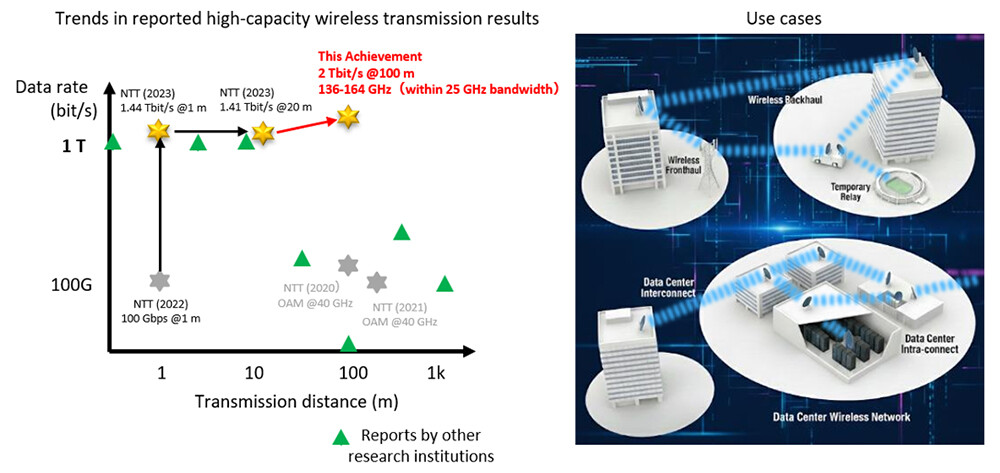 Figure 1. Positioning and potential use cases of the high-capacity wireless transmission technology
Background
Rapid growth in computing demand driven by advances in AI, together with increasingly sophisticated mobile communications toward the IOWN and 6G era, is causing data transfer capacity requirements in AI data centers and RANs to rise sharply. The transition to next-generation 800G and 1.6T optical communications4 is therefore becoming increasingly important. At the same time, demand is growing for high-capacity wireless communications that are not constrained by physical installation work or cabling.
High-capacity wireless communications can generally be advanced through three approaches: wider bandwidth, spatial multiplexing, and higher antenna gain5. NTT has pursued wider bandwidth by using the largely untapped sub-THz band and has led research on OAM multiplexing, which spatially multiplexes multiple radio waves within a narrow beam by using helical radio waves carrying orbital angular momentum (Figure 2). In 2023, this work led to the world's first 1.4 Tbit/s high-capacity wireless transmission in the sub-THz band over a distance of one meter.
Applying this innovative spatial multiplexing technology to advanced real-world networks, including links within and between AI data centers and wireless backhaul for RANs, requires both capacity comparable to next-generation optical communications and transmission over practical distances.
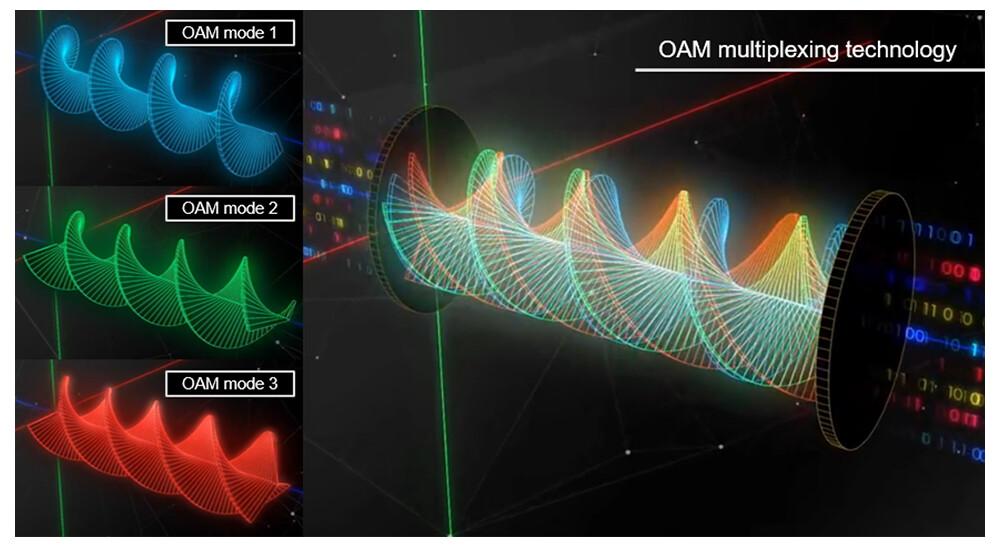 Figure 2. OAM multiplexing technology
Research Results
Conventional multiple-input multiple-output (MIMO) spatial multiplexing requires extensive digital signal processing to eliminate mutual radio interference. When applied to the ultra-wideband signals expected in the millimeter-wave and sub-THz bands, the computational load increases in proportion to the square or cube of the number of antenna elements, making large-scale multiplexing extremely difficult in terms of power consumption and processing latency. NTT addressed this challenge with a hybrid architecture that effectively allocates spatial-multiplexing functions between digital and analog processing. This proprietary OAM-MIMO multiplexing method takes advantage of the unique helical shape of each OAM mode, which can be generated through fixed processing and therefore efficiently implemented using analog technology. Most spatial-multiplexing operations, including OAM-mode multiplexing and separation, are performed by analog waveguide circuits, while digital signal processing is applied only to spatial multiplexing within each OAM mode (Figure 3). For an antenna configuration comprising two rings, each forming an 8-element uniform circular array (UCA)6, analog signal processing multiplexes and separates eight OAM modes, while the digital computational load within each OAM mode is reduced to the equivalent of two elements. This dramatically reduces the digital computational load to just a few hundredths of that required for fully digital processing.
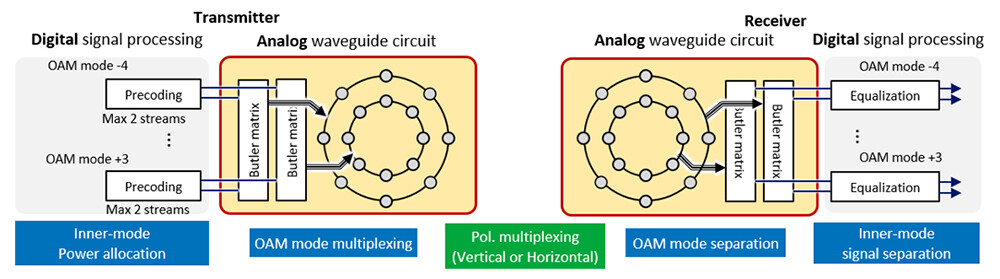 Figure 3. Hybrid architecture that allocates spatial-multiplexing signal processing between analog and digital functions
To implement the OAM-MIMO multiplexing method in the sub-THz band over a practical distance, NTT established three new component technologies: a multi-UCA Butler matrix waveguide circuit, an imaging reflector, and axis-misalignment compensation. See "Key Features of the Technology." Together, these technologies enabled the world's fastest radio-based wireless transmission experiment at 2 Tbit/s over 100 meters (Figure 4). The experiment used the 136.0–148.5 GHz and 151.5–164.0 GHz frequency bands and achieved up to 22 spatially multiplexed streams. The spatial-multiplexing configuration was as follows:
- OAM-mode multiplexing: Simultaneous use of eight OAM modes: 0, ±1, ±2, ±3, and −4
- Adaptive in-mode multiplexing control: Selection of the appropriate number of spatially multiplexed streams within each mode, up to two, according to distance and propagation conditions, together with power allocation and pre-equalization/equalization processing7
- Polarization multiplexing8: OAM-MIMO multiplexed transmission using two different polarizations, horizontal and vertical
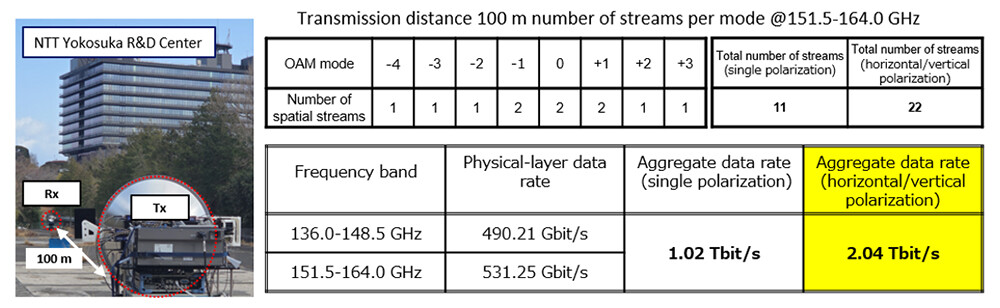 Figure 4. Field experiment setup and wireless transmission results
Key Features of the Technology
① Multi-UCA Butler matrix waveguide circuit technology
This core component multiplexes and separates OAM modes in the OAM-MIMO method through analog signal processing without the additional power consumption or processing latency. Building on NTT's fundamental waveguide design technology9, NTT optimized the three-dimensional routing and compact structure of the waveguide circuit to develop a multi-ring, or Multi-UCA, circuit-integrated antenna (Figure 5).
Although the circuit scale was doubled compared with the previous design9, the circuit size was reduced by approximately 40%. Inter-mode interference caused by waveguide-circuit imperfections was held to an average of −20 dB or less, equivalent to 1/100 or less, while average circuit loss was limited to 2.2 dB or less.
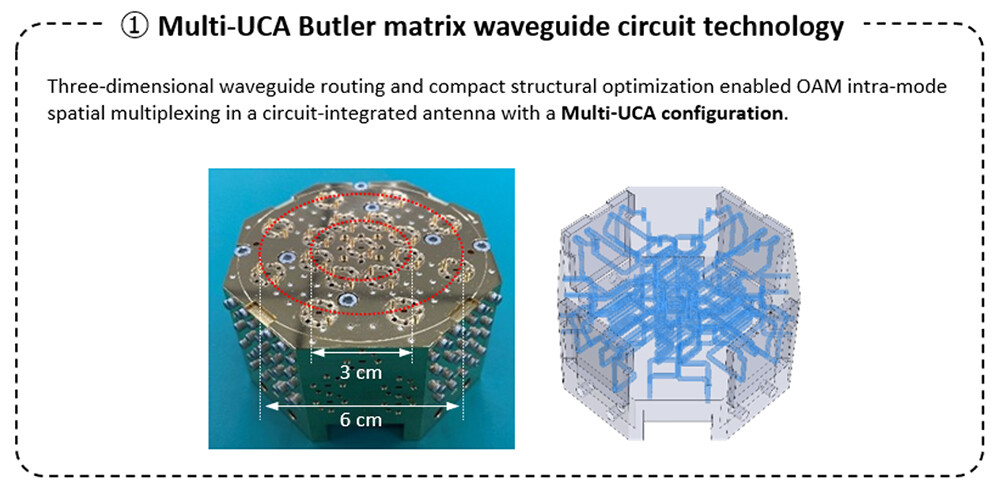 Figure 5. Multi-UCA Butler matrix waveguide circuit technology for the sub-THz band
② Imaging reflector technology
This core technology extends the transmission distance of high-capacity wireless communications using OAM. Increasing the diameter, and therefore the gain, of both antenna pairs can extend OAM transmission distance approximately in proportion to the product of their diameters. For example, increasing each antenna diameter tenfold extends the distance by approximately 10 × 10, or 100 times. Simply enlarging a circuit-integrated antenna, however, lengthens waveguide routing and increases loss and error. The imaging-reflector approach instead uses the compact circuit-integrated antenna designed with the Multi-UCA Butler matrix waveguide technology as the primary radiator and forms an enlarged image of the antenna with multiple reflectors.
Preserving the characteristics of OAM modes with helical wavefronts requires a structure that remains rotationally symmetric about the propagation axis. At the same time, the non-negligible size of the primary radiator creates a design dilemma because reflected radio waves can be blocked by the radiator itself, causing scattering and loss. To avoid this self-blocking while preserving overall rotational symmetry, the reflectors were designed to focus the radiated power temporarily away from the propagation axis (Figure 6). This design provides a high-gain antenna without degrading the characteristics of OAM waves. The compact circuit-integrated antenna remains unchanged, while the reflector design varies the size of the enlarged antenna image. Transmission distance can therefore be scaled to suit the use case.
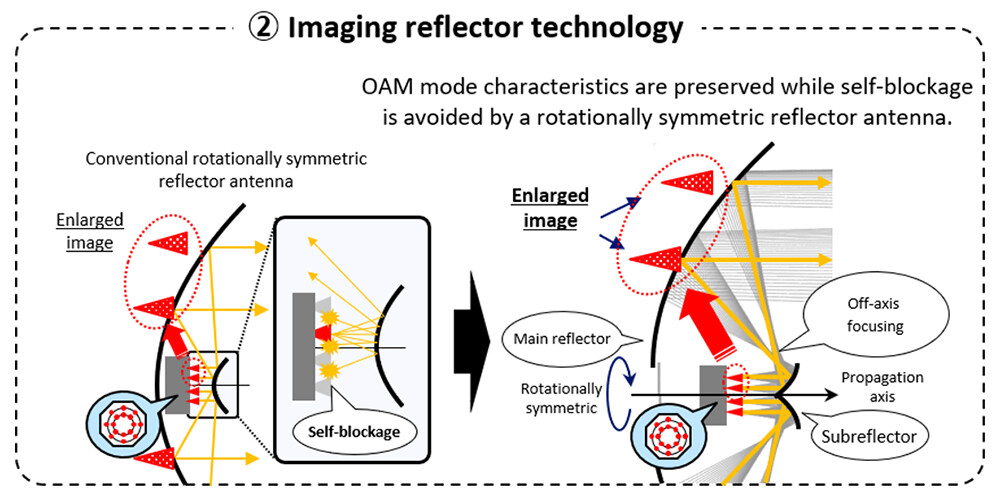 Figure 6. Imaging reflector technology
③ Axis-misalignment compensation technology
To use the non-interfering properties of different OAM modes in OAM-MIMO multiplexed transmission, the two antenna pairs must face each other precisely. Directional misalignment between the antennas causes inter-mode interference and degrades communication quality. The impact becomes greater as antenna diameter and transmission distance increase, making precise alignment essential.
This technology focuses on the signal-to-interference-plus-noise ratio (SINR)10, including inter-mode interference. Interference changes sharply near the point of precise axial alignment, allowing highly accurate alignment by rotating each antenna pair while searching for the SINR peak. However, with many modes, the SINR profile is not a smooth, single-peak curve. A conventional search that simply follows the direction of increasing SINR can become trapped at a smaller local peak rather than reaching the true global maximum. NTT therefore developed a search algorithm that narrows the search path based on the characteristic inter-mode interference patterns caused by misalignment of OAM waves. Coordinated rotation of the two antenna pairs in the same or opposite directions limits the search to the appropriate paths (Figure 7), enabling precise misalignment compensation that converges rapidly and reliably on the optimum alignment.
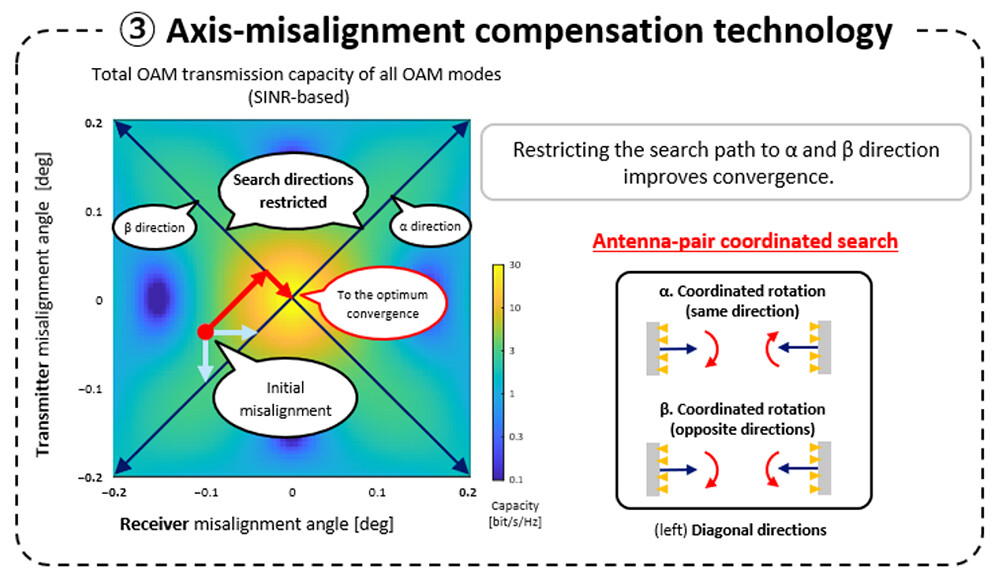 Figure 7. Axis-misalignment compensation technology
Future Development
The achievement establishes a high-capacity wireless transmission technology comparable to next-generation 800G and 1.6T optical communications now under development for commercialization.
NTT will continue research and development toward practical deployment, including long-term operation in real-world environments and integration with existing wireless systems. The work will target use cases where optical-fiber installation is difficult or where the mobility of a fully cable-free wireless system can provide the greatest benefit, with the aim of building high-capacity wireless networks that substantially increase the flexibility of next-generation social infrastructure:
- Wireless connectivity within AI data centers and between buildings for distributed computing environments
- Wireless backhaul and fronthaul between base station facilities in mobile communications systems
- Rapid deployment of temporary relay links for large-scale urban events and during disasters
Building on the high-frequency wireless system technologies established through this work, which combine capacity comparable to next-generation optical communications with long-distance transmission, NTT will work to evolve current point-to-point communications to wireless transmission supporting simultaneous multipoint connectivity. Research and development will continue toward high-capacity wireless transmission at the 10 Tbit/s class.
Paper Information
Title: Field Experiment of 2.04 Tbps Wireless Transmission over 100 m Using Orbital Angular Momentum Multiplexing in the Sub-THz Band
Conference: VTC2026-Fall (2026 IEEE 104th Vehicular Technology Conference)
Authors: Hirofumi Sasaki, Yasunori Yagi, Jun Mashino, Doohwan Lee
Related Press Releases
- March 24, 2025, "NTT, DOCOMO and NEC Demonstrate World's Fastest 140 Gbps Bidirectional Wireless Transmission in 80 GHz Band"
(https://group.ntt/en/newsrelease/2025/03/24/250324a.html) - March 30, 2023, "World's First Successful 1.4-Tbit/s Wireless Transmission in the Sub-THz Band"
(https://group.ntt/en/newsrelease/2023/03/30/230330a.html) - May 15, 2018, "NTT successfully demonstrates 100 Gbps wireless transmission using a new principle (OAM multiplexing) as a world's first"
(https://group.ntt/en/newsrelease/2018/05/15/180515a.html)
Notes
1OAM-MIMO
A wireless transmission method that combines OAM and MIMO technologies to achieve high-capacity spatial multiplexing.
2OAM (orbital angular momentum)
A physical property of electromagnetic waves in which the phase rotates helically along the direction of propagation. OAM waves in different modes do not interfere with one another, enabling high-capacity wireless transmission through spatial multiplexing of multiple OAM modes.
3Spatial multiplexing
A transmission method that sends multiple data streams in parallel at the same time and in the same frequency band using multiple spatially independent radio waves.
4800G/1.6T optical communications standards
Next-generation standards following today's mainstream 100G and 400G systems, enabling ultra-high-capacity communications at 800 gigabits per second (800 Gbit/s) and 1.6 terabits per second (1.6 Tbit/s).
5Higher antenna gain
A technology that enables stronger transmission and reception of radio waves in a specific direction, increasing received signal power to carry more information or extend transmission distance.
6UCA (uniform circular array)
A circular array antenna in which multiple antenna elements are positioned at equal intervals around a circle.
7 Pre-equalization and equalization
In communications that simultaneously transmit and receive multiple radio waves, equalization separates and restores mixed signals to their original form, while pre-equalization adjusts signals at transmission so they can be correctly restored at the receiver.
8Polarization multiplexing
A form of spatial multiplexing that uses the non-interfering properties of waves with different directions of oscillation, or polarizations, to transmit multiple signals simultaneously at the same frequency and increase communications capacity.
9See [2] under "Related Press Releases."
10SINR (signal-to-interference-plus-noise ratio)
A measure of the strength of the desired received signal relative to noise and radio interference from other signals. In this technology, interference refers to inter-mode interference.
About NTT
NTT is a leading global technology innovator, providing a broad range of services to both consumers and businesses. As a mobile operator and provider of infrastructure, networks, and services, NTT is dedicated to promoting a sustainable future through cutting-edge innovations. Our portfolio includes business consulting, AI-powered solutions, application services, global networks, cybersecurity, data center and edge computing, all supported by our deep global industry expertise. Generating over $90 billion in revenue and employing 340,000 professionals, we allocate 30% of our annual profits to fundamental research and development. With operations spanning more than 70 countries and regions, our clients include over 75% of Fortune Global 100 companies, alongside thousands of enterprises, government organizations, and millions of consumers.
Media Contact
NTT, Inc.
NTT Science and Core Technology Laboratory Group
Public Relations
Inquiry Form
Information is current as of the date of issue of the individual press release.
Please be advised that information may be outdated after that point.


NTT STORY
WEB media that thinks about the future with NTT