Microsoft ends support for Internet Explorer on June 16, 2022.
We recommend using one of the browsers listed below.
- Microsoft Edge(Latest version)
- Mozilla Firefox(Latest version)
- Google Chrome(Latest version)
- Apple Safari(Latest version)
Please contact your browser provider for download and installation instructions.



NTT's Sustainability Efforts
Utilizing ICT to visualize forest information
Achieving sustainable forestry and creating new value
NTT BUSINESS SOLUTIONS Miyazaki Business Sales
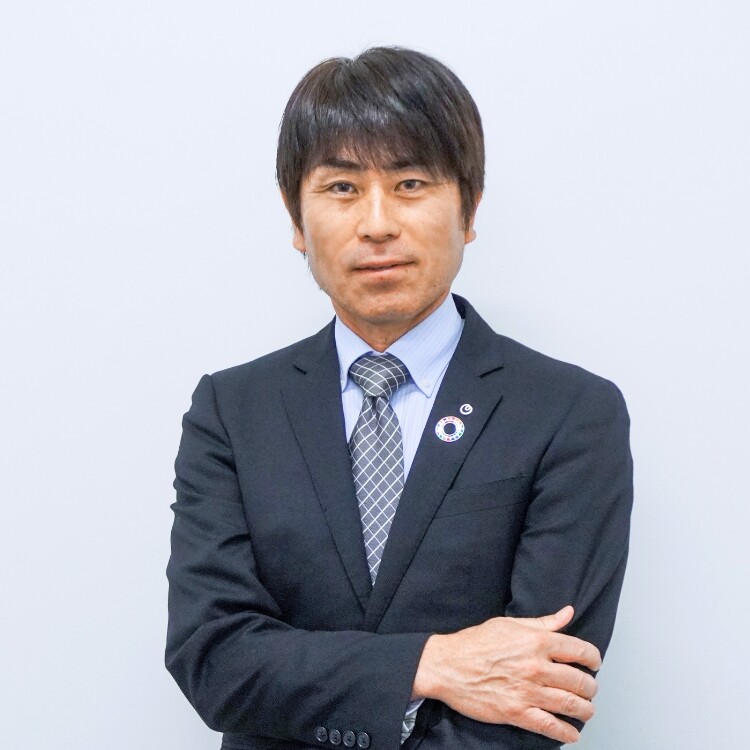
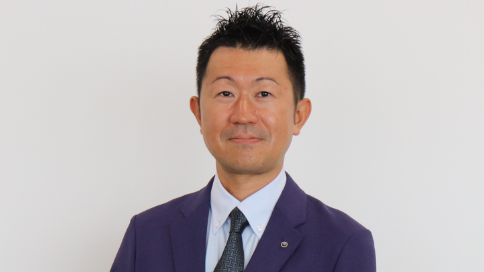
Hirofumi Yuji

Aiming to resolve numerous issues faced by mountain and forest regions by using DX
Morotsuka Village is located in Northern Miyazaki Prefecture right in the middle of Kyushu Chuo Sanchi, and around 90% of the area is mountains and forests. Since ancient times, this region has coexisted with nature, and its inhabitants protect their forests and focus on forestry as their main industry. The NTT WEST Group aims to achieve sustainable forest management in Northern Miyazaki Prefecture and has used forestry as a starting point for pursuing a regional revitalization project. One central figure who has driven this project is Mr. Hirofumi Yuji from Miyazaki Business Sales Department, NTT Business Solutions.

"When we started our regional revitalization project back in 2019, I remember looking for what makes Miyazaki Prefecture, where I was born, unique. As I sought a way to contribute to this region, I learned that it had been Japan's number-one producer of cedar materials (logs) for 32 years in a row. In addition, as Japan reviewed how to utilize its domestic lumber, illegal logging had become a problem in the mountains and forests, and there were ten such incidents per year in the prefecture alone. In response, we considered the possibility of using drones to monitor for illegal logging, which was the start of this project." (Hirofumi Yuji, same below)
During subsequent research regarding the situation of forestry, it became clear that mountain and forest regions throughout Japan shared certain issues.
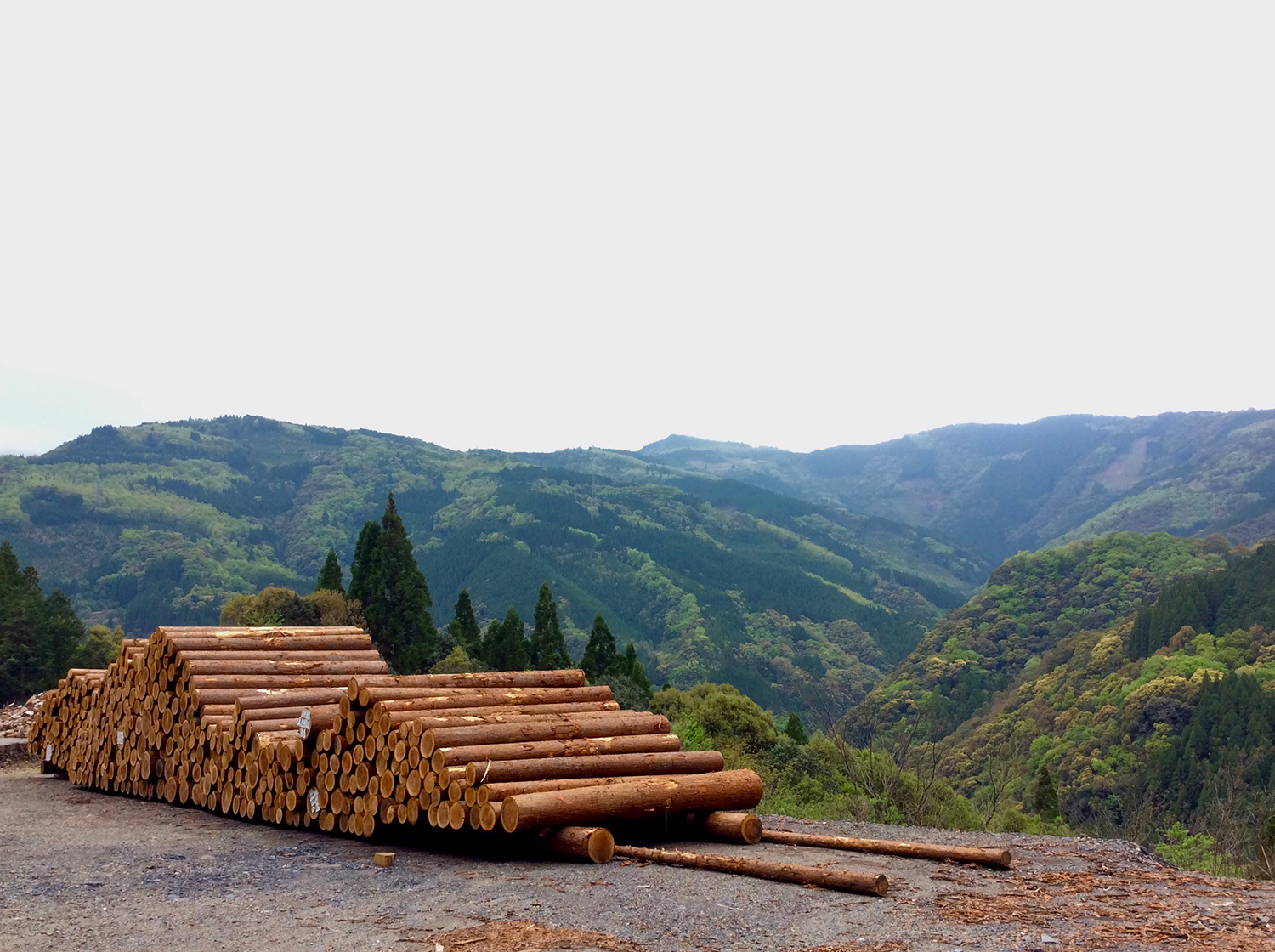
"About two-thirds of Japan's territory is forest, making it one of the world's forest powerhouses. However, in Miyazaki Prefecture and the rest of Japan, people are leaving the mountains due to the aging of forest owners and a shortage of successors, and areas are increasingly not being reforested after being logged. There is also a shortage of forestry workers, given the demand for domestic lumber. Therefore, we considered whether we could use DX, including drones, artificial satellites, and ICT, to resolve such issues, specifically by promoting efficient, sustainable forest and forestry management as well as the stable supply and use of domestically produced wood."
Coordinating stakeholders by establishing the Forest and Forestry DX Association
We started by conducting a forest survey in collaboration with the Miyazaki Prefectural Federation of Forest Owners' Co-operative Associations, the University of Miyazaki, and drone vendor.
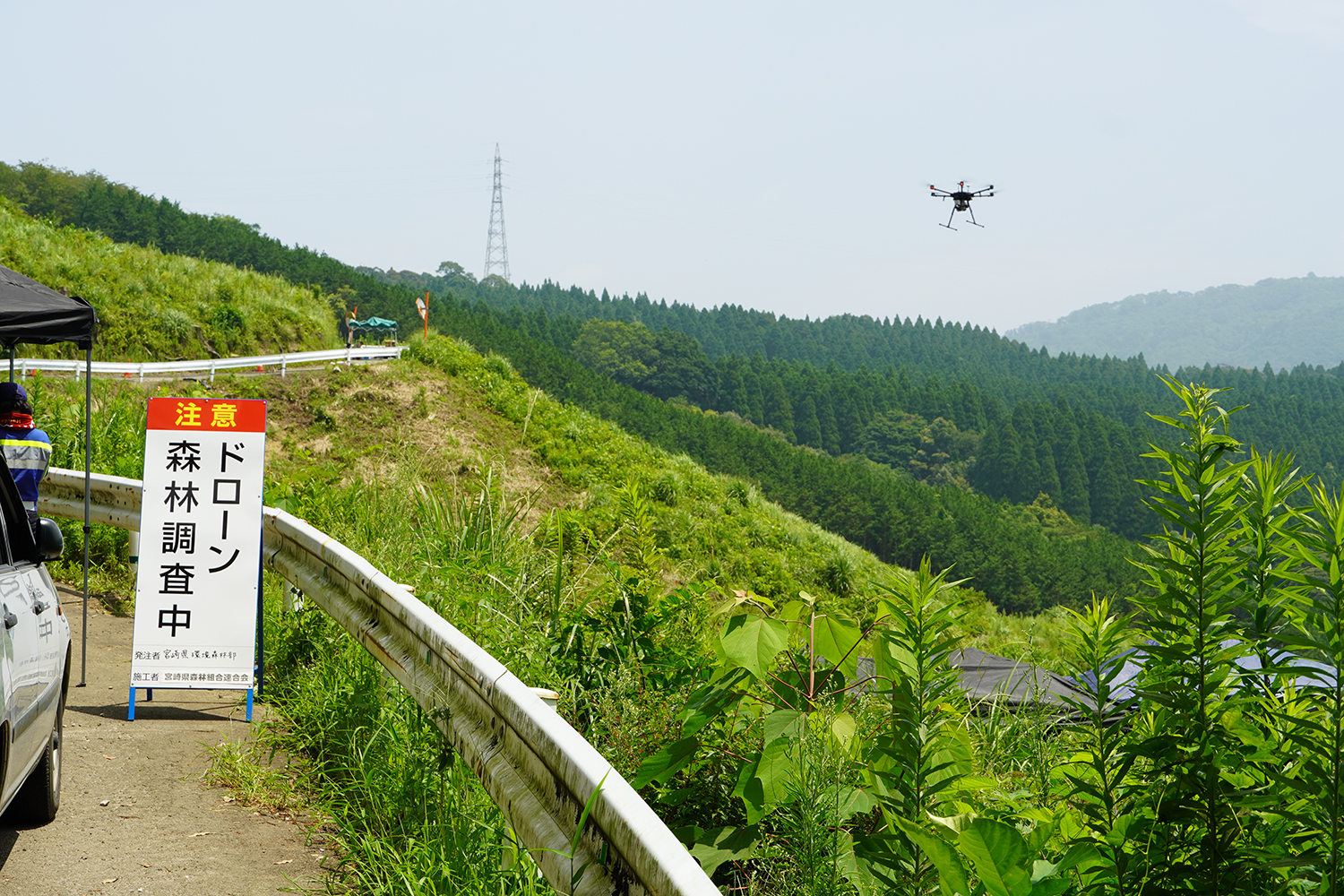
"The goal of our forest survey was to research the number of cedar trees growing in mountains and forests while also determining their height and thickness. Based on these values, we calculated the production output of materials based on how many trees we could log in the region, etc. to determine the mountain value. However, we faced issues in terms of how long the survey took and labor shortages. In the past, such a survey would have taken a team of four employees around nine days to visually confirm and manually measure an eight-hectare area of mountains and forests. However, by combining laser measurements from drones with artificial-satellite video, we were able to make measurements in 30 minutes and check the obtained data in around half a day, thus reducing our operation time to around one-fortieth. We also verified an accuracy of 90% by comparing the results with visual checking and manual measurements, so we made considerable progress on digitalizing forest information."
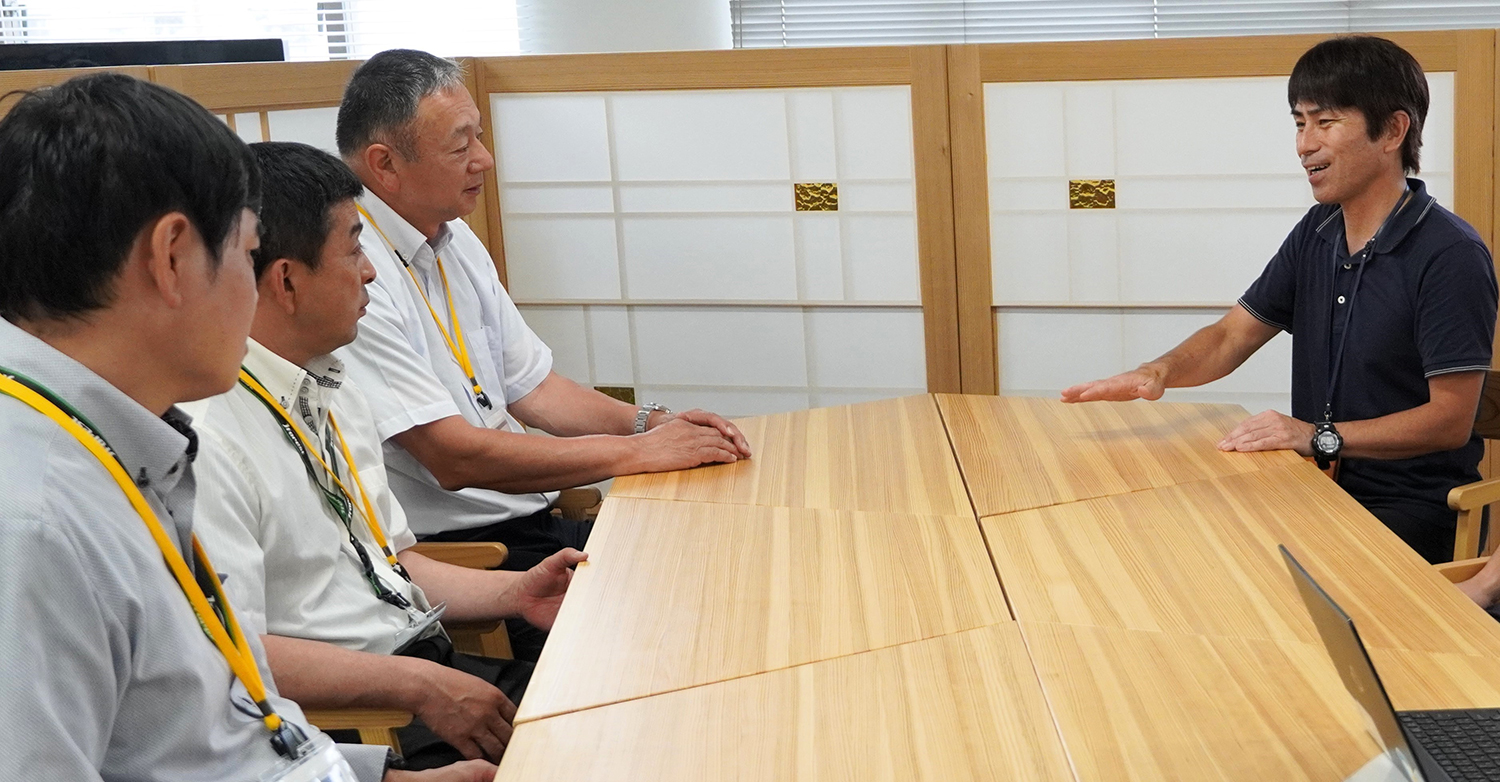
By utilizing ICT and promoting DX in this way, we demonstrated the potential of our technology in terms of saving on forestry labor and visualizing the value of mountains and forests. We also established the Forest and Forestry DX Association, which consists of various stakeholders, including Morotsuka Village and other local governments, federations of forest owners' cooperative associations that handle guidance and economic business, wide-area forest cooperatives in charge of forest cultivation, cooperative unions of materials production companies that handle logging, transportation, and other production business, cooperative unions of lumber mills that produce wood, and the University of Miyazaki, which was in charge of academic support. Mr. Yuji had this to say about the role of the Forest and Forestry DX Association.
"To achieve sustainable forest and forestry management as well as the stable supply and use of domestically produced wood, it is necessary to achieve a sound forest life cycle―felling trees, using them, planting them, and growing them. However, due to Japan's declining birthrate and aging population, forest owners are leaving the mountains, and there are labor shortages that affect forest surveys by forestry businesses. Various stakeholders therefore face issues they want to resolve. To help resolve such issues, it was not enough for us to simply bring cutting-edge expertise to the table. We also had to get deeply involved in the community as we listened intently to understand forestry stakeholders' perspectives. I feel like establishing the Forest and Forestry DX Association as a co-creation platform was essential. As a promoter and person in charge of the association's executive office, I tried to determine the core issues facing forestry by personally visiting owners struggling with forest management and maintenance, materials producers hoping to sell wood for even a bit more, lumber mills hoping to stably purchase wood, and other stakeholders to hear what they had to say."
Although there have been a mountain of problems to deal with, Mr. Yuji, who knows that every stakeholder wants to protect the mountains and make forestry a sustainable industry, will continue to drive the association forward. However, at first, more than a few stakeholders were doubtful of Mr. Yuji, an outsider, who was trying to promote ICT and DX to transform forestry.
"At one point, I was told to go to a mountainous area off the path of a forest road where tiger mosquitos were buzzing around for a meeting to explain my proposed DX system, which entailed climbing a hill in a suit and leather shoes. This conveyed how serious I was, and every local stakeholder finally started to accept me."
Using the Forest Cloud app to achieve wood supply and demand matching while working towards the utilization of carbon credits
While building relationships of trust with stakeholders through steady initiatives, the Forest and Forestry DX Association took steps to achieve sustainable forestry by demonstrating the digitalization of forest information, data sharing, and visualization, trade through wood supply and demand matching, and the creation of new added value through carbon credits.
 Example of app screen showing mountain and forest asset value
Visualizing the asset value of each owner
Source:Co-Designing Institute for Polyphonic Society
"We used artificial-satellite and drone-based laser measurement as well as AI data analysis to compile data on the number and types of trees in the mountains, their asset value, the CO2 absorption amount, etc. We also developed the Forest Cloud app to enable the viewing of such information and share it with our stakeholders. As a result, we learned from our questionnaire survey that the desire of forest owners to manage their forests increased due to their increased understanding of the value of their mountains.
We also demonstrated the use of the Forest Cloud app for wood trading. Wood trading is normally done in the log market, where logging companies act as the sellers and lumber producers act as the buyers, and auctions are held while looking at the actual logs. However, in the past, even when lumber producers headed to the market hoping to consistently buy logs, there were cases where logging was not possible due to weather conditions or other issues, which meant that logs did not arrive, frequently resulting in a gap between supply and demand. In response to such issues, we made it possible for lumber mills to reserve the wood they want to buy, thereby stabilizing purchasing. Buyers appreciate the convenience of this and sometimes buy wood for hundreds of yen above the market price as a result. This also satisfies the needs of logging companies hoping to sell at as high a price as possible, and the profits end up getting returned to mountain and forest owners, which increases reforestation motivation."
Social value through DX for forest and forestry : significance of demonstration results
By using forest owners as a starting point to promote DX, we will promote the proper management of owned forests, revitalization of trade, shifting to reforestation business, expansion of materials production output, and expansion of investment in forests , thereby contributing to the achievement of a more sustainable forestry and wood industry as well as a carbon neutral society.

In addition to using DX to resolve supply and demand issues in the log market and contribute to ensuring a stable supply of wood, the Forest and Forestry DX Association has promoted the creation of new added value through carbon credits as a specific initiative for helping to achieve sustainable forest management.
"In the forestry business, it takes around 30 to 50 years to achieve everything from forest cultivation to logging. And it is necessary to strive for sustainability during this entire period. In terms of felling trees, using them, planting them, and growing them, to more effectively plant and grow trees in particular, it is vital to increase the value of mountains and forests."
Therefore, we decided to focus on Japan's J-Credit system, which is intended to assign value to the CO2 absorbing ability of forests. Under the J-Credit system, the Japanese government certifies the introduction of energy-saving equipment, the reduction amount of CO2 and other emissions by using renewable energy, and the absorption amount of CO2 and other gases through suitable forest management by providing credit. This credit can be sold to companies, etc., and it can also be used for carbon offsets and other initiatives. We provided support to facilitate J-Credit creation and sales.
"This issue applies to mountains and forests throughout the rest of Japan as well, but most mountain and forest land in Morotsuka Village is privately owned by different owners. However, trying to register such small parcels of land for the J-Credit scheme would be complicated. We therefore collaborated with the local cooperative to consolidate the land of around 100 privately owned forest owners into a 178-hectare parcel. This forest cooperative and the mountain and forest owners then applied for the J-Credit scheme and were approved for 2,200 tons in 2024. This was a progressive example of gaining approval upon applying for pseudo-consolidated privately owned forests, and we were thus able us to apply throughout Japan."
If the estimated amount of credit is issued, it is expected to be on the scale of hundreds of millions of yen, and this credit will be utilized to achieve sustainable forests in the region. If we also have a long-term forest management plan, we will be able to encourage the participation of companies and investors.
"In other words, issuing highly reliable carbon credits increases mountain value and provides a powerful boost in terms of revitalizing local forestry, conserving the environment through suitable forest management, and implementing a sound forest life cycle."
What Self as We means to Mr. Yuji
Achieving sustainable forest management and forestry throughout Japan
According to Mr. Yuji, he experienced Self as We in Morotsuka Village along with the joy that came with resolving local issues after working hard with local stakeholders, starting at the demonstration-project stage and eventually achieving social implementation.
"However, our initiatives are still ongoing. After all, around 60% of the forests that make up two-thirds of Japan are privately owned forests, each less than 10 hectares, and about half of these trees are of suitable logging age. Unfortunately, these forests have fallen into a downward cycle. The sound forest life cycle of felling trees, using them, planting them, and growing them has not been implemented for them. Forest resources are valuable assets that can be used for disaster prevention, biodiversity conservation, CO2 absorption, climate-change mitigation, and other purposes, and they are essential for achieving carbon neutrality by 2050. To me, Self as We is embodied by how NTT Group companies, which promote community-based business, strive to get stakeholders involved by leveraging strengths of each company to achieve sustainable forest management and forestry throughout Japan."
See other stories
-
- Forest
- Environment
Stimulating the Exchange of Carbon Credits with Morikachi A Forest Value Creation Platform That Connects Localities and Companies
-

- Aquaculture
- Environment
Offering new potential to the fisheries industry with smart land-based aquaculture
-
- DX Farming
- Environment
Sustainable crop protection NTT DATA Argentina's Sistema Integra
-

- Recycling
- Environment
Utilizing AI technology to establish an efficient recycling environment
-
- Environment
- Power-Saving
Achieving Our 2040 Net-Zero Commitment Innovative Measures Promoted by NTT Global Data Centers
-
- Society
- AI
Using Advanced Technologies to Protect the Lives of Children Is Work the NTT Group Should Do
-

- Diversity
- Work Style
Creating a society in which people with various disabilities can work naturally
-
- Diversity
- Gender
Moving forward with our colleagues A club encouraging women to take a step forward on their own
-

- Diversity
- Gender
Protecting girls' right to learn and building a sustainable society
-

- Diversity
- Work Style
New regional communities created by "another workplace"
Sustainability
NTT STORY
WEB media that thinks about the future with NTT