Microsoft ends support for Internet Explorer on June 16, 2022.
We recommend using one of the browsers listed below.
- Microsoft Edge(Latest version)
- Mozilla Firefox(Latest version)
- Google Chrome(Latest version)
- Apple Safari(Latest version)
Please contact your browser provider for download and installation instructions.



April 15, 2026
NTT, Inc.
NTT and JAXA Commence On-Orbit Demonstration of LEO Satellite MIMO and Satellite Sensing Technologies
– High-resolution observation as well as enhancing IoT utilization in areas without terrestrial communication infrastructure, including oceans and mountainous regions –
News Highlights:
- RApid Innovative payload demonstration SatellitE-4 (RAISE-4), equipped with eight experimental payloads including the Low Earth Orbit (LEO) satellite MIMO/IoT transmission system (LEOMI) designed to demonstrate LEO satellite MIMO technology and satellite sensing technology, was successfully launched on December 14, 2025 (JST).
- On-orbit demonstration experiments of LEOMI have commenced. Following the completion of checkout testing to confirm normal operation, the initial operational phase has been successfully concluded.
- Full-scale steady-state operations have begun, and MIMO transmission communication has been successfully established.
- Over the next year, experiments are planned with the aim of establishing the underlying technologies. In the future, these technologies are expected to enhance communication quality through higher transmission speeds in satellite communications, as well as enable applications such as IoT device utilization and sensing services in areas where terrestrial communication infrastructure is not available, including oceans and mountainous regions.
TOKYO, April 15, 2026 — NTT, Inc. (Headquarters: Chiyoda-ku, Tokyo; President and CEO: Akira Shimada; hereinafter "NTT"), in collaboration with The Japan Aerospace Exploration Agency (JAXA), has commenced on-orbit demonstration experiments toward the world's first demonstration of a "920 MHz-band satellite IoT platform utilizing satellite MIMO*1 technology." For this purpose, the Low Earth Orbit (LEO) satellite MIMO/IoT transmission system (LEOMI) has been installed on the RAISE-4*2.
The satellite was launched at 12:09 on December 14, 2025 (Japan Standard Time, 24-hour format). Subsequently, checkout testing was completed to confirm the normal operation of LEOMI in orbit, and the initial operational phase required for the demonstration was successfully concluded. Steady-state operations have since commenced.
During steady-state operations, it was confirmed shortly after commencement that signal processing based on the MIMO scheme was functioning as expected. Over the next year, further experiments are planned with the aim of establishing this technology.
Once established, this technology is expected to enable ultra-wide-area, low-power sensing services that support a globally connected world. Potential applications include IoT device utilization and sensing services in areas where terrestrial communication infrastructure is not available, such as oceans and mountainous regions.
NTT will continue to address challenges related to social infrastructure by leveraging satellite technologies under the "NTT C89*3" brand.
The technology is scheduled to be exhibited at "Tsukuba Forum 2026"*4, to be held on May 27 and 28, 2026.
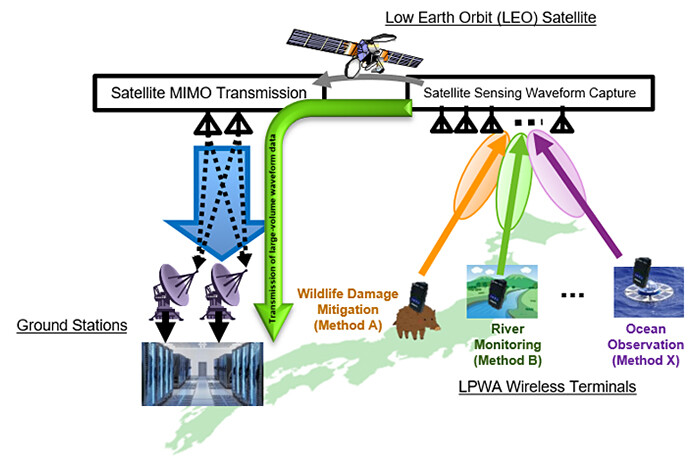 Figure 1. Conceptual image of the demonstration of a satellite sensing platform utilizing LEO satellite MIMO technology by NTT and JAXA
Background
In recent years, the Low Earth Orbit (LEO) satellite sector has experienced rapid global growth, with the number of satellites in orbit approaching 10,000 as of 2025. This represents approximately ten times the level of a decade ago. This expansion has been driven by private-sector companies such as SpaceX and Amazon, intensifying international competition in the space industry.
Against this backdrop, NTT has been advancing its space-related initiatives, including the announcement of the Space Integrated Computing and Network concept*5 and the establishment of Space Compass Corporation*6. In addition, since November 2019, NTT has been engaged in joint research*7 with JAXA by combining NTT's optical and wireless network technologies with JAXA's spacecraft system integration technologies. Through this collaboration, the partners aim to realize a high-speed, high-capacity, and secure optical and wireless communication infrastructure that seamlessly connects space and terrestrial networks, thereby contributing to the development of next-generation social infrastructure.
Space sensing, one of the key components of the Space Integrated Computing and Network concept, aims to realize an ultra-wide-area satellite sensing platform*8. This platform will enable the utilization of high-resolution, large-volume observation data acquired by satellites, as well as the collection of sensor data from virtually any location on Earth. Achieving this vision requires both LEO satellite MIMO technology, which improves spectral efficiency and transmission capacity for wireless signals transmitted from LEO satellites to ground stations, and satellite sensing technology, which enables the accommodation of diverse LPWA*9 wireless terminals for terrestrial use without requiring radio station licenses.
To demonstrate these technologies, NTT and JAXA applied for and were selected for an on-orbit demonstration under the Innovative Satellite Technology Demonstration Program, specifically as part RAISE-4. Following the successful launch of the RAISE-4, which is equipped with experimental payloads including LEOMI, at 12:09 on December 14, 2025 (Japan Standard Time, 24-hour format), the companies have commenced the world's first demonstration of a "920 MHz-band satellite IoT platform utilizing satellite MIMO technology."
Technical Overview
In this demonstration, technical elements required to realize an ultra-wide-area satellite sensing platform will be validated in Low Earth Orbit using LEOMI, a scale model designed with consideration for onboard implementation on a small demonstration satellite.
Key Technology [1]:
LEO Satellite MIMO Technology (High-Capacity Communication Between LEO Satellites and Ground Stations)
■Overview of the Demonstration
In feeder link communications from the satellite to ground stations, MIMO transmission using multiple antennas on the satellite is performed toward multiple receiving antennas deployed remotely from the ground station. After aggregating the received signals at the ground station, synchronization and channel estimation of the MIMO signals are conducted, followed by signal equalization. This enables multiplexed signal transmission.
■Expected Effects
Establishing this technology will enable a fundamental increase in the capacity of future satellite communications. This is expected to improve transmission speeds and significantly increase the number of supported terminals. In addition, application to observation satellites will enable the acquisition of higher-resolution image and radar data, contributing to improved accuracy in areas such as weather monitoring, terrain change detection, ocean observation, and disaster prediction.
Key Technology [2]:
Satellite Sensing Technology (Realization of an Ultra-Wide-Area Satellite IoT Platform)
■Overview of the Demonstration
- Simultaneous communication from multiple terrestrial LPWA-based IoT devices will be demonstrated by transmitting signals at the same time and frequency.
- The radio environment for satellite IoT will be evaluated using waveform data of 920 MHz-band signals received by the satellite.
- It will be verified that the battery life of IoT devices using the satellite IoT network can reach multi-year durations comparable to those achieved with terrestrial IoT networks.
■Expected Effects
Establishing this technology will make it possible to accommodate large numbers of compact, low-power IoT devices anywhere on Earth using satellites alone. Since no ground stations are required, this approach is expected to enable low-cost and wide-area deployment of IoT services, such as infrastructure inspection, environmental monitoring, and smart metering.
Experiment Overview
Checkout Testing
Following the launch of the RAISE-4, a critical operations period was conducted. This period covers operations from satellite separation from the launch vehicle to confirmation of normal operation of the satellite's power and communication systems. After completing this phase and the checkout of the satellite bus systems, operations transitioned to the initial operational phase for the satellite MIMO/IoT system.
During this phase, checkout testing was conducted to confirm the normal on-orbit operation of the onboard equipment. All tests confirmed normal operation in response to control commands, and it was verified that the system could transition to steady-state operations without any issues.
Steady-State Operations (From FY2025 Q4 to FY2026 Q4)
Steady-state operations are planned for approximately one year. During this period, the effectiveness of both the satellite MIMO technology and the satellite IoT technology will be demonstrated.
Preliminary Results of MIMO Transmission Testing (March 13, 2026)
For the satellite MIMO technology, the first steady-state experiment was conducted on March 13, 2026. Two different data streams stored in the memory of the onboard equipment (LEOMI) were modulated and converted into electrical signals. These signals were transmitted simultaneously at the same frequency using two antennas in a MIMO configuration. After being received at two ground stations, signal separation was performed through equalization processing.
A comparison between the constellation points of the received digital signals and those after interference compensation through equalization showed that, after compensation, the signal points converged clearly into four distinct clusters (Figure 2). In contrast, the received signals prior to compensation showed no such convergence. This result confirms that signal processing based on the MIMO scheme is functioning as expected.
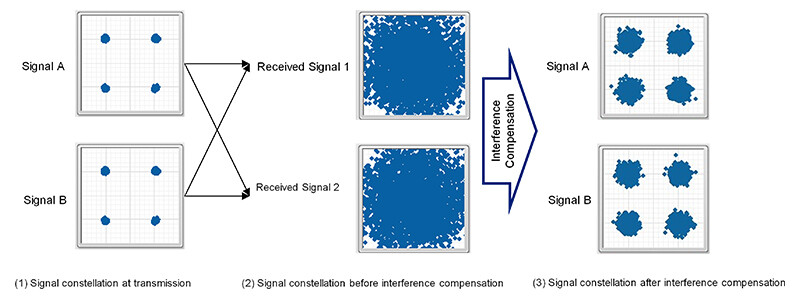 Figure 2. Interference compensation of received signal constellation points through MIMO signal processing
Note: The convergence of signal points into four distinct clusters indicates that MIMO signal processing is functioning as expected.
Future Outlook
Over the next approximately one year, from FY2025 Q4 to FY2026 Q4, steady-state operations will be conducted to carry out demonstration experiments of the satellite MIMO/IoT system, with the aim of establishing these technologies.
By establishing satellite MIMO and IoT technologies, it will become possible to achieve both a significant increase in satellite communication capacity and the large-scale accommodation of compact terminals. It is expected that application to observation satellites will enable the acquisition of higher-resolution image and radar data, contributing to improved accuracy in areas such as weather monitoring, terrain change detection, ocean observation, and disaster prediction.
Furthermore, by enabling IoT services without the need for ground stations, these technologies are expected to support low-cost and wide-area deployment of applications such as infrastructure inspection, environmental monitoring, and smart metering.
Past Related Press Releases
- November 5, 2019: "NTT and JAXA Launch Joint Research Toward Realizing a High-Speed, High-Capacity, and Secure Optical and Wireless Communication Infrastructure Seamlessly Connecting Space and Terrestrial Networks"
https://group.ntt/jp/newsrelease/2019/11/05/191105c.html (Japanese) - May 29, 2020: "Technology Demonstration Proposal for Achieving Over 20 Gbps Communication Between LEO Satellites and Ground and Ultra-Wide-Area IoT Data Collection Selected for Innovative Satellite Technology Demonstration Program"
https://group.ntt/jp/newsrelease/2020/05/29/200529a.html (Japanese) - February 10, 2023: "Challenges with on-orbit demonstration of satellite sensing platform using low earth orbit satellite MIMO technology"
https://group.ntt/en/newsrelease/2023/02/10/230210a.html
[Glossary]
*1MIMO (Multiple-Input Multiple-Output)
A wireless communication technology in which both transmitters and receivers use multiple antennas to improve transmission capacity.
*2Launch Result of the RApid Innovative payload demonstration SatellitE-4
URL: https://www.jaxa.jp/press/2025/12/20251214-1_j.html (Japanese)
*3"NTT C89" is a trademark of NTT, Inc.
It is an abbreviation of "NTT CONSTELLATION 89 PROJECT" and represents an initiative aimed at expanding space-related businesses and contributing to the development of the overall space industry through the provision of solutions to societal challenges.
This release is one of the initiatives under the NTT C89 brand, which encompasses space business activities promoted by companies within the NTT Group and its affiliates.
URL: https://group.ntt/en/aerospace

*4Tsukuba Forum 2026
URL: https://www.rd.ntt/e/as/tforum/
*5NTT and SKY Perfect JSAT conclude collaboration agreement on new space enterprise to aid realization of a sustainable society
URL: https://group.ntt/en/newsrelease/2021/05/20/210520a.html
*6Press release: NTT and SKY Perfect JSAT Agree to Establish Space Compass Corporation
URL: https://group.ntt/en/newsrelease/2022/04/26/220426a.html
*7NTT and JAXA launch joint research toward realizing a high-speed, high-capacity, and secure optical and wireless communication infrastructure that seamlessly connects space and terrestrial networks
URL: https://group.ntt/jp/newsrelease/2019/11/05/191105c.html (Japanese)
*8NTT Technical Journal Feature: Space Integrated Computing and Network – "Satellite Sensing Platform"
URL: https://journal.ntt.co.jp/article/19891 (Japanese)
*9LPWA (Low Power Wide Area)
A wireless communication technology characterized by low power consumption, low data rates, and wide-area coverage.
About NTT
NTT is a leading global technology innovator, providing a broad range of services to both consumers and businesses. As a mobile operator and provider of infrastructure, networks, and services, NTT is dedicated to promoting a sustainable future through cutting-edge innovations. Our portfolio includes business consulting, AI-powered solutions, application services, global networks, cybersecurity, data center and edge computing, all supported by our deep global industry expertise. Generating over $90 billion in revenue and employing 340,000 professionals, we allocate 30% of our annual profits to fundamental research and development. With operations spanning more than 70 countries and regions, our clients include over 75% of Fortune Global 100 companies, alongside thousands of enterprises, government organizations, and millions of consumers.
Media Contact
NTT, Inc.
NTT Information Network Laboratory Group
Public Relations
Inquiry Form
Information is current as of the date of issue of the individual press release.
Please be advised that information may be outdated after that point.


NTT STORY
WEB media that thinks about the future with NTT